
ANZCA Fellowship
consultant-ready.
763 sourced study notes and 10,515 spaced-repetition flashcards across the ANZCA Fellowship curriculum (13 clinical sections). AI SAQ grading on the Fail / Borderline / Pass / Distinction tier, a four-phase clinical viva simulator, and an unlimited Fellowship-level MCQ library. Built for the Final Exam.
- 763 sourced study notes
- AI SAQ grading
- 4-phase viva simulator
- 7-day free trial
Your PRIMEX account, now in your pocket.
Specialist unlocks every PRIMEX exam track. Accessible is limited to AMC and Medical Student. Subscribe on the website or in the iPhone app, then use the same account to keep your access and progress together.

ANZCA Fellowship Exam Dates 2026-2027
Published dates for the upcoming sittings. Always confirm against the official ANZCA exam calendar before scheduling. I refresh this section quarterly as new windows are announced.
- Final Written 2026.117 Mar 2026
- Final Viva 2026.1 (Melbourne)4-6 Jun 2026
- Final Written 2026.211 Aug 2026
- Final Viva 2026.2 (Brisbane)5-7 Nov 2026
- Final Written 2027.116 Mar 2027
- Final Viva 2027.1 (Melbourne)3-5 Jun 2027
- Final Written 2027.217 Aug 2027
- Final Viva 2027.2 (Brisbane)28-30 Oct 2027
Applications close ~2 months before written. Results ~1 week after viva. 2027.1 applications close 14 Jan 2027 (special consideration 17 Dec 2026); 2027.2 close 22 Jun 2027.
Inside PRIMEX, in under a minute
Recorded in the app, with real ANZCA Final questions and notes. No sound needed to follow it.
Topics tested in the ANZCA Fellowship exam
How candidates prepare for the ANZCA Fellowship
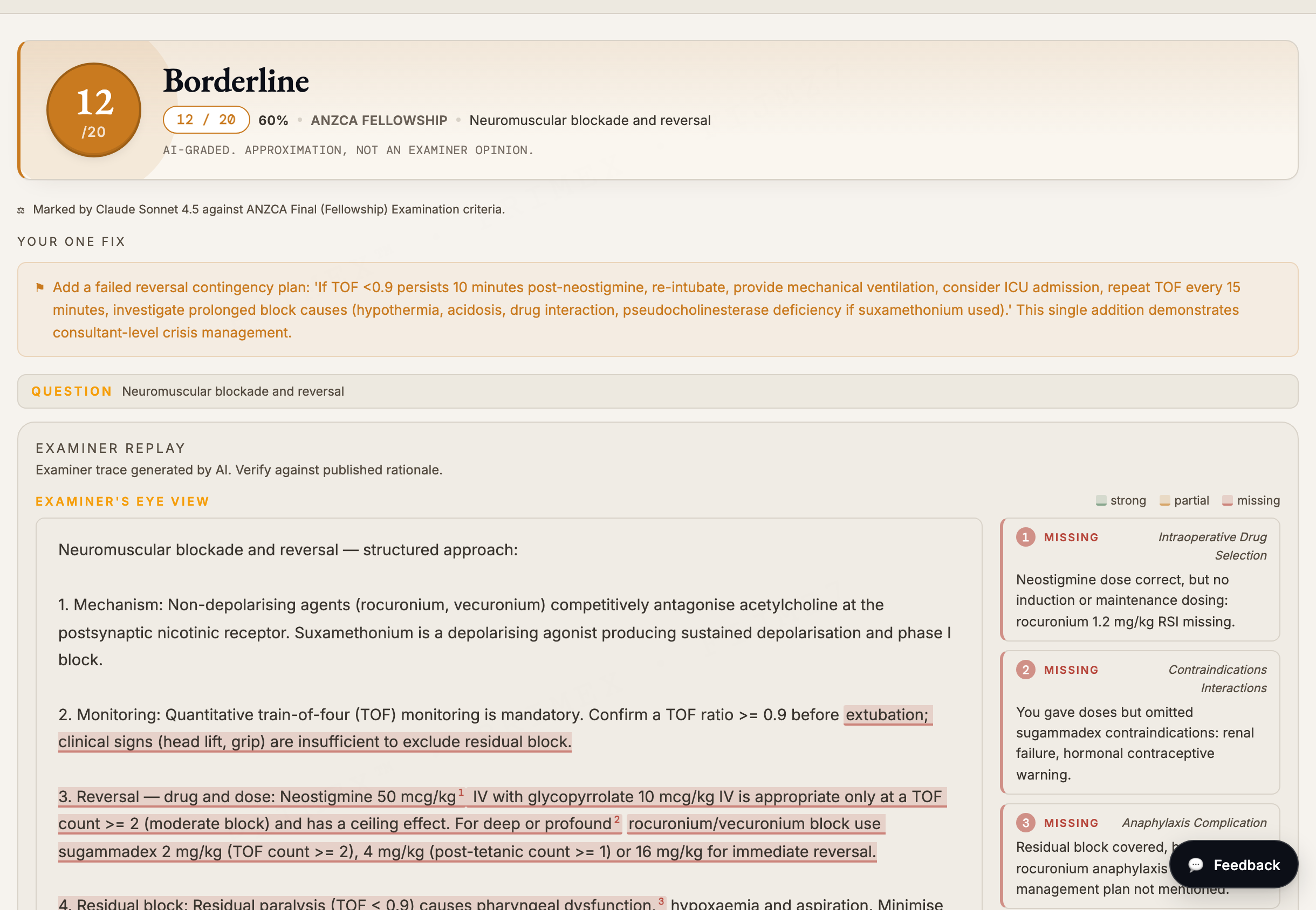
Write a Fellowship SAQ and get an examiner-style debrief in seconds. A Fail / Borderline / Pass / Distinction tier, every clinical point flagged hit or missed, an examiner comment, and a model answer at consultant level with specific drug doses, monitoring choices, and contingency plans. The grader rejects basic-science answers. The library is unlimited.
- Fail / Borderline / Pass / Distinction tier with score estimate
- Every marking point checked against ANZCA Final curriculum learning objectives
- Distinction-pitched model answer: specific doses, monitoring, and contingency plans
- Examiner comment flags the single most important gap
- Unlimited AI-generated SAQs in Final Exam format, no repetition
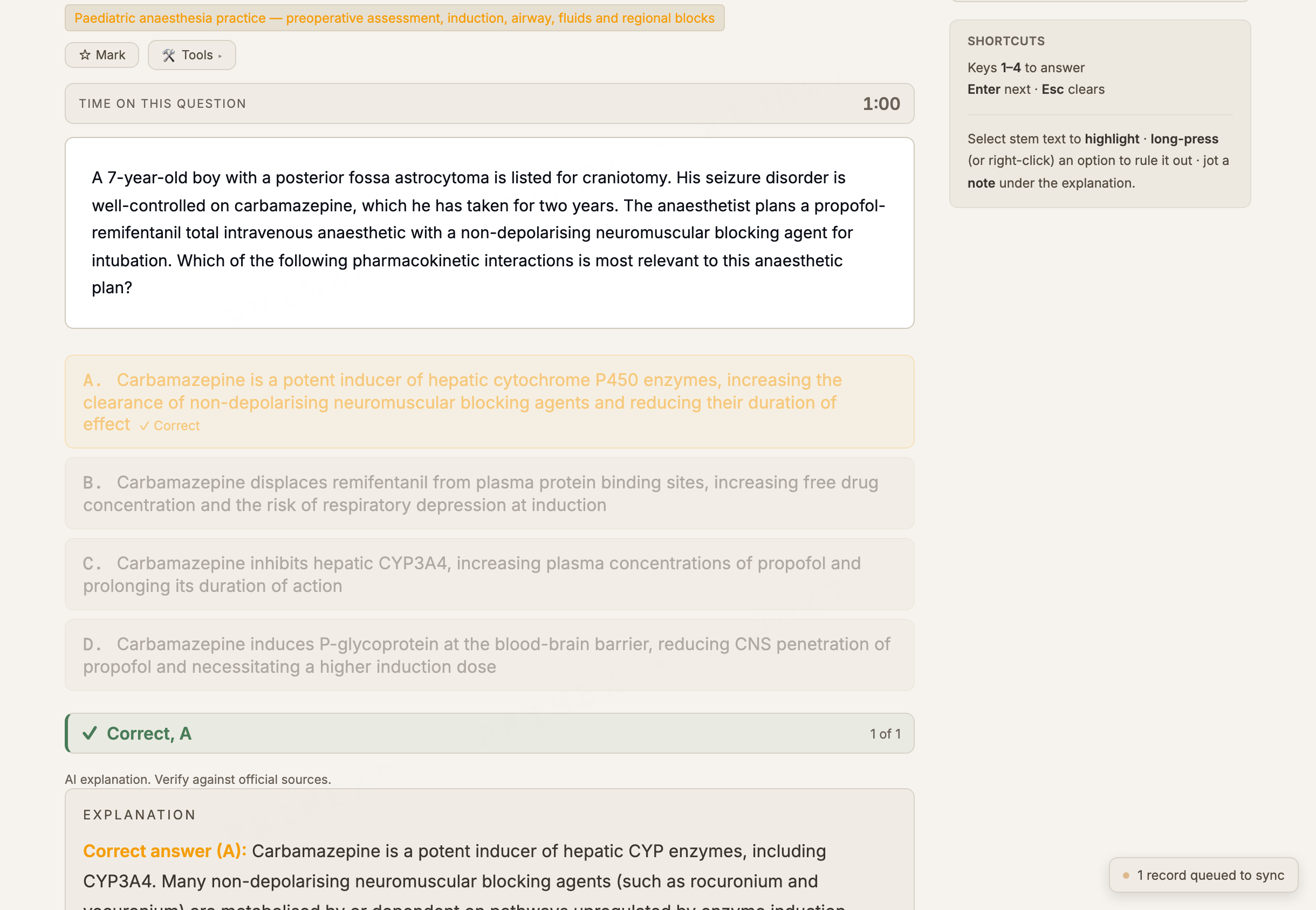
Clinical application MCQs across all Fellowship subspecialties, mapped to the ANZCA Training Program curriculum. These are not basic-science questions. Every option has a full written explanation, and a community answer distribution shows how other candidates responded after each question.
- Fellowship-level MCQs across all 13 clinical sections
- Full explanation for every option, including the distractors
- Community answer distribution after each question
- Unlimited AI-generated, curriculum-mapped questions
- Timed practice mode replicating real exam conditions
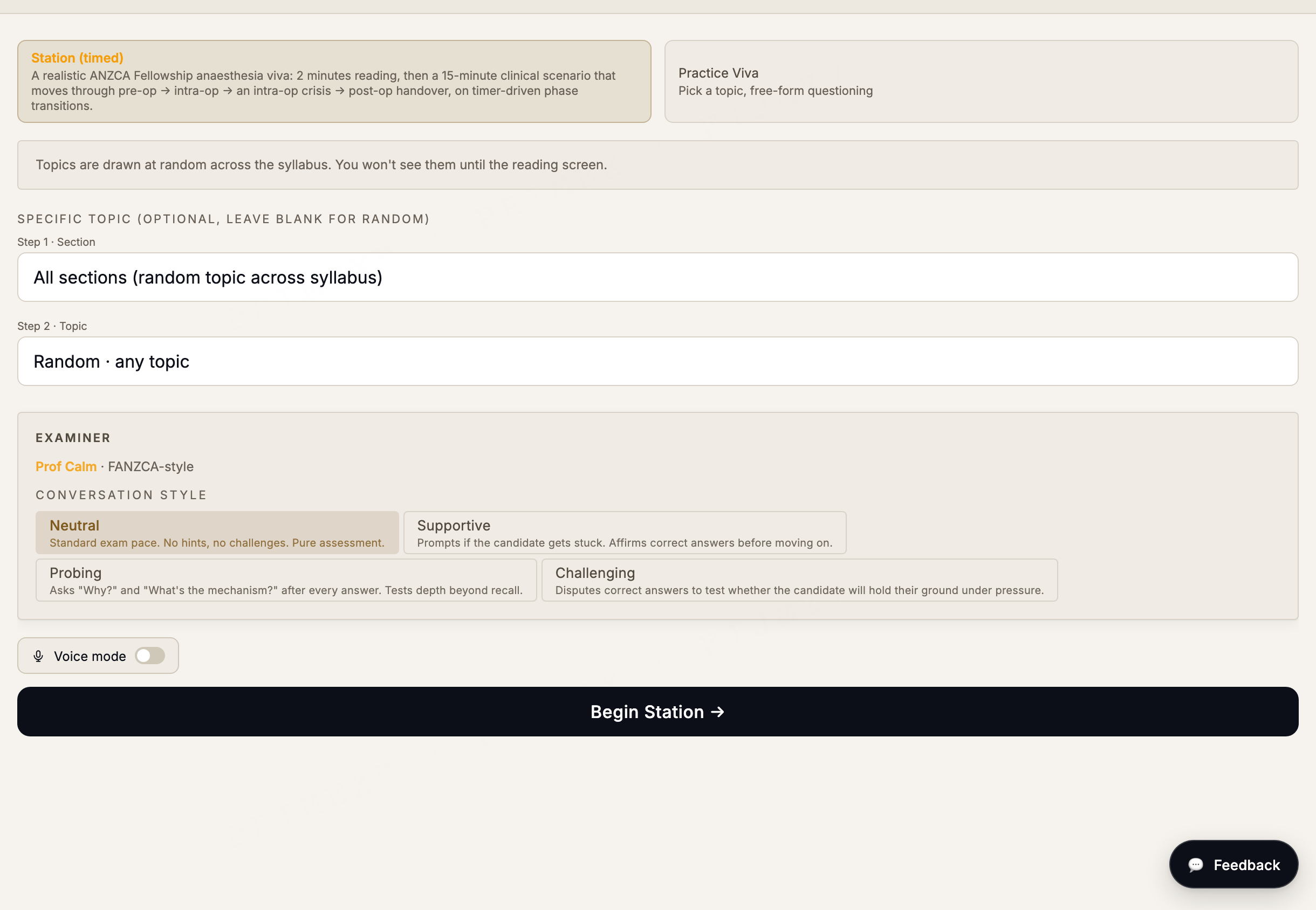
The real Fellowship viva consists of ten structured clinical vivas over three days (eight anaesthesia, two general medicine), each with two minutes of reading time followed by fifteen minutes of active examination. The PRIMEX viva simulator runs the same timed format, moving through pre-operative assessment, intra-operative management, an intra-operative crisis, and post-operative handover in a single case. Voice mode transcribes spoken answers using medical speech recognition.
- Timed format matching the real exam: 2-minute reading, 15-minute active viva
- Four phases per case: pre-op, intra-op, crisis management, post-op handover
- Pushes for specific drugs, doses, monitoring choices, and plan B throughout
- Voice mode: speak your answer, medical speech recognition transcribes it
- Per-phase debrief: tier, strengths, gaps, and key learning point
Work through a full mock viva out loud with this college's AI examiner, in real time. Answer by voice, get probed and interrupted like you would in the real viva, then step out to a graded debrief: how you performed on the station, the topics you covered, your strengths and gaps, and how you handled the pressure. Every mock viva feeds your weak-topic plan, so what to practise next is always clear.
- Real-time spoken viva in this college's examiner voice, fully interruptible
- Graded debrief on every station: your performance tier, the topics you covered, and the gaps to close
- Communication and composure feedback: pacing, hesitation, clarity under pressure
- Weak topics flow straight into your study plan and daily practice
- Part of PRIMEX Pro, with monthly mock vivas included
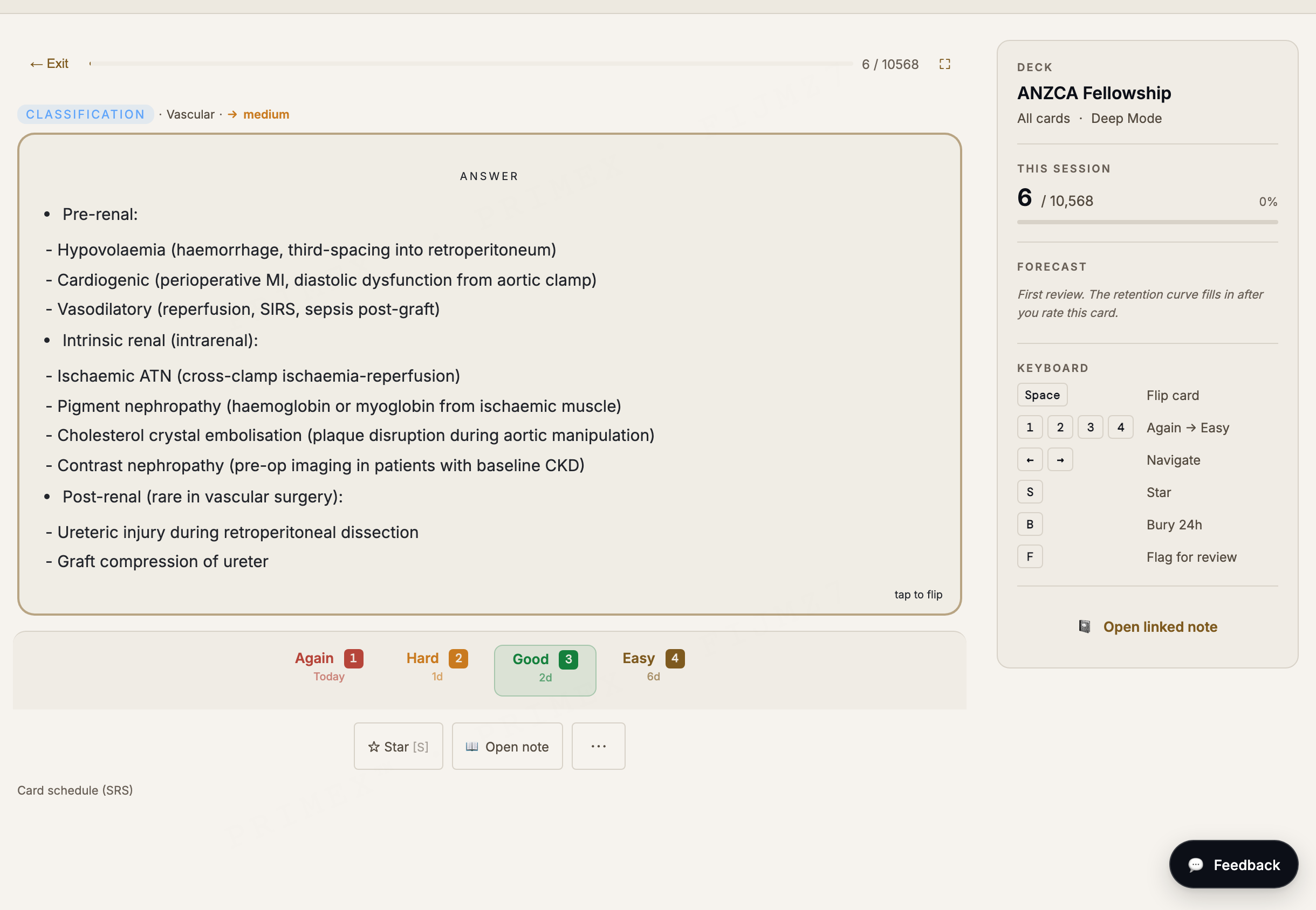
Curriculum-mapped flashcard decks with spaced repetition across every Fellowship section. Cards cover clinical management scenarios, drug selection and dosing, subspecialty physiology, crisis protocols, and technique steps. Cards you struggle with come back sooner; cards you know drop back automatically.
- 10,515 cards mapped to the ANZCA Fellowship curriculum
- Clinical scenario cards, drug dosing cards, and crisis management protocols
- MCQ drill mode for rapid-fire Fellowship question practice
- One click from any card to the full study note on that topic
- Image cards: monitoring waveforms, TOE views, and regional anatomy
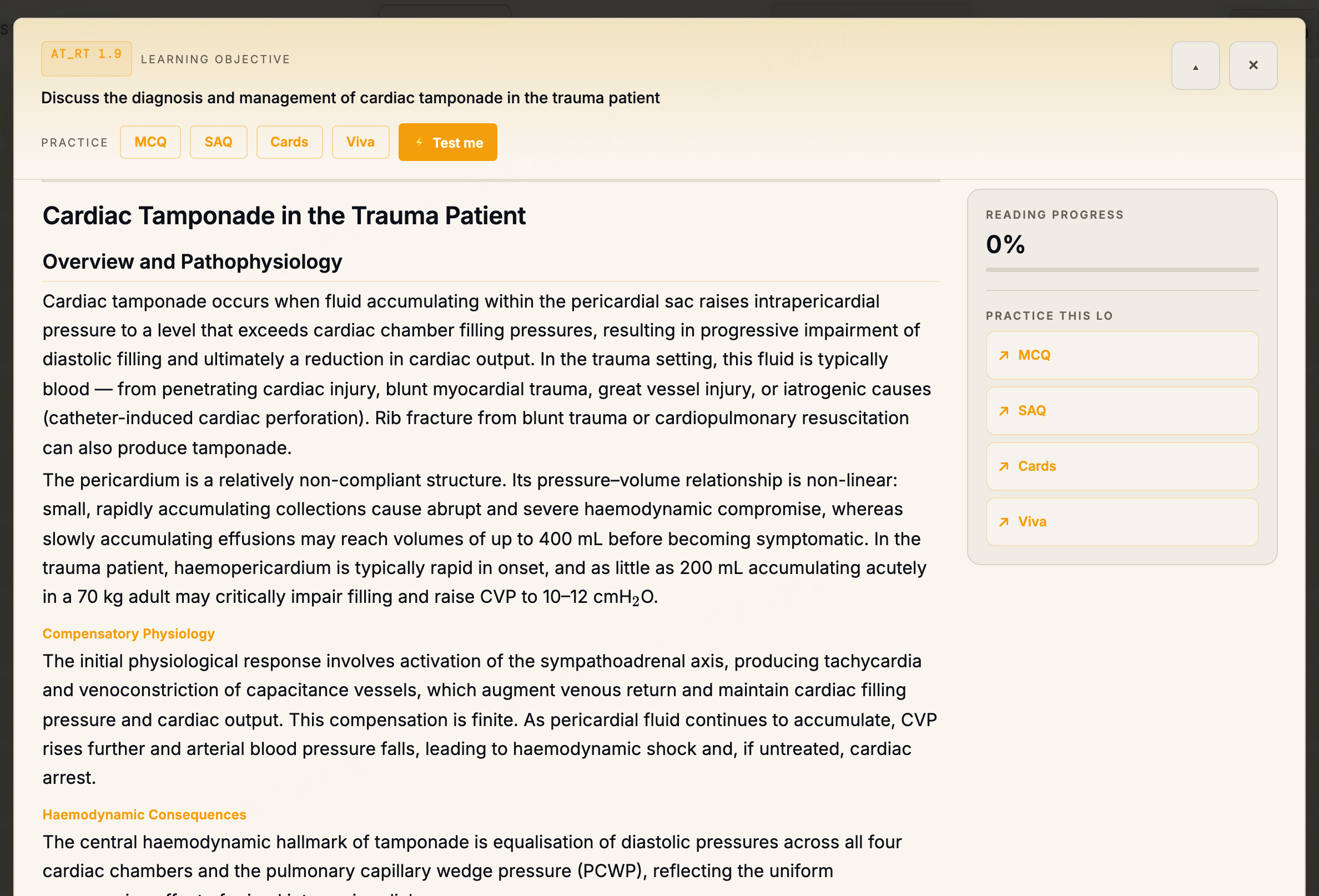
763 sourced study notes across the Fellowship curriculum, one for every covered learning objective. Consistent seven-section format, referenced to the published ANZCA Fellowship curriculum, Australian guidelines, and primary literature. Notes surface automatically alongside SAQ and viva debriefs, so you move from feedback to the relevant note in one click.
- 763 study notes across all 13 clinical sections, one per covered LO
- Consistent 7-section structure: scannable, not a wall of text
- Aligned to the published ANZCA Fellowship curriculum and Australian guidelines
- Full-text search across all notes
- Linked from SAQ debrief, viva feedback, and flashcards
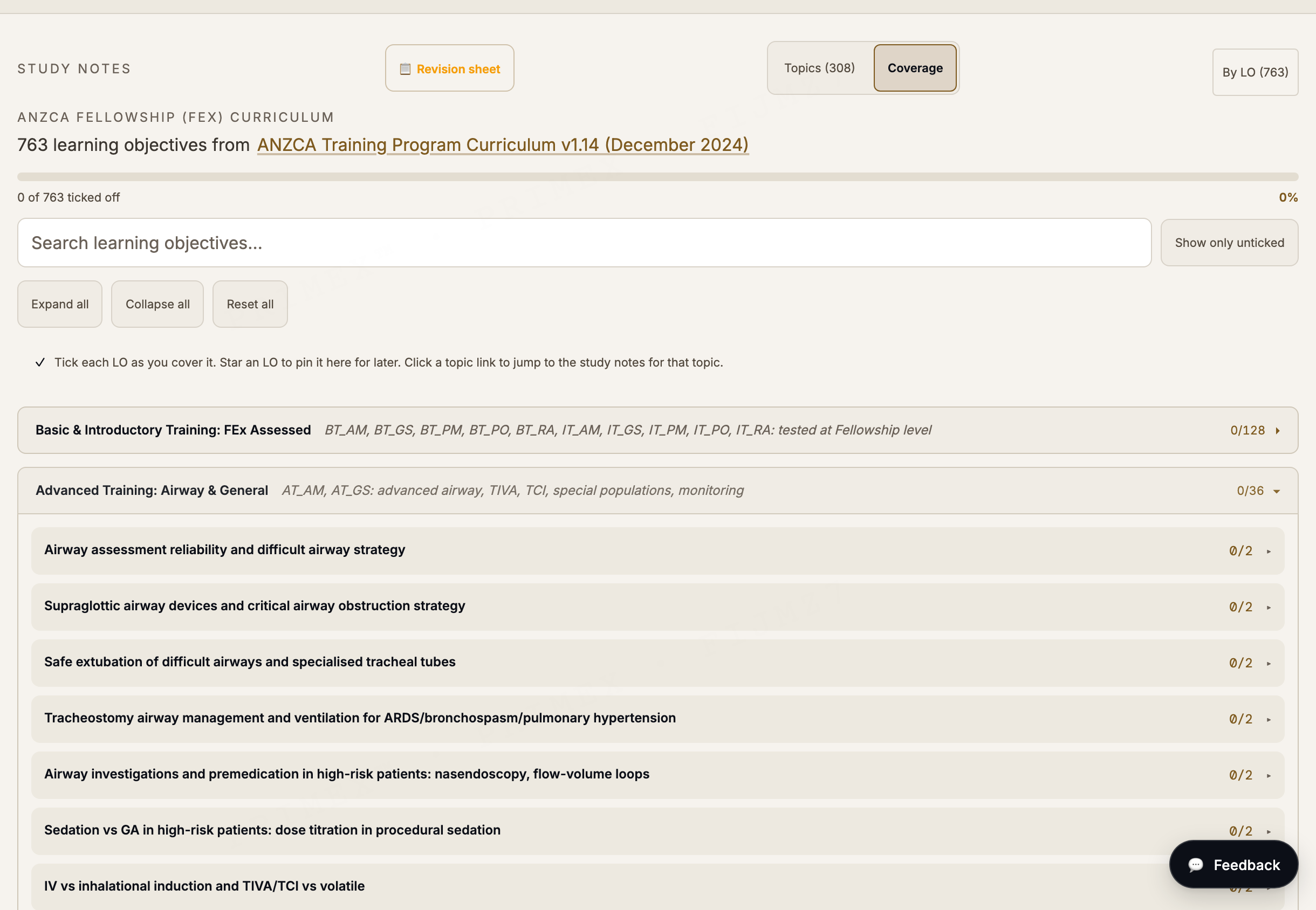
The ANZCA Training Program Curriculum (v1.14, December 2025) defines the Fellowship-assessed learning objectives across Advanced Training, Specialised Study Units, and Roles in Practice. PRIMEX surfaces every LO in a Curriculum tab with a checkbox checklist and per-section progress bars; the majority click through directly to the mapped study note, and Roles-in-Practice LOs are tracked alongside clinical knowledge.
- ANZCA Fellowship LOs across 13 sections, verbatim from the v1.14 curriculum document
- Most LOs click through directly to the mapped study note
- Roles-in-Practice LOs (Health Advocate, Leader/Manager, Medical Expert, Professionalism) tracked alongside clinical knowledge
- Checkbox completion persisted across sessions, with per-section progress bars
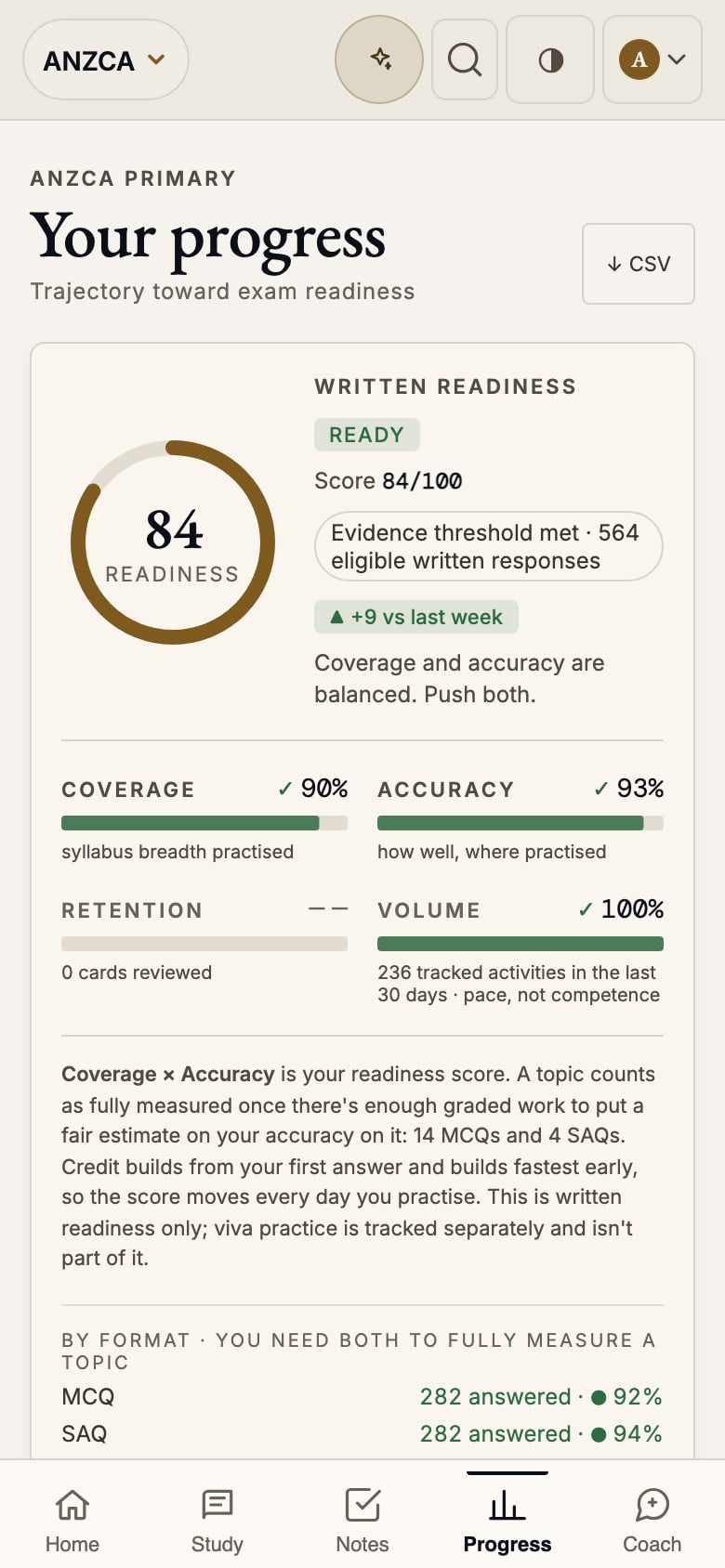
An adaptive study plan counts down to your ANZCA Fellowship date and tells you what to study next. The written-readiness score combines eligible syllabus coverage with accuracy from recognised written results. Activity pace and supplemental practice are shown separately and do not change the score.
- Days-to-exam countdown and pace tracking, ahead or behind
- Written-readiness score backed by eligible written assessments
- Coverage and accuracy broken out with evidence context
- Activity pace and weekly target shown separately from readiness
- Study this next: the topic queued for today, one tap to open
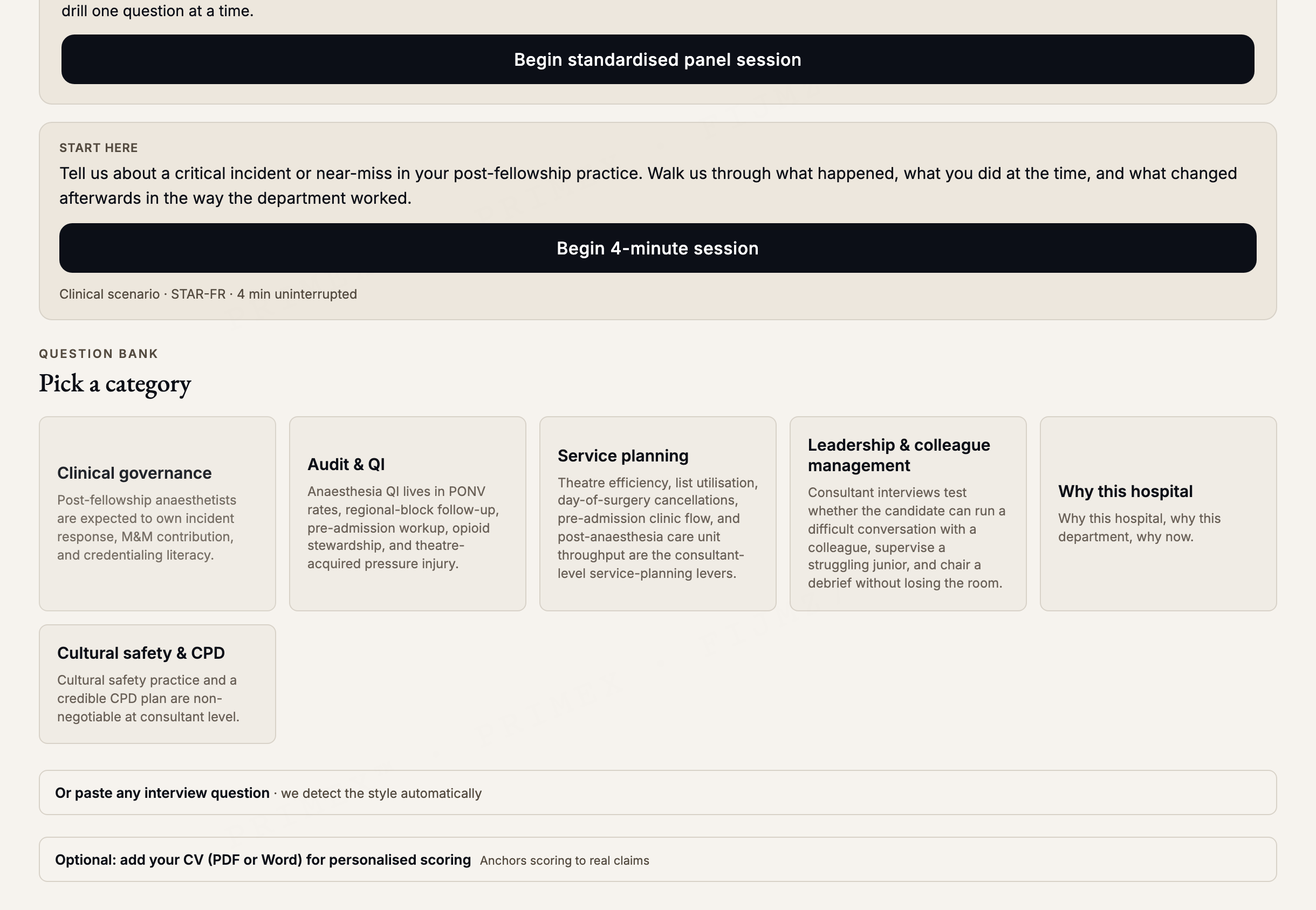
Rehearse the standardised panel interview format Australian and New Zealand hospitals use for staff specialist and VMO consultant anaesthetist appointments. Six standardised questions cover clinical governance, audit and quality improvement, service planning, leadership and supervision, cultural safety, and credible motivation for the post. The panel stays silent until your answer is complete. The debrief returns a tier band, per-dimension rubric scores against ANZCA Roles in Practice (CanMEDS), framework beat checks (STAR-FR, ABCDE, SPIES, PEARLS, PDSA), and the moments your answer demonstrated each role.
- Standardised panel format mirrored from NSW Health PD2023_024 and equivalent state recruitment policies
- Six questions covering governance, audit, service planning, leadership, cultural safety, motivation
- Calibrated rubric scoring per dimension with full band descriptions
- ANZCA Roles in Practice (CanMEDS) demonstrated and missed per answer
- Framework beat tracking for STAR-FR, SPIES, PEARLS, PDSA
- Save your CV for grounded model answers tied to your real consultant trajectory
ANZCA Fellowship format and structure: written, MCQ, medical and anaesthesia vivas
The ANZCA Fellowship Examination is the culmination of advanced anaesthesia training. It tests consultant-level clinical reasoning across the full breadth of anaesthetic practice: general, regional, obstetric, paediatric, cardiac, thoracic, neuroanaesthesia, perioperative medicine, and pain. The written component (SAQ and MCQ, sat on the same day) must be passed before candidates sit the vivas. The ANZCA Training Program Curriculum maps the Fellowship-assessed learning objectives across these domains. ANZCA publishes no Final pass-rate percentage: it releases individual results per sitting rather than an aggregate rate. PRIMEX is built by Dr Jay Marshall, an anaesthetics registrar in Taree, NSW.
- OrganiserAustralian and New Zealand College of Anaesthetists (ANZCA)
- FormatWritten day: 150 MCQs over 150 minutes and 15 SAQs over 150 minutes. Candidates who pass the written then sit ten clinical vivas over three days (eight anaesthesia vivas, two general medicine vivas), each with 2 minutes reading and 15 minutes active examination.
- Pass markAt least 40% on the SAQ and 50% overall on the written component. For the vivas, candidates must pass at least four of the eight anaesthesia vivas, pass the anaesthesia viva section and at least one other section, and are failed automatically for scoring 3 or less out of 10 in three or more anaesthesia vivas.
- SittingsTwice yearly. Written component typically in March and August. Vivas in June and November.
- Pass rateANZCA publishes no Final pass-rate percentage; it releases individual results per sitting, not an aggregate rate
ANZCA Fellowship pass rates and exam statistics
- Sourced study notes
- 763 (one per covered LO)
- Spaced-repetition flashcards
- 10,515
- Clinical sections covered
- 13
- SAQ grading tier
- Fail / Borderline / Pass / Distinction
- Viva format
- 2-min reading + 15-min active, 4 phases
- Curriculum version
- v1.14 (December 2025)
- Trial
- 7 days, free
The ANZCA Fellowship learning objectives are taken verbatim from the ANZCA Training Program Curriculum (v1.14, December 2025). The Curriculum tab persists checkbox progress across sessions and shows per-section progress bars, so you know exactly how much of the syllabus is covered before exam day.
Try the same AI grader our subscribers use.
Five high-yield ANZCA Fellowship topics. Free MCQ practice, graded against college-standard marking points. No signup.
Airway Assessment Methods and Predictors of Difficult Airway Management
Preoperative airway assessment is a fundamental component of the pre-anaesthesia consultation and a core consultant anaesthetist competency.
Paediatric Regional Anaesthesia: Differences in Performance Compared with Adults
Paediatric regional anaesthesia (PRA) encompasses peripheral nerve blocks, neuraxial techniques (spinal, epidural, caudal).
Pulmonary Hypertension: Pathophysiology and Manipulation of Pulmonary Vascular Resistance
Pulmonary hypertension (PH) is defined as a resting mean pulmonary artery pressure (mPAP) ≥ 25 mmHg measured by right heart catheterisation.
Liked those five? That's a sliver of what's inside.
Get 763 study notes, 10,515 spaced-repetition flashcards, unlimited question practice and the full exam simulator. Free for 7 days, then from A$44.99/month.
Start free trial, 7 days free Cancel anytime · no commitmentCommon questions about the ANZCA Fellowship exam
Specialist pricing and 7-day free trial
Specialist unlocks every PRIMEX exam track: the specialist pathways, AMC and Medical Student. Every study tool is included, with no per-feature paywalls.
- ✓ Every exam track: specialist pathways, AMC & Medical Student
- ✓ Flashcards with spaced repetition & MCQ drill
- ✓ Study notes for every curriculum topic
- ✓ SAQ library & sessions
- ✓ Study plan with pace tracking
- ✓ Curriculum tracker & readiness insights
- ✓ Every exam track: specialist pathways, AMC & Medical Student
- ✓ Flashcards with spaced repetition & MCQ drill
- ✓ Study notes for every curriculum topic
- ✓ SAQ library & sessions
- ✓ Study plan with pace tracking
- ✓ Curriculum tracker & readiness insights
- ✓ Every exam track: specialist pathways, AMC & Medical Student
- ✓ Flashcards with spaced repetition & MCQ drill
- ✓ Study notes for every curriculum topic
- ✓ SAQ library & sessions
- ✓ Study plan with pace tracking
- ✓ Curriculum tracker & readiness insights
You'll land on a confirmation page. Tap the sign-up button (or sign in if you already have an account) and your subscription links automatically. If you close the page first, just use the same email when you sign up and it'll still link.