
RACS GSSE / the science behind surgery.
268 sourced study notes and 5,272 spaced-repetition flashcards across surgical anatomy, surgical physiology, surgical pathology, and operative sciences. GSSE-format MCQ practice and anatomy spot revision. Built for the breadth the GSSE demands.
Try free: Colorectal cancer staging, shock classification, wound healing
Your PRIMEX account, now in your pocket.
Specialist unlocks every PRIMEX exam track. Accessible is limited to AMC and Medical Student. Subscribe on the website or in the iPhone app, then use the same account to keep your access and progress together.

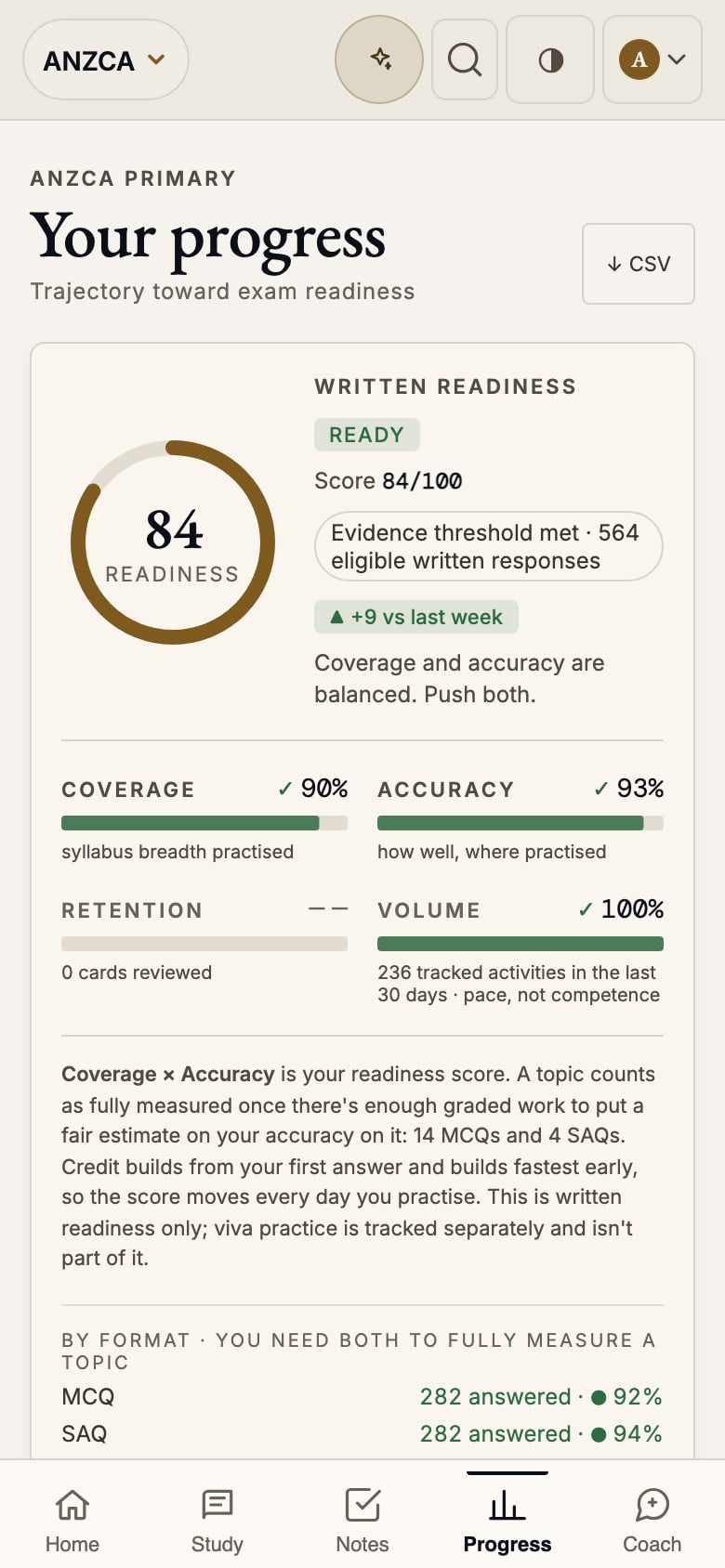
RACS GSSE Exam Dates 2026 & 2027
Published dates for the upcoming sittings. Always confirm against the official RACS GSSE dates and locations page before scheduling. I refresh this section quarterly as new windows are announced.
- October 2026 sitting7-8 Oct 2026
- February 2027 sitting10-11 Feb 2027
- June 2027 sitting9-10 Jun 2027
Registration ~3 months before each sitting. Held across AU + NZ Pearson VUE test centres. Full GSSE dates page →
Inside PRIMEX, in under a minute
Recorded in the app, with real RACS GSSE questions and notes. No sound needed to follow it.
Topics tested in the RACS GSSE exam
How candidates prepare for the RACS GSSE
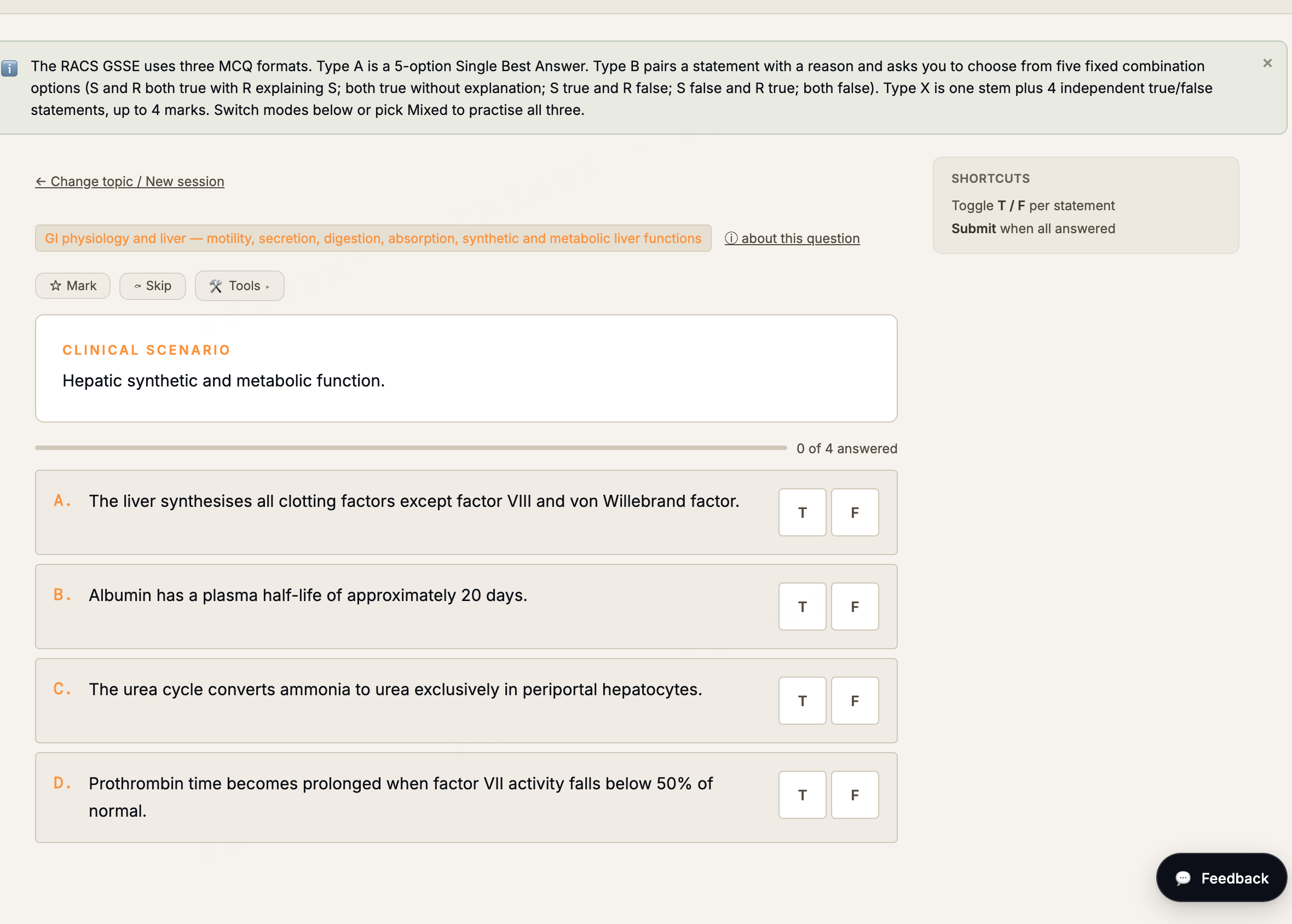
The GSSE uses three MCQ formats. Type A is a 5-option Single Best Answer (1 mark). Type B pairs a statement with a reason and asks you to pick from five fixed combination options A to E (1 mark). Type X is one stem plus 4 independent true/false statements (up to 4 marks). PRIMEX supports all three formats individually or as Mixed mode, across all four GSSE domains: surgical anatomy, physiology, pathology, and operative science. Full explanations for every option.
- Type A · Type B · Type X · Mixed mode that samples across the three
- Applied scientific level: anatomy in operative context, physiology in surgical scenario
- Explanation for every option, including the distractors
- Community answer distribution after each question
- Timed mock: full paper simulation
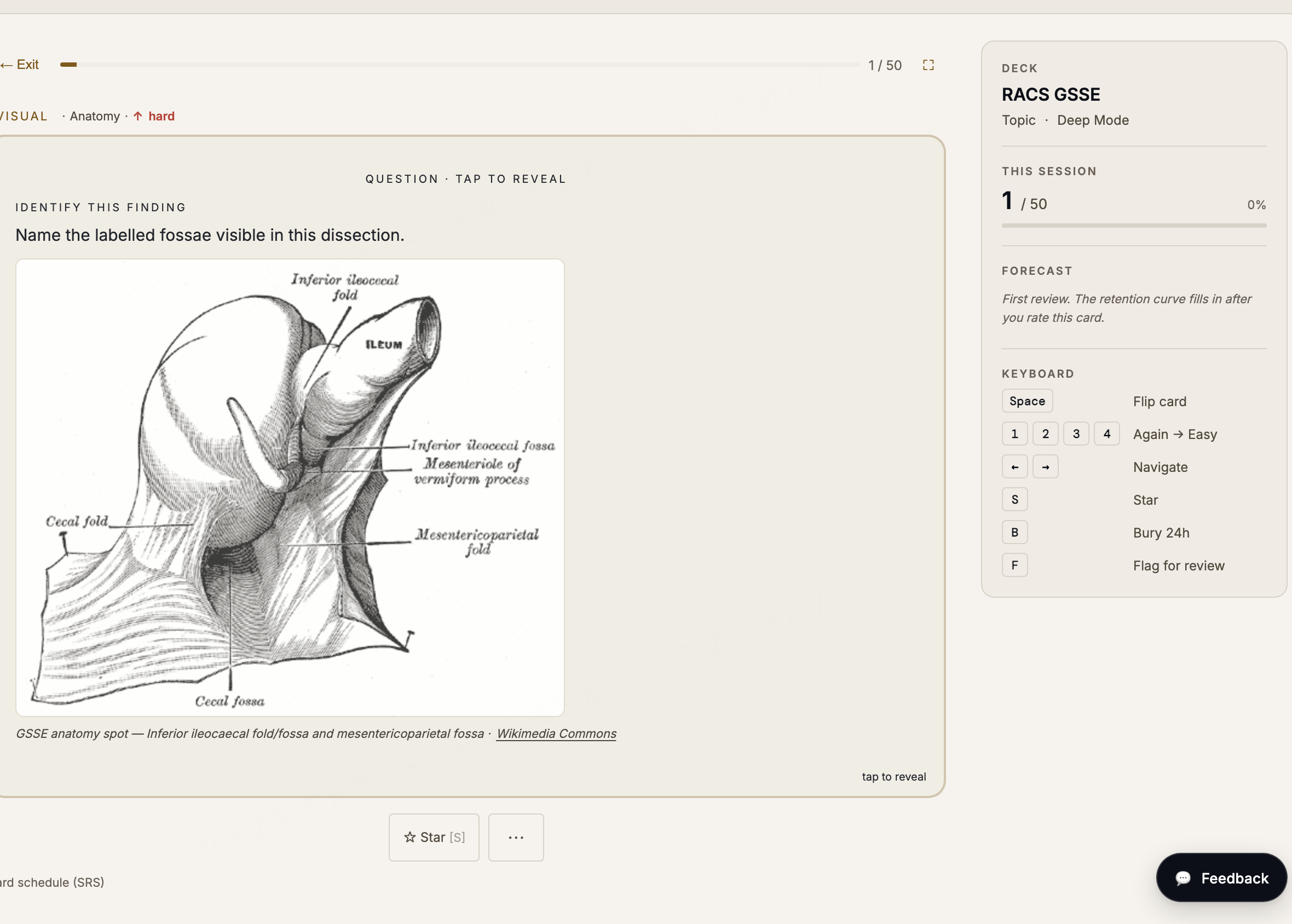
The anatomy spots component requires candidates to identify structures on cadaveric and specimen images. PRIMEX flashcard decks include 240 visual anatomy image cards with labelled structures across all tested body regions; sourced from Wikimedia Commons, grouped by region, and integrated with the study notes for each topic.
- 240 visual anatomy image cards across all GSSE-tested body regions
- Structures labelled and explained: vessels, nerves, fascial planes, organs
- Grouped by region: neck, thorax, abdomen, pelvis, limbs
- One click from anatomy card to full regional study note
- Spaced repetition: revisit missed structures automatically
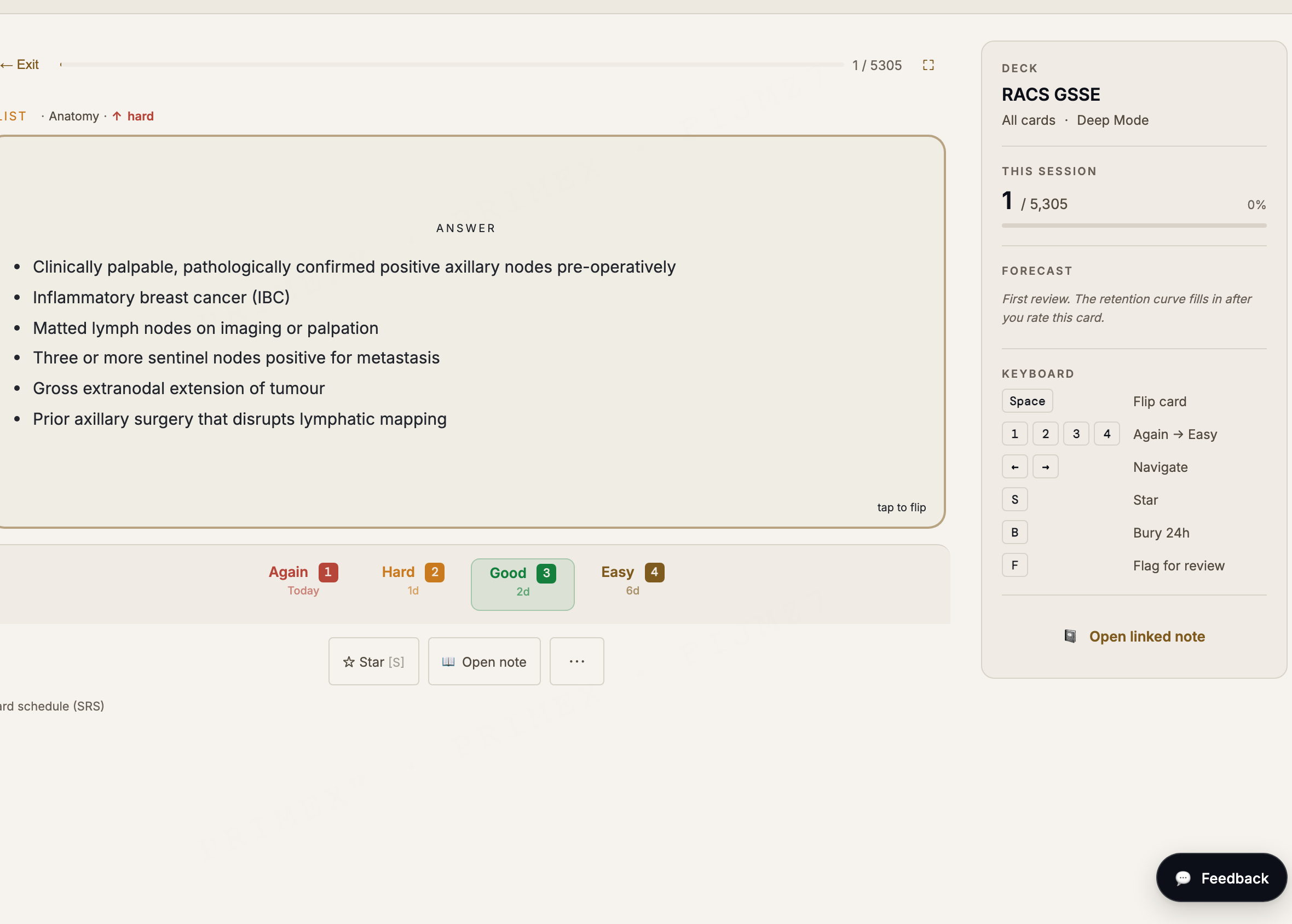
5,272 curriculum-mapped flashcards covering all GSSE domains, including 240 visual anatomy image cards. Spaced repetition keeps the detail in memory across the full breadth of the GSSE curriculum. Covers anatomical relations, drug mechanisms, coagulation pathways, tumour classification systems, and operative principles.
- 5,272 cards including 240 visual anatomy image cards
- Anatomy: regional relations, nerve anatomy, fascial planes
- Physiology: fluid calculations, acid-base interpretation, coagulation cascade
- Pathology: tumour classification, inflammatory pathways, DVT/PE
- One click from card to full study note
Sourced, structured study notes across the GSSE curriculum. Written to a consistent seven-section format with surgical relevance throughout: anatomical hazards in operative surgery, physiological responses to surgical stress, and pathological mechanisms that drive surgical disease. Referenced to Australian guidelines, RACS position statements, and primary literature.
- Growing across all four GSSE domains: anatomy, physiology, pathology and operative science
- Surgical context throughout: anatomy notes name the relevant operations
- Referenced to Therapeutic Guidelines (eTG), RACS position statements, and primary literature
- Full-text search across all notes
- Linked from MCQ explanations, spot cards, and flashcards
RACS GSSE format and structure
The RACS Generic Surgical Sciences Examination (GSSE) is a written examination that forms part of the RACS Surgical Education and Training (SET) program. It assesses the scientific foundations of surgical practice: surgical anatomy, surgical physiology, surgical pathology, and operative principles. The GSSE is sat over two consecutive days as two papers. Exam 1 (Anatomy) is 150 minutes and combines 60 Type X MCQs with 20 anatomy spot-test questions. Exam 2 (Pathology and Physiology) is 150 minutes and has 125 MCQs (65 pathology, 60 physiology) in a mix of Type A, Type B and Type X formats. There is no reading time and no negative marking on either paper. The GSSE is criterion-referenced: RACS sets the standard by domain rather than publishing a fixed numerical pass mark or a per-sitting pass-rate percentage, so no verified GSSE pass rate is quoted here. It must be passed before progression to the FRACS Fellowship examination and is a prerequisite for all surgical specialties within RACS. PRIMEX is built by Dr Jay Marshall, an anaesthetics registrar in Taree, NSW.
- OrganiserRoyal Australasian College of Surgeons (RACS)
- FormatTwo written papers over two consecutive days (150 minutes each, no reading time, no negative marking). Exam 1: 60 Type X MCQs + 20 anatomy spot-test questions. Exam 2: 125 MCQs (65 pathology + 60 physiology) mixing Type A, Type B and Type X
- DomainsSurgical Anatomy, Surgical Physiology, Surgical Pathology, Operative Science and Perioperative Care
- Pass standardCriterion-referenced with domain standard-setting; RACS does not publish a fixed numerical pass mark or a per-sitting pass rate, and issues candidate performance reports
- SittingsThree times a year for prevocational candidates: February, June and October (SET trainees may sit only February and June)
- AttemptsSET trainees: complete within two active clinical years, maximum four attempts
- RequirementMust be passed before the FRACS Fellowship examination in all surgical specialties
Practice every topic with the same AI grader the in-app uses
Five high-yield learning objectives. 3 free MCQs each, graded against college-standard marking points. No signup needed.
Adrenal Surgery: Phaeochromocytoma, Conn's Syndrome, Cushing's Syndrome & Adrenalectomy
The adrenal glands sit at the superior pole of each kidney within Gerota's fascia.
Bone Structure and Healing: Cortical vs Cancellous, Fracture Healing, Callus, and Influencing Factors
Bone is a specialised connective tissue that provides structural support, mineral homeostasis (primarily calcium and phosphate).
Nutrition in Surgical Patients - Enteral vs Parenteral Nutrition and Nutritional Assessment
Nutritional support in surgical patients aims to meet metabolic demands, preserve lean body mass, support wound healing.
Liked those five? That's a sliver of what's inside.
Get 268 study notes, 5,272 spaced-repetition flashcards, unlimited question practice and the full exam simulator. Free for 7 days, then from A$44.99/month.
Start free trial, 7 days free Cancel anytime · no commitmentCommon questions about the RACS GSSE exam
Specialist pricing and 7-day free trial
Specialist unlocks every PRIMEX exam track: the specialist pathways, AMC and Medical Student. Every study tool is included, with no per-feature paywalls.
- ✓ Every exam track: specialist pathways, AMC & Medical Student
- ✓ Flashcards with spaced repetition & MCQ drill
- ✓ Study notes for every curriculum topic
- ✓ SAQ library & sessions
- ✓ Study plan with pace tracking
- ✓ Curriculum tracker & readiness insights
- ✓ Every exam track: specialist pathways, AMC & Medical Student
- ✓ Flashcards with spaced repetition & MCQ drill
- ✓ Study notes for every curriculum topic
- ✓ SAQ library & sessions
- ✓ Study plan with pace tracking
- ✓ Curriculum tracker & readiness insights
- ✓ Every exam track: specialist pathways, AMC & Medical Student
- ✓ Flashcards with spaced repetition & MCQ drill
- ✓ Study notes for every curriculum topic
- ✓ SAQ library & sessions
- ✓ Study plan with pace tracking
- ✓ Curriculum tracker & readiness insights
You'll land on a confirmation page. Tap the sign-up button (or sign in if you already have an account) and your subscription links automatically. If you close the page first, just use the same email when you sign up and it'll still link.