
FRACS GS / operate.
111 sourced study notes and 3,659 spaced-repetition flashcards across the 9 examined subspecialties. AI SAQ and spots grading on the Fail / Borderline / Pass / Distinction tier, a five-station viva simulator with voice mode, and an unlimited Fellowship-level MCQ library. Built for the depth the Fellowship vivas demand.
Your PRIMEX account, now in your pocket.
Specialist unlocks every PRIMEX exam track. Accessible is limited to AMC and Medical Student. Subscribe on the website or in the iPhone app, then use the same account to keep your access and progress together.

FRACS General Surgery Fellowship Exam Dates 2026-2027
Published dates for the upcoming sittings. Always confirm against the official RACS Fellowship Examination page before scheduling. I refresh this section quarterly as new windows are announced.
- Written 2026.19 Apr 2026
- Clinical/Viva 2026.1 (Wellington)23-24 May 2026
- Clinical/Viva 2026.1 (Melbourne)30-31 May 2026
- Written 2026.26 Aug 2026
- Clinical/Viva 2026.2 (Sydney)19-20 Sep 2026
- Written 2027.111 Mar 2027
- Clinical/Viva 2027.1 (Christchurch)15-17 May 2027 (GS/Ortho only)
- Clinical/Viva 2027.1 (Melbourne)21-24 May 2027 (all specialties)
- Written 2027.219 Aug 2027
- Clinical/Viva 2027.2 (Adelaide)22-25 Oct 2027 (all specialties)
First-come, first-served registration due to limited GS/Ortho places in Australia. Registration windows: 12-28 Jan and 9-25 Jun 2026.
Inside PRIMEX, in under a minute
Recorded in the app, with real FRACS General Surgery questions and notes. No sound needed to follow it.
Topics tested in the FRACS General Surgery exam
Practice on real radiology images
Used with permission from LearningRadiology.com. Every image links to its full teaching case. Tap to open.
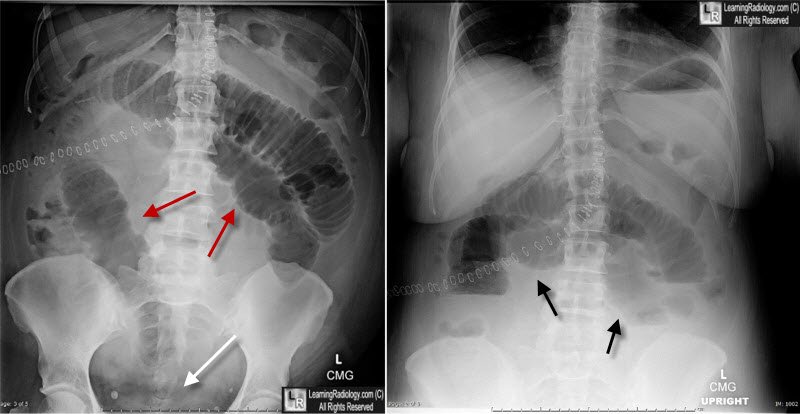 Small bowel obstruction
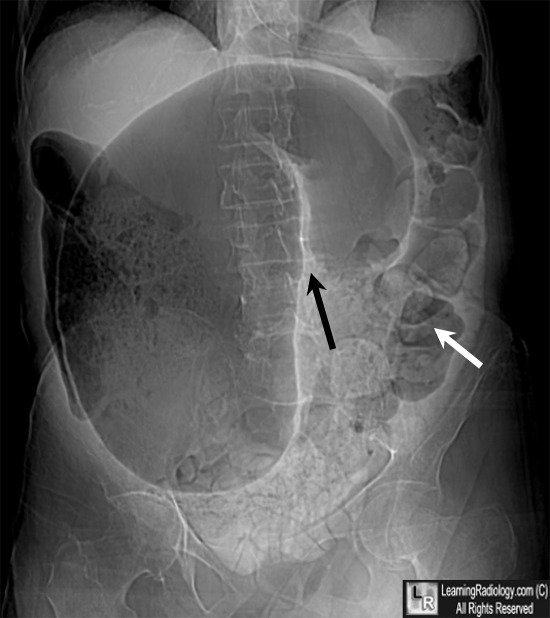 Sigmoid volvulus (coffee bean sign)
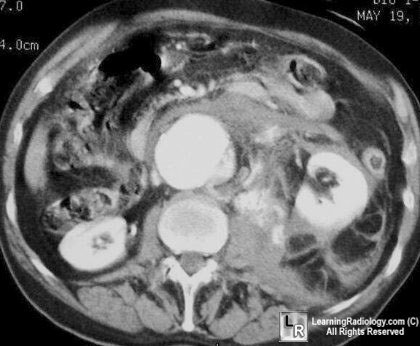 Ruptured abdominal aortic aneurysm
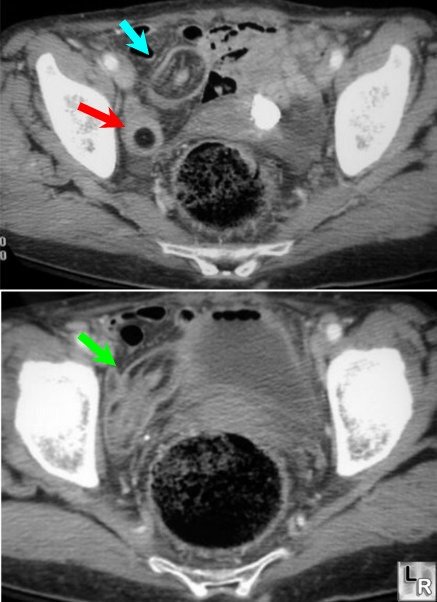 Intussusception (target sign)
How candidates prepare for the FRACS General Surgery
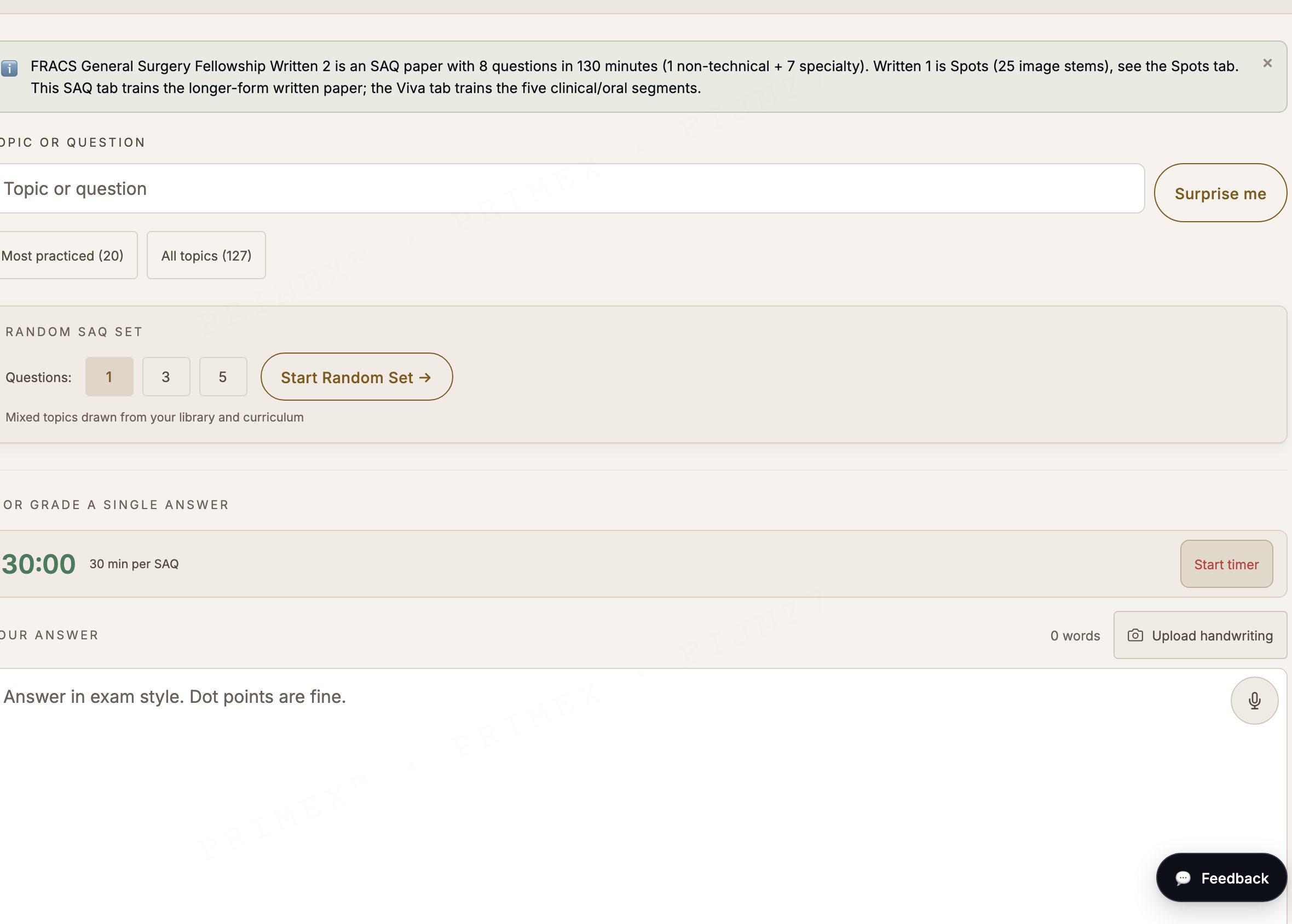
Written 2 of the FRACS Fellowship is an SAQ paper: 8 questions in 130 minutes, 1 non-technical question plus 7 specialty questions, each requiring structured surgical reasoning with specific operative detail: name of the procedure, the approach, the key anatomical steps, oncological margins, and complication management. The PRIMEX SAQ grader generates questions in authentic FRACS format, marks every point, and returns a tier with an examiner-style model answer that flags when your response is too generic.
- FRACS-format SAQs across all surgical subspecialties
- Pass / Borderline / Distinction tier with marking commentary
- Every marking point checked: operative indications, staging, complications
- Model answer at FRACS examiner standard with specific surgical detail
- Timed mock: 8 questions, 130 minutes
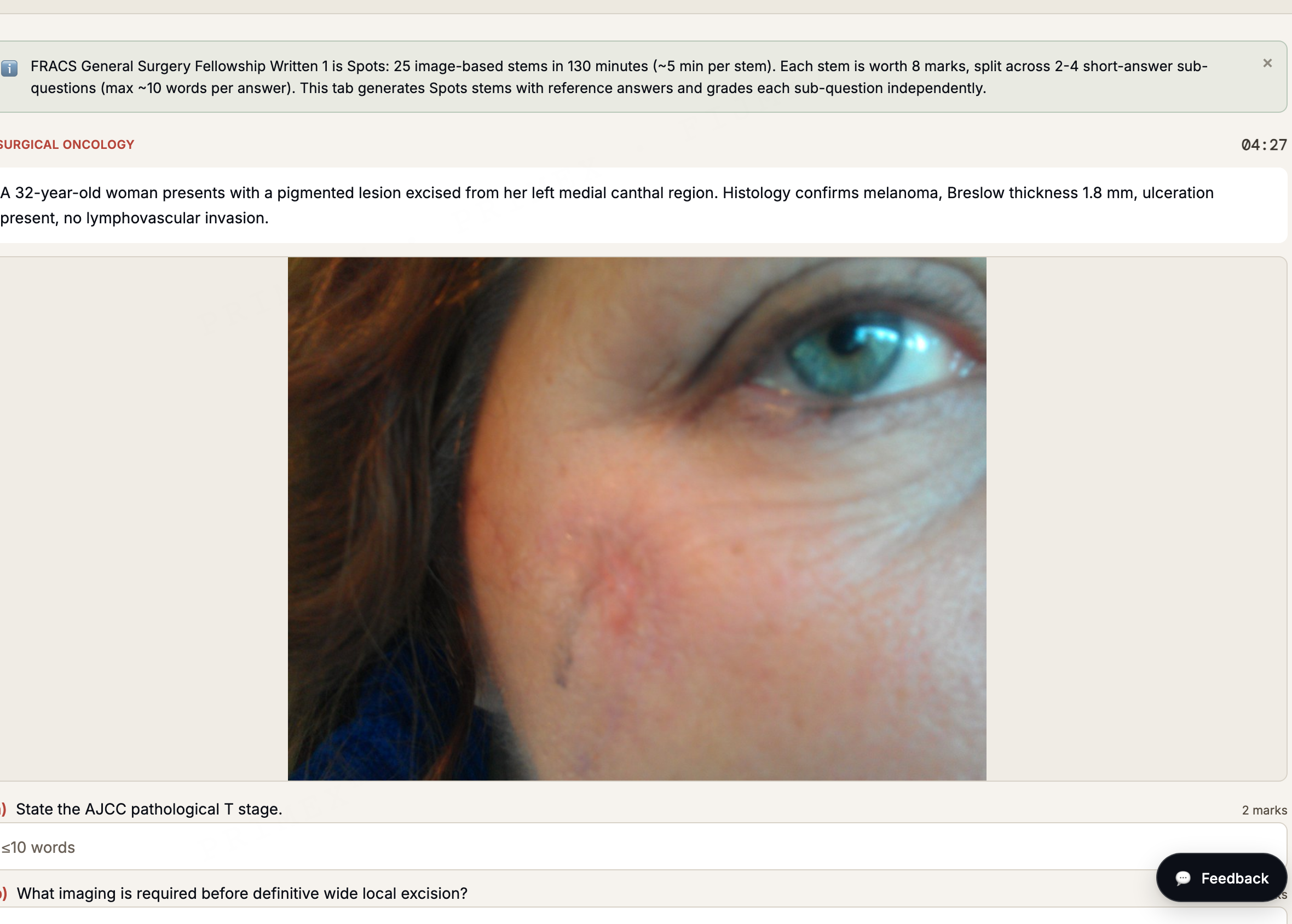
Written 1 of the FRACS Fellowship is Spots: 25 image-based stems in 130 minutes, roughly five minutes per stem, each worth 8 marks split across 2 to 4 short-answer sub-questions (max ~10 words per answer). The PRIMEX Spots Mode generates fresh stems with reference answers and grades each sub-question independently, so you can see which marking points you carried and which you missed.
- Twenty-five-stem mock paper at the real five-minute pace
- Image library across HPB, vascular, breast, endocrine, trauma, GI and 10 other surgical categories
- Independent per-sub-question marking, not a single tier
- Library tab to revisit attempted stems and re-grade
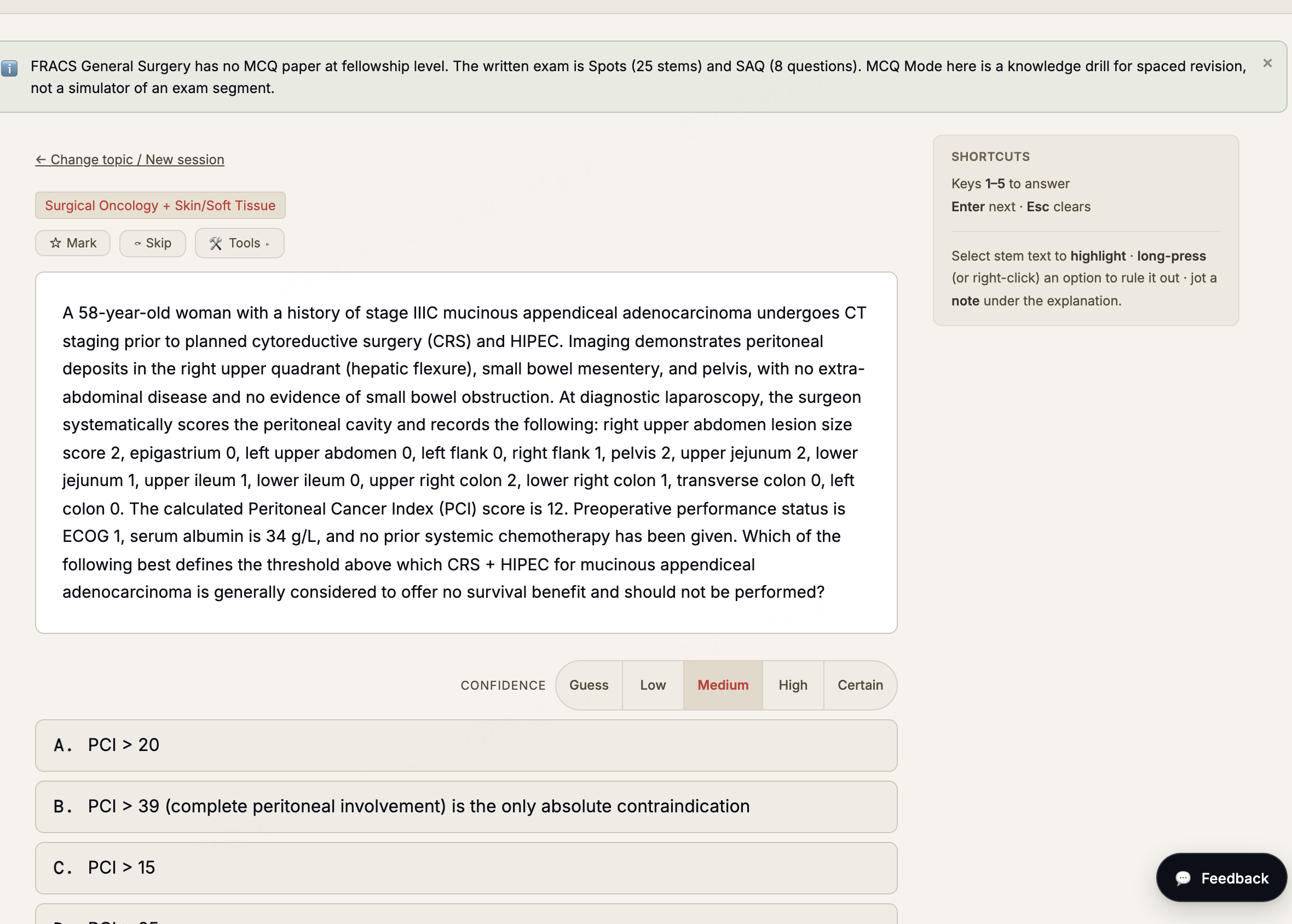
Fellowship-level MCQs across all nine general surgery subspecialties. Questions are framed as operative decision-making scenarios: which approach, which staging, which investigation changes management. Full explanations for every option with community answer distributions after each question.
- Fellowship-level SBA questions across all nine subspecialties
- Operative decision-making framing: approach, staging, investigation
- Explanation for every option, including the distractors
- Community answer distribution after each question
- AI-generated, curriculum-mapped, endless supply
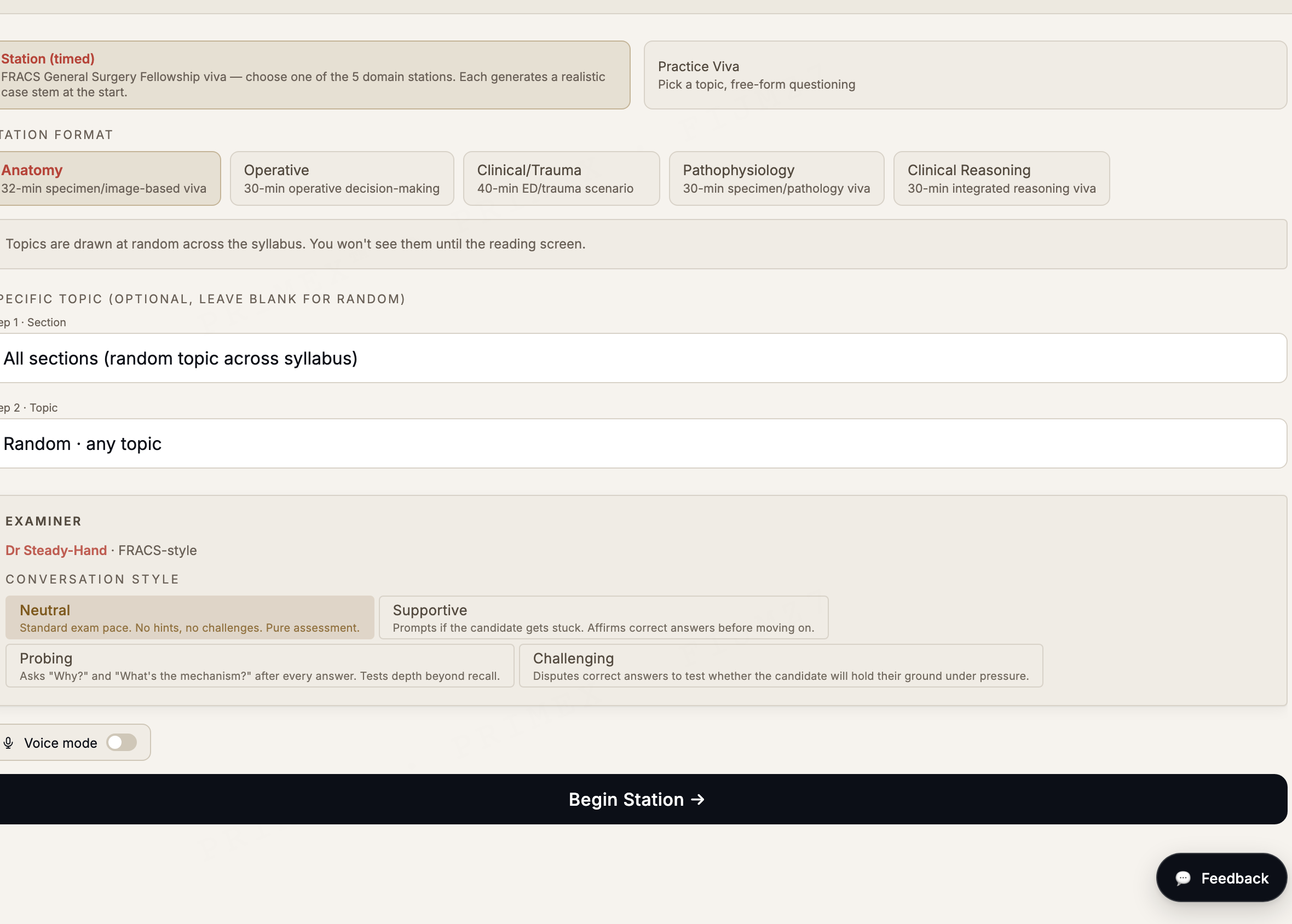
Sessions run in real RACS viva format: Operative Surgery (30 min), Pathophysiology / Critical Care / Clinical Reasoning (40 min), CIAA with eight clinical images (32 min), Clinical 1 medium-case (30 min), and Clinical 2 short-case (40 min). Each station opens on a scenario calibrated to its station type, then the examiner probes operative decision-making, anatomy, or pathophysiological reasoning with the depth a consultant examiner expects. Debrief returns a tier and a specific learning point, with voice mode for spoken answers and an examiner persona tuned to published RACS examiner-report language.
- Five station formats matching the real FRACS Fellowship structure
- Operative Surgery: justify approach, handle complications, manage intraoperative findings
- Pathophysiology / Critical Care: postoperative derangements and physiological reasoning
- CIAA: eight clinical images, structured short-answer interpretation
- Voice mode plus tiered debrief with a specific learning point per session
Work through a full mock viva out loud with this college's AI examiner, in real time. Answer by voice, get probed and interrupted like you would in the real viva, then step out to a graded debrief: how you performed on the station, the topics you covered, your strengths and gaps, and how you handled the pressure. Every mock viva feeds your weak-topic plan, so what to practise next is always clear.
- Real-time spoken viva in this college's examiner voice, fully interruptible
- Graded debrief on every station: your performance tier, the topics you covered, and the gaps to close
- Communication and composure feedback: pacing, hesitation, clarity under pressure
- Weak topics flow straight into your study plan and daily practice
- Part of PRIMEX Pro, with monthly mock vivas included
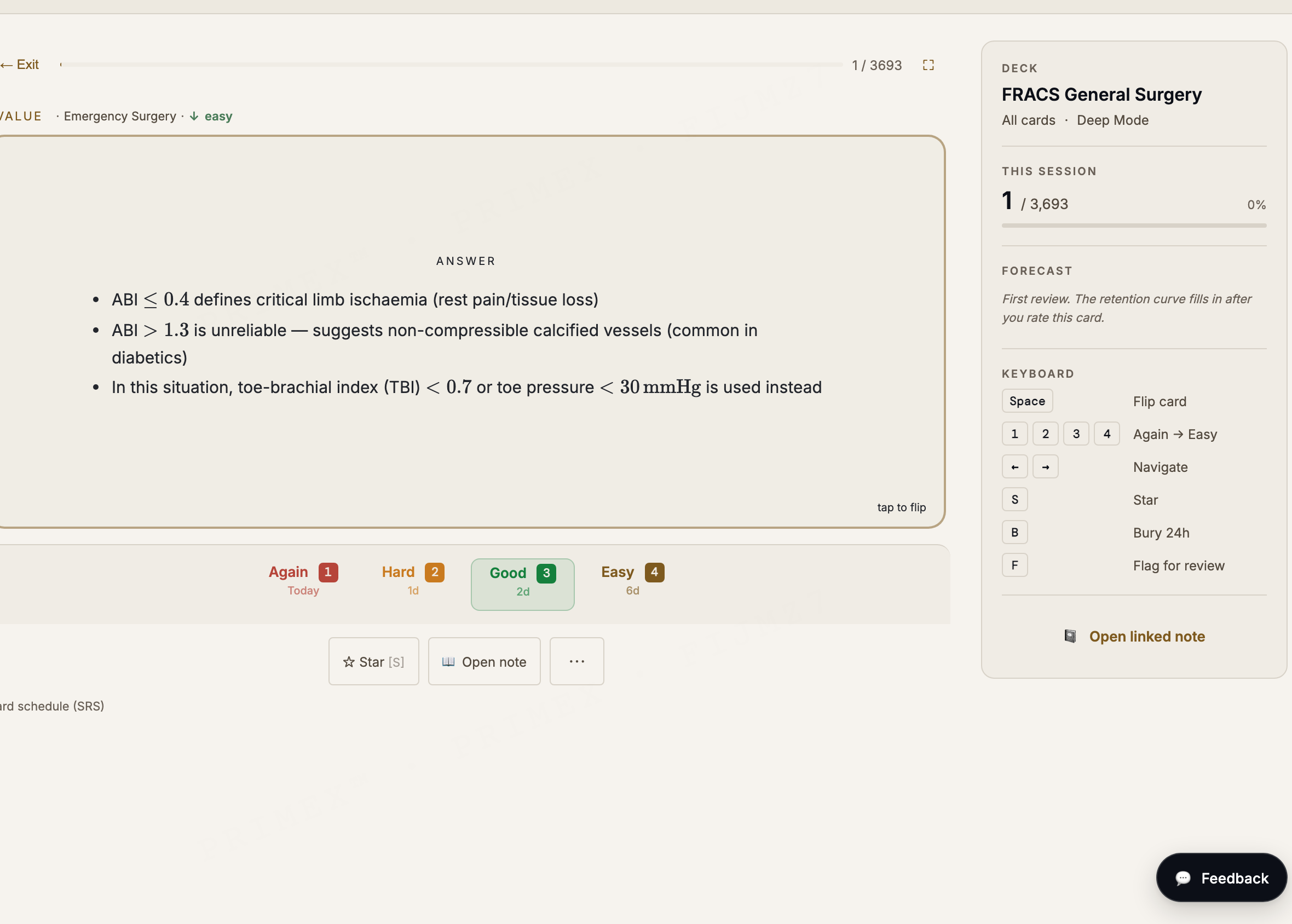
3,659 curriculum-mapped flashcards across all nine general surgery subspecialties. Spaced repetition keeps the operative detail in memory between sittings. Covers TNM staging, classification systems, drug doses, and operative steps. Cards you struggle with come back sooner; cards you know drop back automatically.
- 3,659 cards mapped to the FRACS General Surgery curriculum
- Clinical vignette, classification, and value cards across nine subspecialties
- TNM staging, Hinchey, Forrest, Bismuth-Corlette classification systems
- Operative steps and perioperative management algorithms
- One click from card to full study note
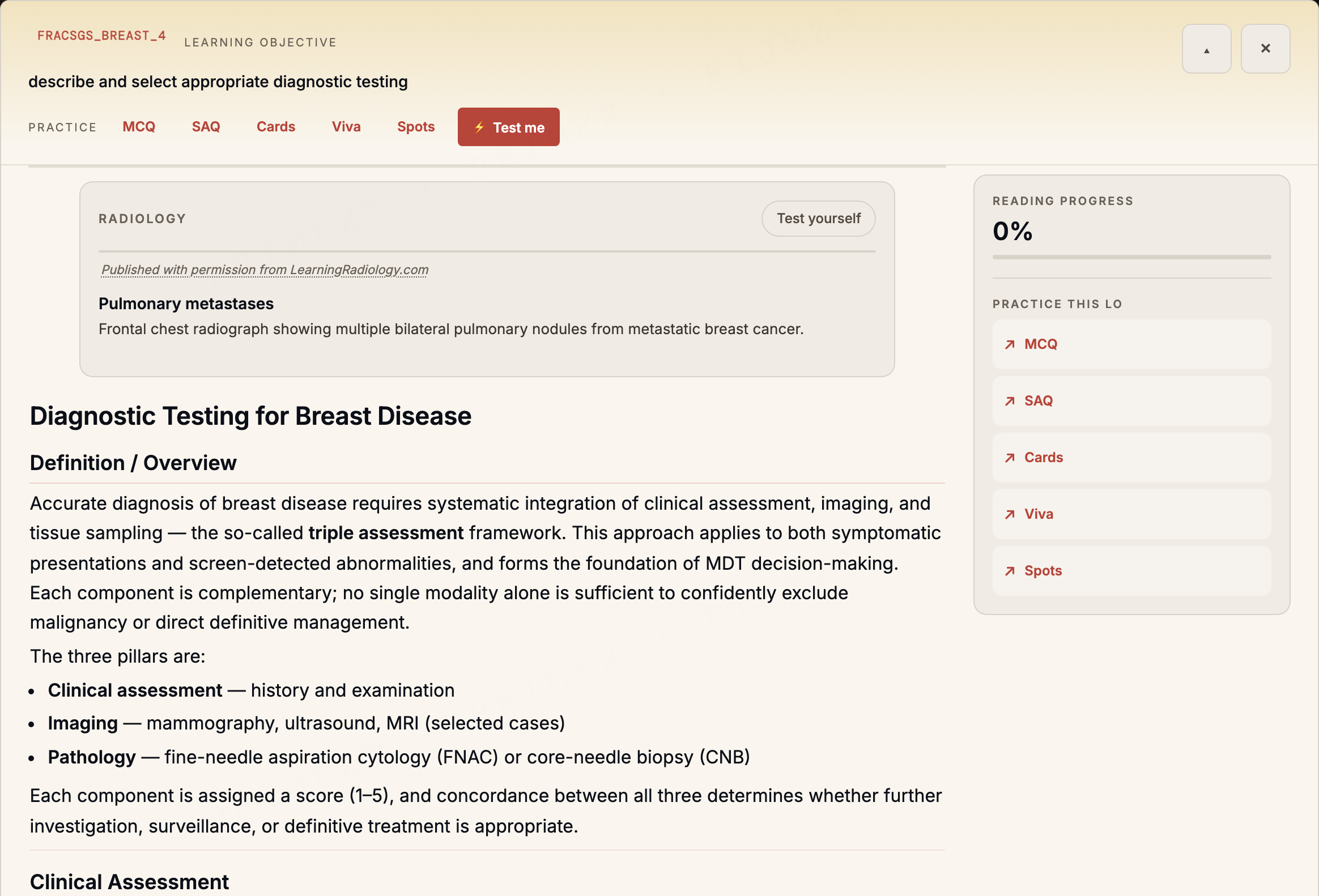
111 sourced study notes across the FRACS General Surgery curriculum, one for every covered learning objective. Written to a consistent seven-section format with operative detail throughout: staging systems, surgical approach decisions, intraoperative steps, and complication management. Referenced to NCCN, ANZGOSA, and current Australian oncology guidelines.
- 111 study notes across nine subspecialties, one per LO
- Operative context: approach, key steps, anatomical hazards, complications
- Referenced to NCCN, ANZGOSA, RACS position statements, and primary literature
- Full-text search across all notes
- Linked from MCQ explanations, SAQ feedback, and viva debriefs
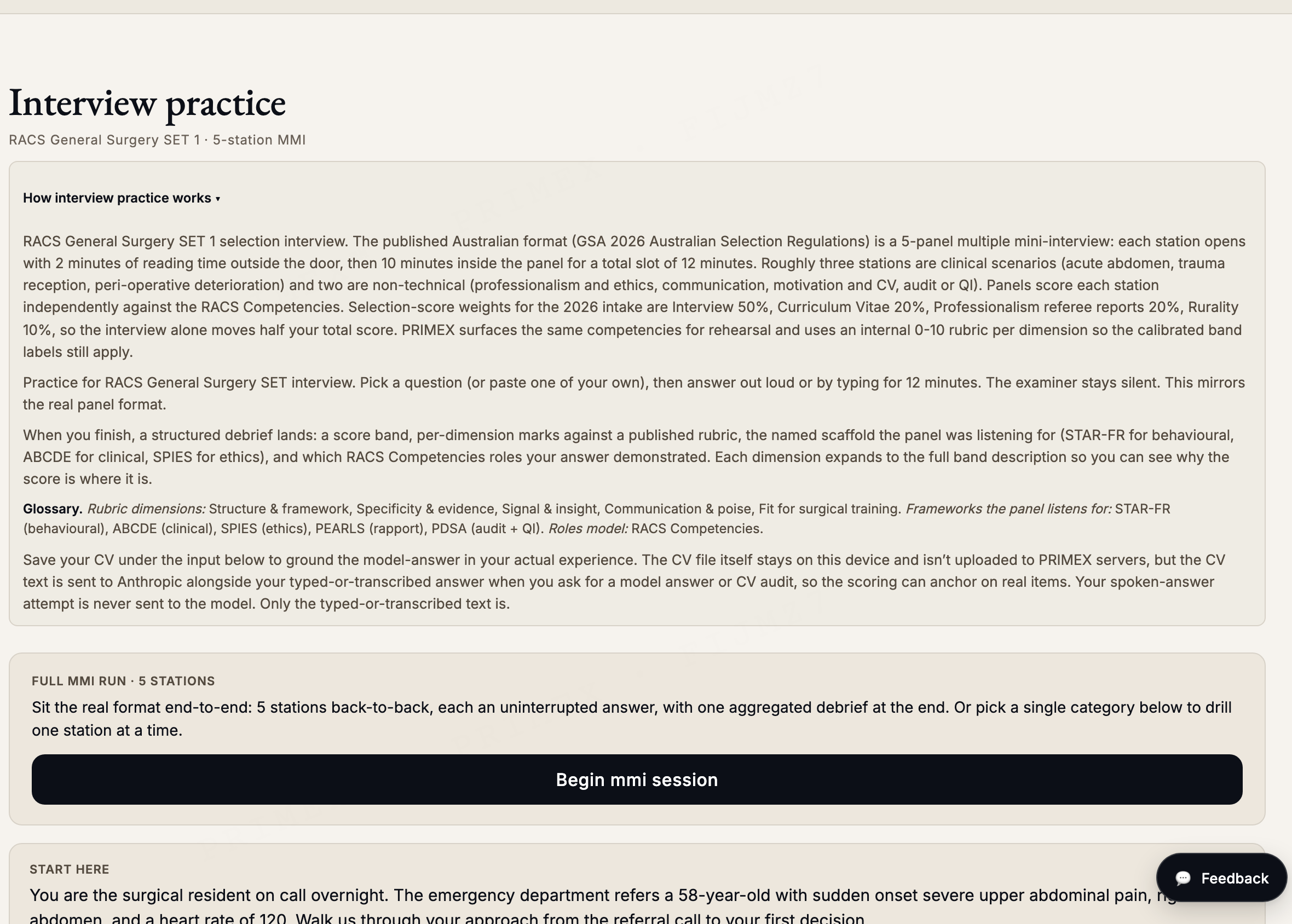
Rehearse the publicly-documented RACS General Surgery SET 1 selection MMI format. Five stations of 12 minutes each (2 minutes reading plus 10 minutes inside the panel), roughly three clinical scenarios (acute abdomen, trauma triage, peri-operative deterioration) and two non-technical stations (professionalism and ethics, communication, motivation and CV, audit and QI). The interview alone carries 50% of the total selection score per the GSA 2026 Australian Selection Regulations, alongside CV (20%), professionalism referees (20%) and rurality (10%). The debrief returns a tier band, per-dimension rubric scores against the RACS Competencies framework (Medical Expertise, Judgement, Communication, Collaboration, Management, Health Advocacy, Scholarship, Professionalism), and framework beat checks per station.
- 5-station MMI format with 12-minute slots (2 min reading + 10 min response per panel)
- Mirrored from the GSA 2026 Australian Selection Regulations + RACS SET selection-process page
- Stations cover clinical scenarios, professionalism and ethics, communication, motivation, audit and QI
- Calibrated rubric scoring per dimension with full band descriptions
- RACS Competencies (NOT CanMEDS) demonstrated and missed per station
- Framework beat tracking for STAR-FR, SPIES, PEARLS, PDSA, ABCDE, ISBAR
FRACS General Surgery format and structure: Fellowship Examination
The FRACS General Surgery Fellowship Examination has a written component and an oral viva component. The written examination includes a Spots paper (25 image-based stems, 130 minutes, 8 marks per stem) and an SAQ paper (8 questions, 130 minutes: 1 non-technical plus 7 specialty). The oral component comprises five viva stations: Operative Surgery (30 min), Pathophysiology / Critical Care / Clinical Reasoning (40 min), CIAA with 8 clinical images (32 min), Clinical 1 medium-case (30 min), and Clinical 2 short-case (40 min). Candidates must demonstrate operative decision-making, anatomical knowledge, staging and oncological principles, and management of surgical complications across the full breadth of general surgery. PRIMEX is built by Dr Jay Marshall, an anaesthetics registrar in Taree, NSW.
- OrganiserRoyal Australasian College of Surgeons (RACS)
- FormatWritten: Spots (25 stems, 130 min, 8 marks each) + SAQ (8 questions, 130 min: 1 non-technical + 7 specialty). Oral: 5 viva stations; Operative Surgery, Pathophys/CC/Clinical Reasoning, CIAA, Clinical 1 medium, Clinical 2 short
- SpecialtiesUpper GI, Colorectal, HPB, Hernia, Breast, Endocrine, Vascular, Trauma, Surgical Oncology
- SittingsTwice yearly (Written), with matched Clinical/Viva windows in NZ and Australia
- Pass rateRACS does not publish a separated written-vs-viva pass rate; it issues a candidate report after each sitting. Check the RACS website for current figures
Try the same AI grader our subscribers use.
Five high-yield FRACS General Surgery topics. Free MCQ practice, graded against college-standard marking points. No signup.
Breast Cancer: Treatment Options, Indications, and Contraindications
Breast cancer treatment is multimodal and requires careful integration of surgery, radiation, systemic therapy, and MDT decision-making.
Damage Control Surgery: Principles and Indications
Damage control surgery (DCS) is a staged operative strategy in which the initial operation is deliberately abbreviated to address only immediately.
Liked those five? That's a sliver of what's inside.
Get 111 study notes, 3,659 spaced-repetition flashcards, unlimited question practice and the full exam simulator. Free for 7 days, then from A$44.99/month.
Start free trial, 7 days free Cancel anytime · no commitmentCommon questions about the FRACS General Surgery exam
Specialist pricing and 7-day free trial
Specialist unlocks every PRIMEX exam track: the specialist pathways, AMC and Medical Student. Every study tool is included, with no per-feature paywalls.
- ✓ Every exam track: specialist pathways, AMC & Medical Student
- ✓ Flashcards with spaced repetition & MCQ drill
- ✓ Study notes for every curriculum topic
- ✓ SAQ library & sessions
- ✓ Study plan with pace tracking
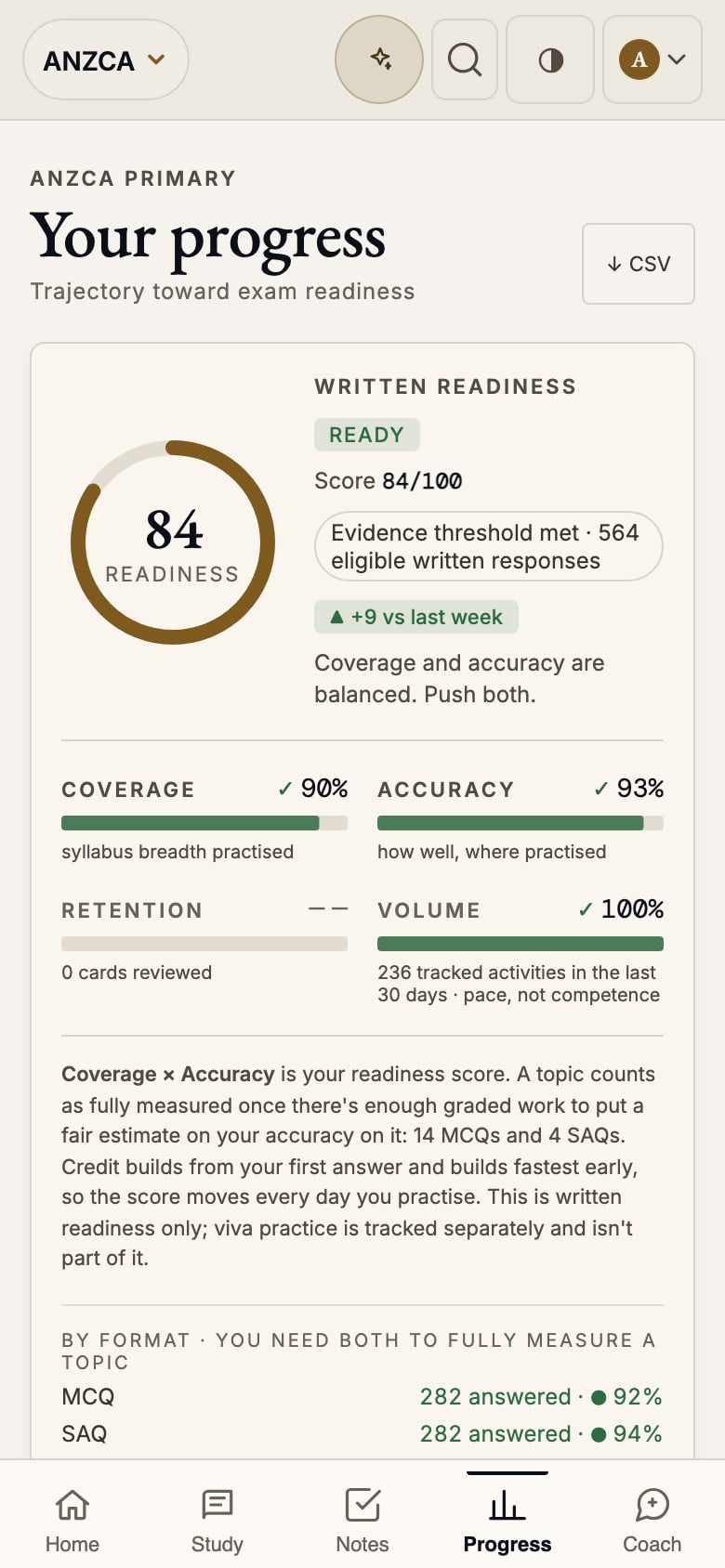
- ✓ Curriculum tracker & readiness insights
- ✓ Every exam track: specialist pathways, AMC & Medical Student
- ✓ Flashcards with spaced repetition & MCQ drill
- ✓ Study notes for every curriculum topic
- ✓ SAQ library & sessions
- ✓ Study plan with pace tracking
- ✓ Curriculum tracker & readiness insights
- ✓ Every exam track: specialist pathways, AMC & Medical Student
- ✓ Flashcards with spaced repetition & MCQ drill
- ✓ Study notes for every curriculum topic
- ✓ SAQ library & sessions
- ✓ Study plan with pace tracking
- ✓ Curriculum tracker & readiness insights
You'll land on a confirmation page. Tap the sign-up button (or sign in if you already have an account) and your subscription links automatically. If you close the page first, just use the same email when you sign up and it'll still link.