
RCPA AP / diagnose it.
308 sourced study notes across the RCPA Anatomical Pathology curriculum (356 LOs, 7 domains). AI essay-written grading with RCPA examiner-style marking, plus a digital-slide viva simulator covering IHC panels and tumour grading. 10,156 LO-aligned spaced-repetition flashcards. Built for the precision the fellowship demands.
Your PRIMEX account, now in your pocket.
Specialist unlocks every PRIMEX exam track. Accessible is limited to AMC and Medical Student. Subscribe on the website or in the iPhone app, then use the same account to keep your access and progress together.

RCPA Anatomical Pathology Exam Dates 2026
Published dates for the upcoming sittings. Always confirm against the official RCPA examinations page before scheduling. I refresh this section quarterly as new windows are announced.
- Part I, WrittenFri 15 May 2026 (online, 3h 15m)
- Part I, Histopathology Digital SlidesSun 17 May 2026 (online/local, 4h 15m)
- Part II, Histopathology Digital SlidesSat 16 May 2026 (online/local, 4h 15m)
- Part II, Small Biopsy & Special TechniquesSat 13 Jun 2026 (online/local, 3h 30m)
- Part II, Cytology Digital SlidesSun 14 Jun 2026 (online/local, 2h 15m)
- Part II, Oral ExaminationSun 23 Aug 2026 (local, all day)
- Part II Repeats, all written componentsFri 31 Jul 2026 (online/local)
- Part II Repeat, OralFri 20 Nov 2026 (local, all day)
Written exams delivered online via the College's risr/assess + Proctor Exam platform. 2026 applications closed Sat 28 Feb 2026; the 2027 application window typically opens late in the prior year, so confirm dates on the official RCPA examinations page.
Inside PRIMEX, in under a minute
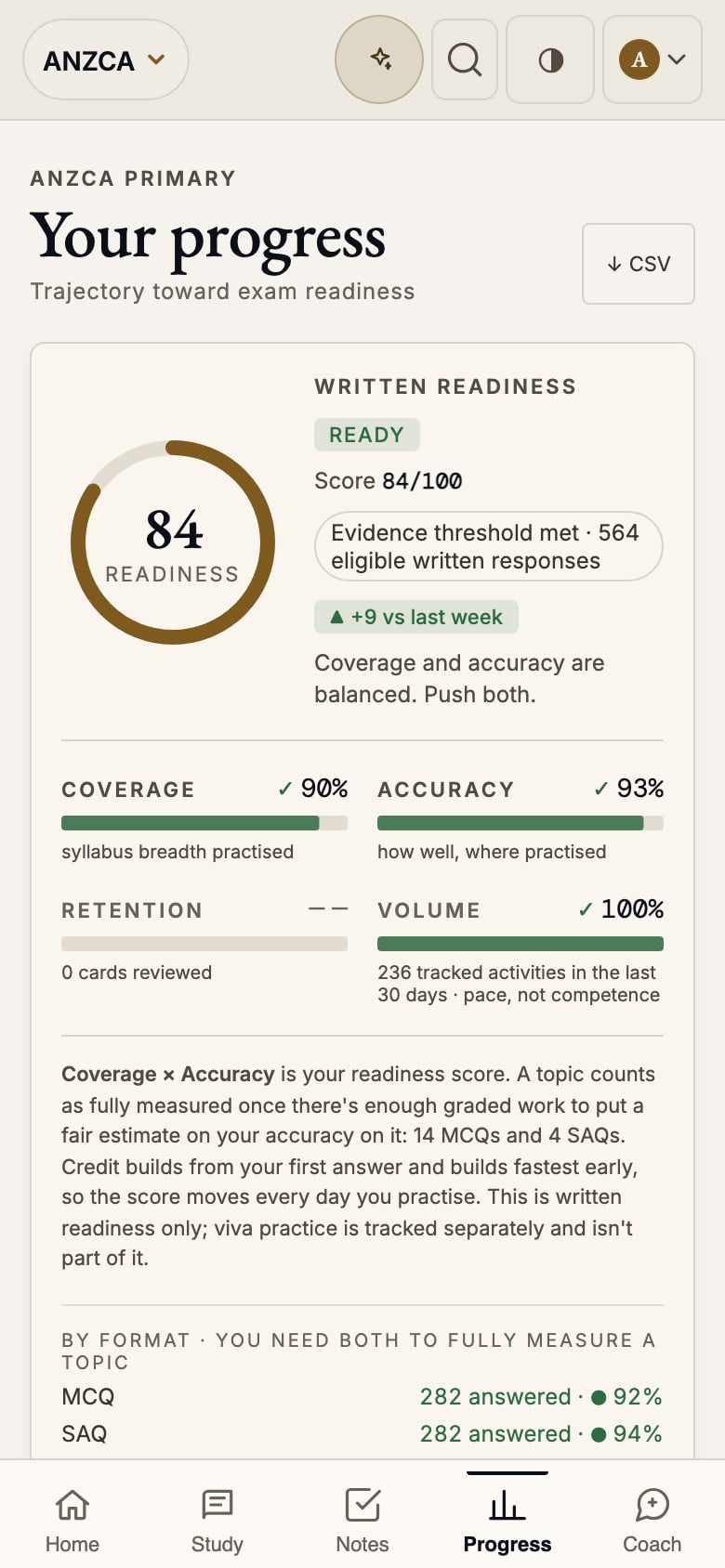
Recorded in the app, with real RCPA Anatomical Pathology written answers, slides and notes. No sound needed to follow it.
Topics tested in the RCPA Anatomical Pathology exam
How candidates prepare for the RCPA Anatomical Pathology
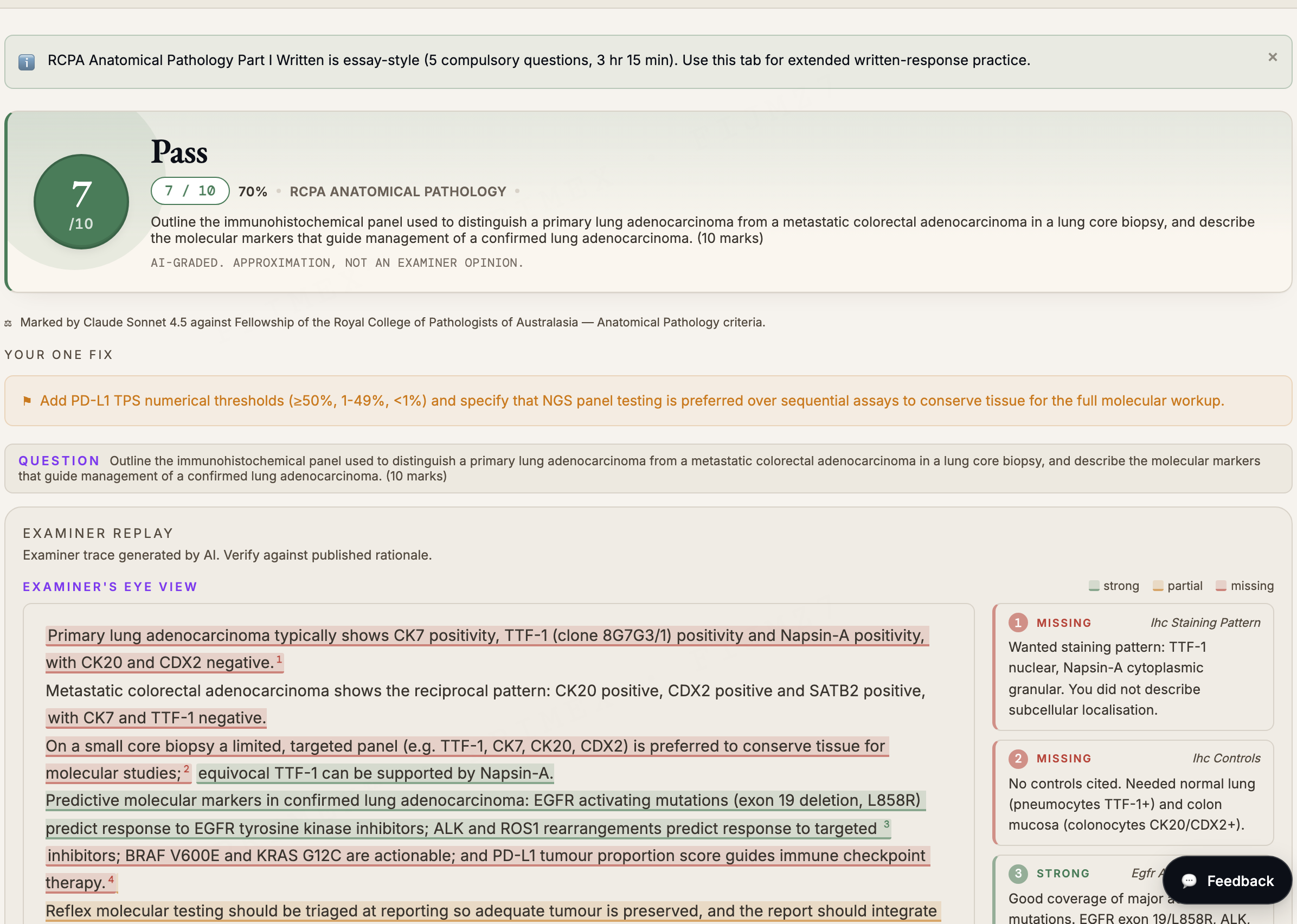
The RCPA Anatomical Pathology Part I Written is an essay-style written paper (3 hr 15 min, online) on general pathology principles, organ system pathology, IHC interpretation, and tumour classification. There is no MCQ in the Fellowship papers themselves, though all RCPA trainees including AP sit the shared BPS gateway multiple-choice exam. PRIMEX grades extended written responses for specific IHC marker combinations, IHC reasoning (positive and negative markers), numerical staging thresholds, and correct tumour classification, the elements RCPA examiners most commonly penalise.
- Part I essay written grading with IHC marker combination feedback
- Extended written response feedback: histological description → differential → IHC panel → diagnosis → management
- Common errors flagged: p63 vs p40 confusion (p40 is superior for squamous), missing synchronous carcinoma in adenoma, FAB vs WHO terminology
- Numerical thresholds checked: Gleason/ISUP grade groups, Breslow depth cut-offs, Nottingham grade elements
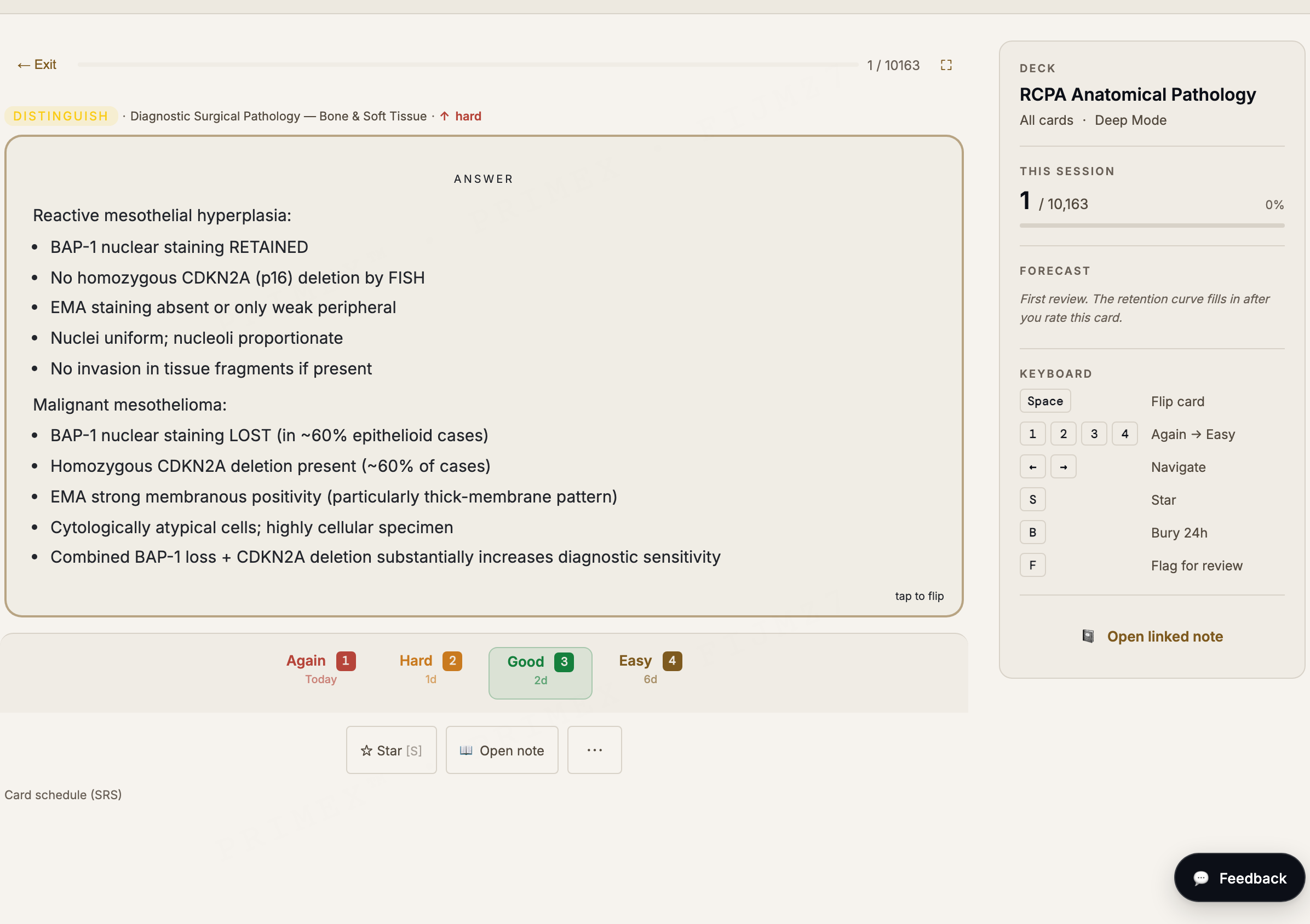
10,156 spaced-repetition flashcards aligned to the curriculum's learning-objective structure across the 356 LOs. Card types include morphology, IHC patterns, classification systems, grading thresholds, and molecular markers. Each card ID is linked to an RCPA AP LO so cards surface alongside the relevant study note.
- Rebuilding per learning objective from the study notes pipeline
- Planned card types: IHC panels (primary lung, mesothelioma, metastatic carcinoma, lymphoma minimum panels), tumour grading (Gleason/ISUP, Nottingham, Breslow, WHO CNS 2021), molecular markers (MSI, IDH1/2, 1p/19q, POLE)
- Staging cards planned: AJCC 8e pT/pN across the major sites
- One click from card to full study note when the deck lands
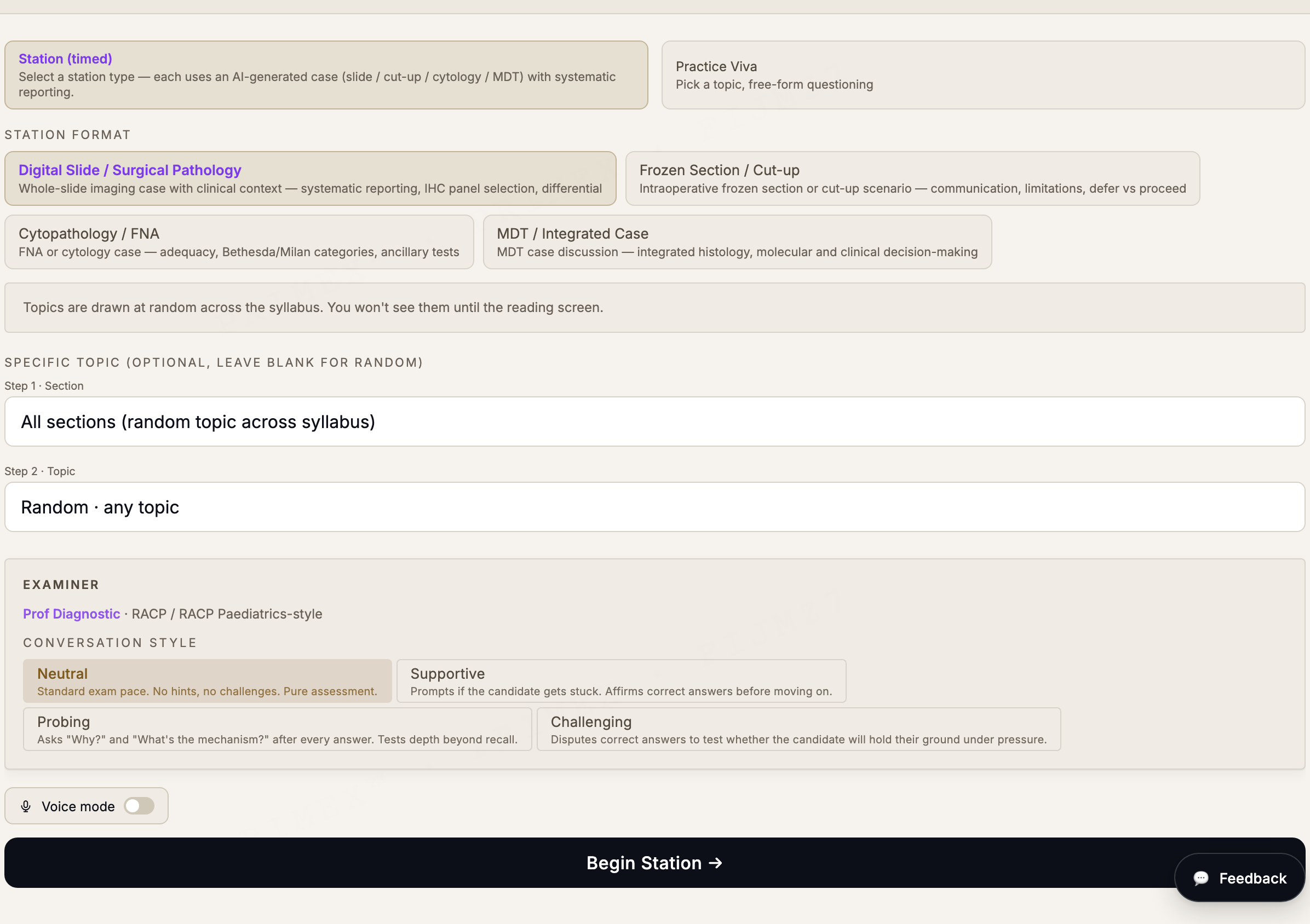
The RCPA AP oral components present histological descriptions (digital slide scenarios) and expect a systematic report approach: specimen type → macroscopic → microscopic → IHC → molecular → integrated WHO-classified diagnosis → clinicopathological correlation. PRIMEX's viva simulator replicates this exactly, presenting histological descriptions and probing at every step.
- Systematic viva structure: specimen → macroscopic → microscopic → IHC → molecular → diagnosis → correlation
- High-yield scenarios: lung biopsy (primary vs metastatic), lymph node biopsy (DLBCL vs Hodgkin vs reactive vs metastatic carcinoma), prostate needle core (systematic Gleason grading per core), frozen section thyroid (when to defer vs proceed)
- Examiner probes: "What additional stain would you perform and what result would confirm your diagnosis?"
- Frozen section communication: how to report findings to surgeons and communicate limitations
Work through a full mock viva out loud with this college's AI examiner, in real time. Answer by voice, get probed and interrupted like you would in the real viva, then step out to a graded debrief: how you performed on the station, the topics you covered, your strengths and gaps, and how you handled the pressure. Every mock viva feeds your weak-topic plan, so what to practise next is always clear.
- Real-time spoken viva in this college's examiner voice, fully interruptible
- Graded debrief on every station: your performance tier, the topics you covered, and the gaps to close
- Communication and composure feedback: pacing, hesitation, clarity under pressure
- Weak topics flow straight into your study plan and daily practice
- Part of PRIMEX Pro, with monthly mock vivas included
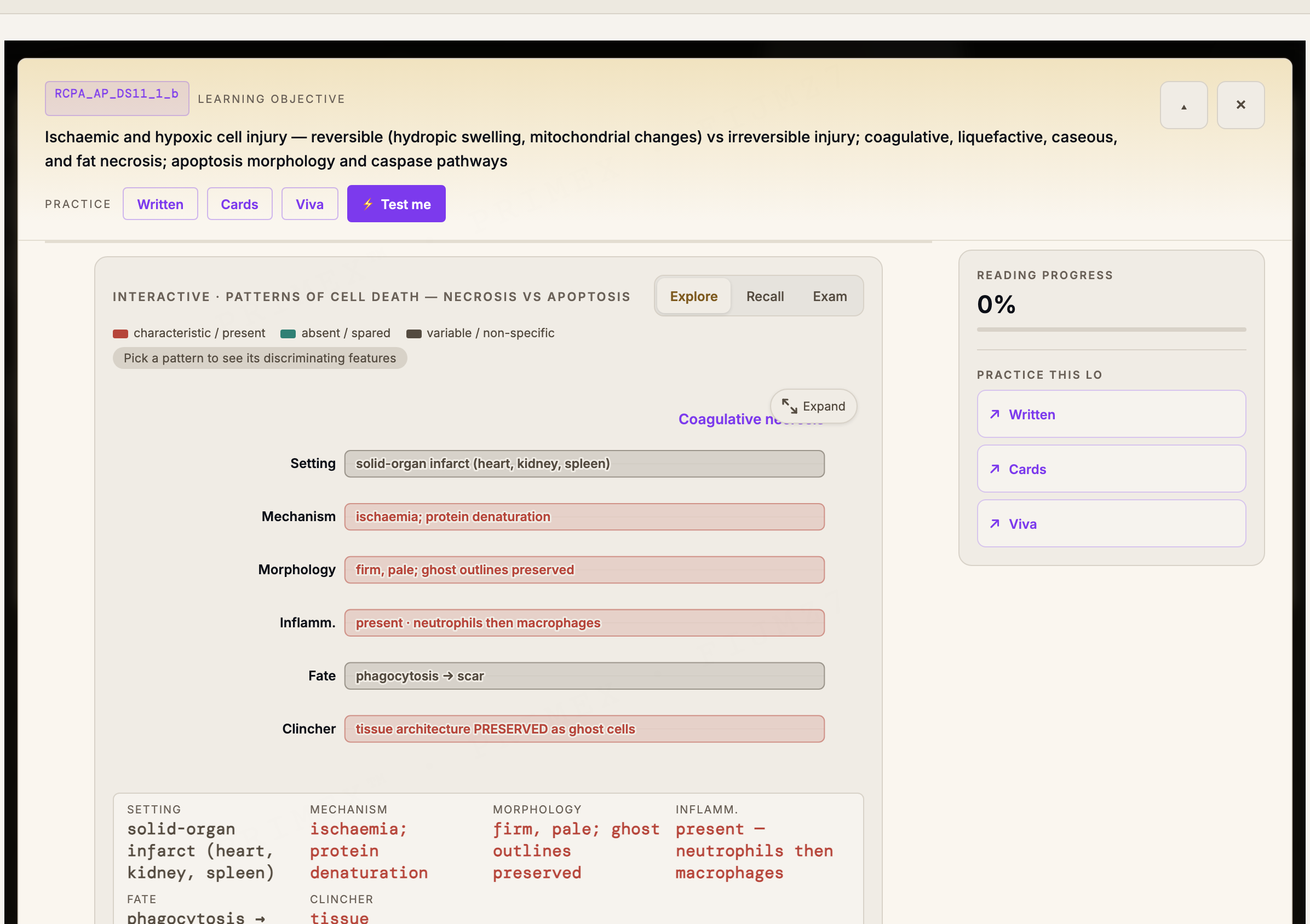
308 sourced study notes across the RCPA AP curriculum, one for every covered learning objective. Each follows a structured format: pathophysiology, WHO classification, IHC panel with specific markers, molecular features, staging criteria, and reporting implications. Each maps to its RCPA Trainee Handbook 2025 curriculum LO.
- 308 sourced notes, one per covered LO; surgical pathology, IHC/molecular, organ systems, laboratory management
- WHO classification criteria with specific numerical thresholds in every relevant note
- IHC panel tables: markers, expected results, and positive/negative controls
- References to WHO Blue Books (CNS 2021, Digestive System 2019, Thoracic Tumours 2021), RCPA structured reporting protocols, and AJCC 8e staging
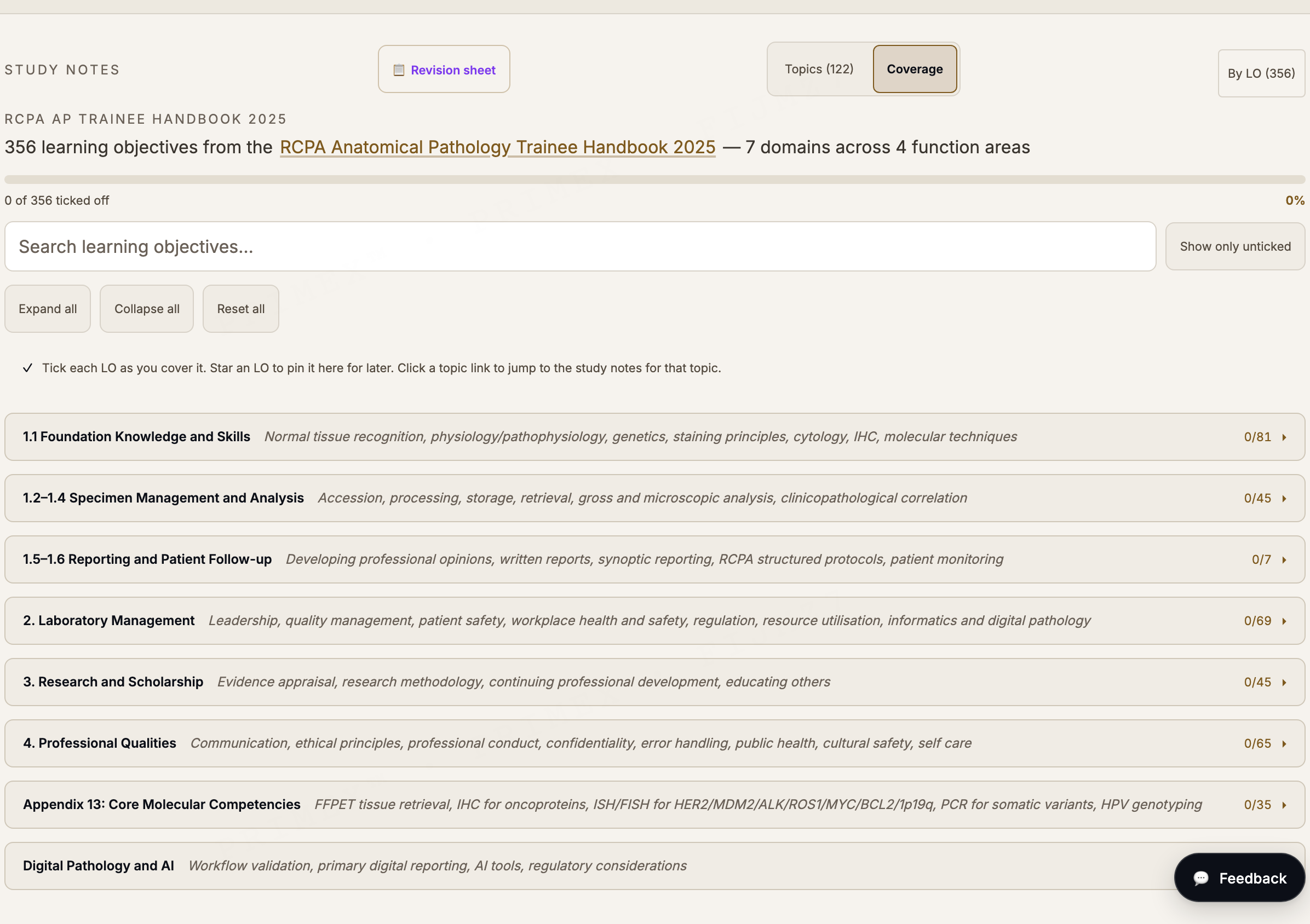
The RCPA Anatomical Pathology Trainee Handbook (January 2025) defines 356 LOs across 7 domains including discipline-specific (Sections 1.1-1.6), laboratory management (2), research (3), and professional qualities (4). PRIMEX maps every LO with per-domain progress tracking.
- All 356 RCPA AP LOs mapped across 7 curriculum domains
- Appendix 13 Molecular Competencies tracked separately (FISH, IHC for oncoproteins, PCR for somatic variants)
- Checkbox completion persisted to localStorage
- Per-domain progress bars showing Part I, Part II, and viva coverage
RCPA Anatomical Pathology format and structure
The RCPA Anatomical Pathology Fellowship Examination is conducted by the Royal College of Pathologists of Australasia. Part I comprises an essay-style Written examination (3 hr 15 min, online) and a Histopathology Digital Slides examination (4 hr 15 min, whole-slide imaging). Part II comprises a Digital Slides examination, a Small Biopsy and Special Techniques (SBST) paper, a Cytology Practical, and a multi-station Oral (criterion-referenced; durations and station structure per the current trainee handbook). Each component must be passed individually. The Fellowship papers carry no MCQ, though all RCPA trainees including AP sit the shared BPS gateway multiple-choice exam. RCPA publishes no aggregate pass rate; it releases individual candidate results only.
The Viva presents histological scenarios with clinical context and requires candidates to demonstrate a systematic reporting approach; from specimen type and macroscopic description through microscopic features, IHC construction, molecular testing, and WHO-classified diagnosis to clinicopathological correlation and management implications. The 2025 curriculum explicitly includes Appendix 13 Molecular Competencies covering FISH, IHC for oncoproteins, and PCR for somatic variants. PRIMEX is built by Dr Jay Marshall, an anaesthetics registrar in Taree, NSW.
- OrganiserRoyal College of Pathologists of Australasia (RCPA)
- Part I WrittenEssay-style written paper, 3 hr 15 min, online; general and organ system pathology, IHC; no MCQ in the Fellowship papers, though AP trainees sit the shared BPS gateway multiple-choice exam
- Part I Digital SlidesHistopathology digital slide (whole-slide imaging) interpretation, 4 hr 15 min; systematic reporting with RCPA structured synoptic protocols
- Part II Digital Slides + SBST + CytologyThree separate practical components: digital slides, small biopsy and special techniques, cytology
- Part II OralMulti-station, criterion-referenced; case-based discussion format (durations and station structure per the current trainee handbook)
- CurriculumRCPA AP Trainee Handbook January 2025; 356 LOs across 7 domains including Appendix 13 Molecular Competencies
Free notes are just the start.
Get 308 study notes, 10,156 spaced-repetition flashcards, unlimited question practice and the full exam simulator. Free for 7 days, then from A$44.99/month.
Start free trial, 7 days free Cancel anytime · no commitmentCommon questions about the RCPA Anatomical Pathology exam
Specialist pricing and 7-day free trial
Specialist unlocks every PRIMEX exam track: the specialist pathways, AMC and Medical Student. Every study tool is included, with no per-feature paywalls.
- ✓ Every exam track: specialist pathways, AMC & Medical Student
- ✓ Flashcards with spaced repetition & MCQ drill
- ✓ Study notes for every curriculum topic
- ✓ SAQ library & sessions
- ✓ Study plan with pace tracking
- ✓ Curriculum tracker & readiness insights
- ✓ Every exam track: specialist pathways, AMC & Medical Student
- ✓ Flashcards with spaced repetition & MCQ drill
- ✓ Study notes for every curriculum topic
- ✓ SAQ library & sessions
- ✓ Study plan with pace tracking
- ✓ Curriculum tracker & readiness insights
- ✓ Every exam track: specialist pathways, AMC & Medical Student
- ✓ Flashcards with spaced repetition & MCQ drill
- ✓ Study notes for every curriculum topic
- ✓ SAQ library & sessions
- ✓ Study plan with pace tracking
- ✓ Curriculum tracker & readiness insights
You'll land on a confirmation page. Tap the sign-up button (or sign in if you already have an account) and your subscription links automatically. If you close the page first, just use the same email when you sign up and it'll still link.