
ACRRM / anywhere.
112 sourced study notes and 5,151 spaced-repetition flashcards across the 8 ACRRM domains. A StAMPS station simulator with AI examiner feedback and voice mode, plus rural-context MCQ practice. Built for the clinical breadth of remote practice.
Your PRIMEX account, now in your pocket.
Specialist unlocks every PRIMEX exam track. Accessible is limited to AMC and Medical Student. Subscribe on the website or in the iPhone app, then use the same account to keep your access and progress together.

ACRRM Fellowship Exam Dates 2026-2027
Published dates for the upcoming sittings. Always confirm against the official ACRRM assessment calendar before scheduling. I refresh this section quarterly as new windows are announced.
- MCQ Sitting 111 Feb 2026
- MCQ Sitting 28 Jul 2026
- Mock StAMPS (March)7-8 Mar 2026
- Mock StAMPS (September)12-13 Sep 2026
- CGT StAMPS (June)12-14 Jun 2026
- CGT StAMPS (November)13-15 Nov 2026
- AST StAMPS Emergency Medicine (May)9 May 2026
- AST StAMPS Emergency Medicine (October)10-11 Oct 2026
- AST StAMPS Specialty Options10 Oct 2026
- MCQ Sitting 1 (2027)17 Feb 2027
- MCQ Sitting 2 (2027)14 Jul 2027
- Mock StAMPS (March 2027)6-7 Mar 2027
- Mock StAMPS (September 2027)11-12 Sep 2027
- CGT StAMPS (June 2027)19-20 Jun 2027
- CGT StAMPS (November 2027)13-14 Nov 2027
- AST StAMPS Emergency Medicine (May 2027)1 May 2027
- AST StAMPS Emergency Medicine (October 2027)9-10 Oct 2027
- AST StAMPS Specialty Options (2027)9 Oct 2027
MCQ enrolment closes ~10 weeks before sitting. CBD/MSF enrolments open year-round.
Inside PRIMEX, in under a minute
Recorded in the app, with real ACRRM Fellowship questions and notes. No sound needed to follow it.
Topics tested in the ACRRM Fellowship exam
How candidates prepare for the ACRRM Fellowship
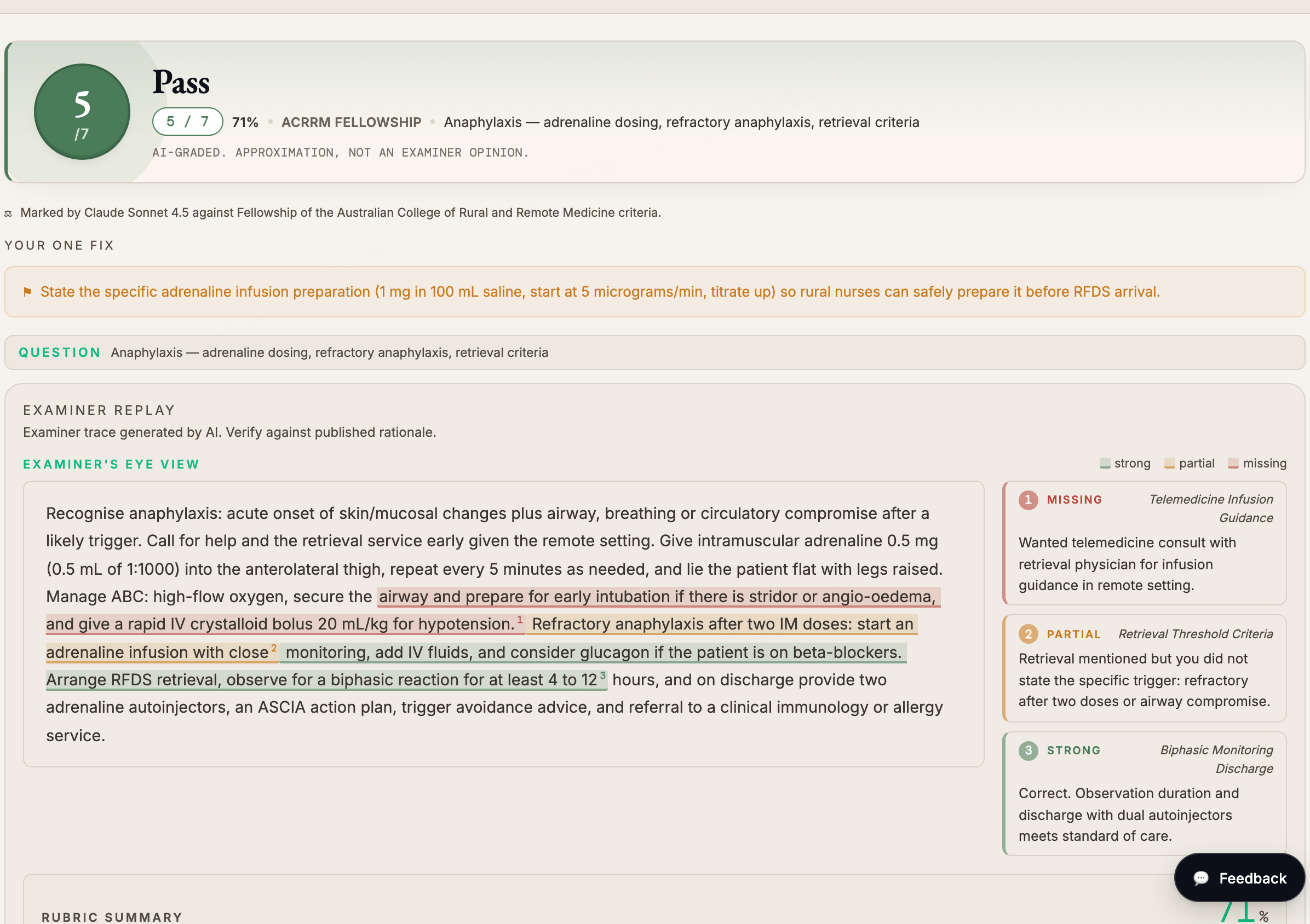
The real StAMPS is an oral viva conducted via Zoom. Eight rotating examiners, one per station, each asking three structured questions. PRIMEX's written mode builds the clinical reasoning and gives structured feedback on every marking point. The Viva tab replicates the spoken format when you want to practise answering out loud.
- Authentic StAMPS format: three questions per station, one per examiner domain
- Pass / Borderline / Fail tier with marking commentary per question
- Every marking point checked: hit, partially hit, or missed
- Model answer written at FACRRM standard for each station
- Timed mode: 10 min oral assessment per scenario with reading time before each, automatic advance
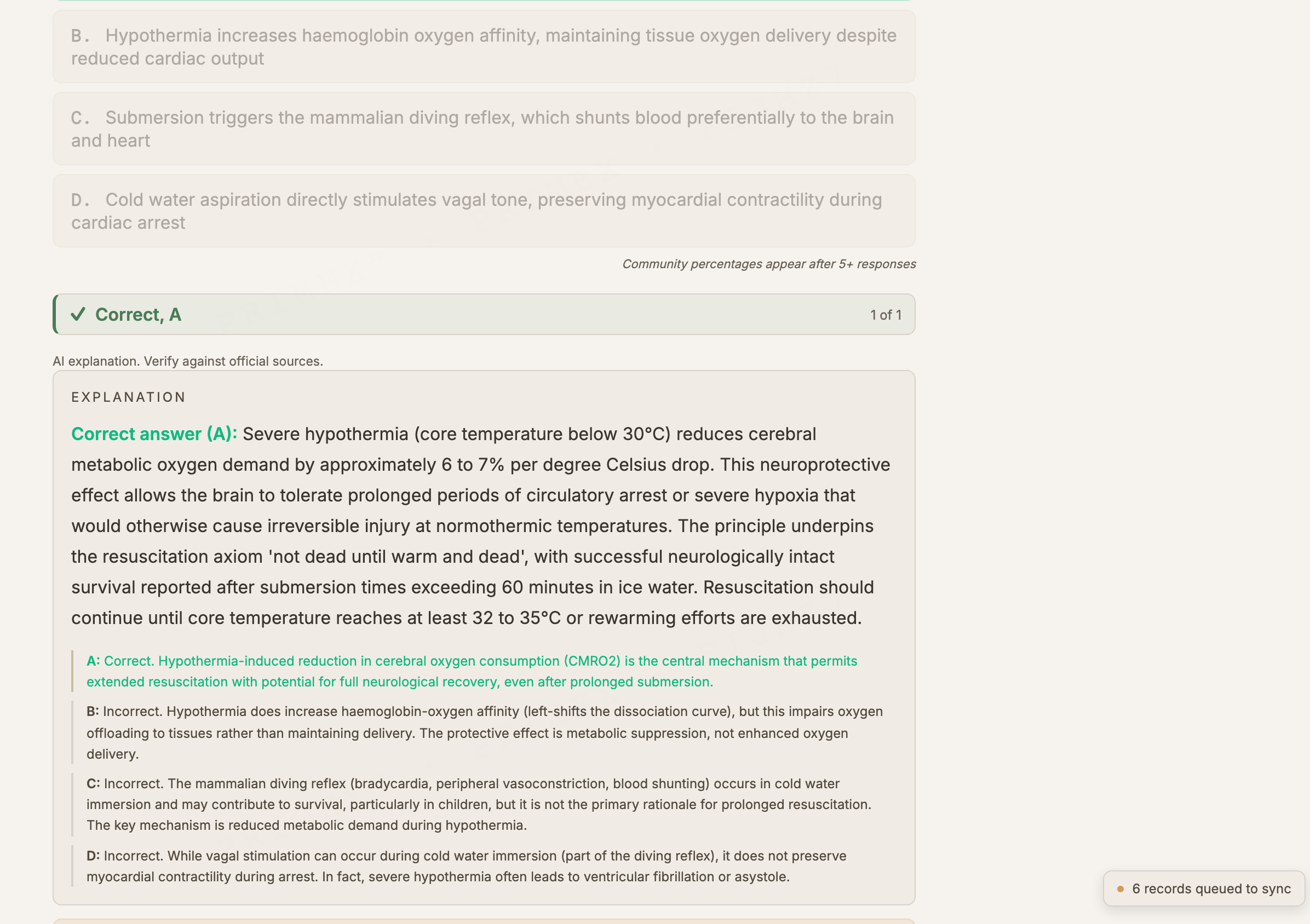
MCQ practice across all 8 ACRRM domains, mapped to the ACRRM Fellowship MCQ paper. Questions are set in remote and rural contexts: the patient is 6 hours from a hospital, the lab results won't be back until tomorrow, and the RFDS has a 90-minute ETA. Full explanations for every option, with community answer distributions after each question.
- Rural-context single-best-answer questions across all 8 domains
- Explanation for every option, including the distractors
- Community answer distribution after each question
- AI-generated, curriculum-mapped, endless supply
- Domain-filtered sessions or random mixed sets
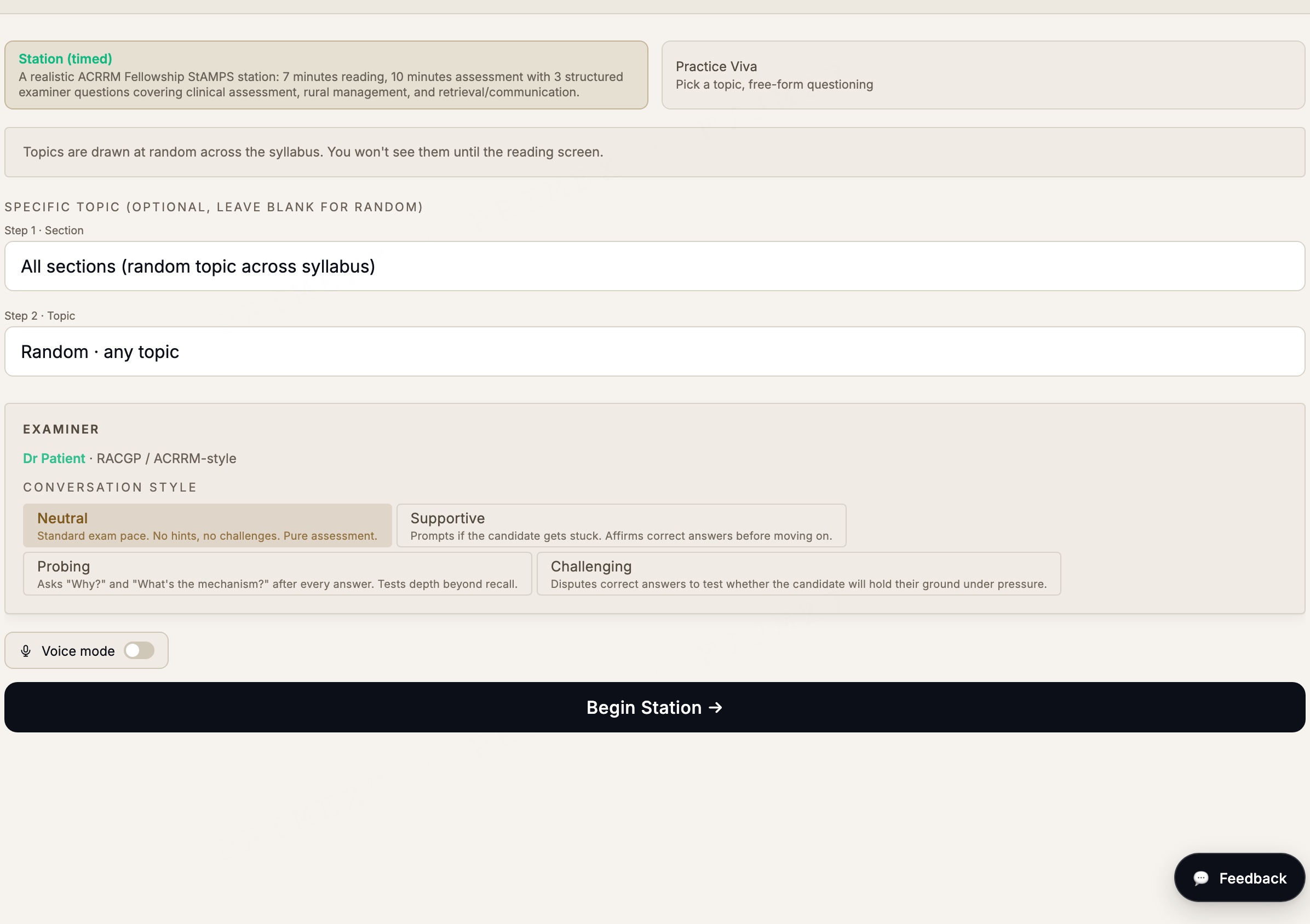
Voice mode transcribes your spoken answer in real time using medical speech recognition. Work through a StAMPS scenario by speaking your response; ideal for practising under time pressure without typing. The AI examiner probes further, challenges your reasoning, and debriefs at the end of each session.
- Voice mode: speak your response, transcribed live
- AI examiner probes your clinical reasoning and decision points
- Covers all rural domains: remote emergencies, tropical, ATSI, procedural
- Debrief with specific learning points after each session
- StAMPSville scenarios: remote central Australia, RFDS, no CT available
Work through a full mock viva out loud with this college's AI examiner, in real time. Answer by voice, get probed and interrupted like you would in the real viva, then step out to a graded debrief: how you performed on the station, the topics you covered, your strengths and gaps, and how you handled the pressure. Every mock viva feeds your weak-topic plan, so what to practise next is always clear.
- Real-time spoken viva in this college's examiner voice, fully interruptible
- Graded debrief on every station: your performance tier, the topics you covered, and the gaps to close
- Communication and composure feedback: pacing, hesitation, clarity under pressure
- Weak topics flow straight into your study plan and daily practice
- Part of PRIMEX Pro, with monthly mock vivas included
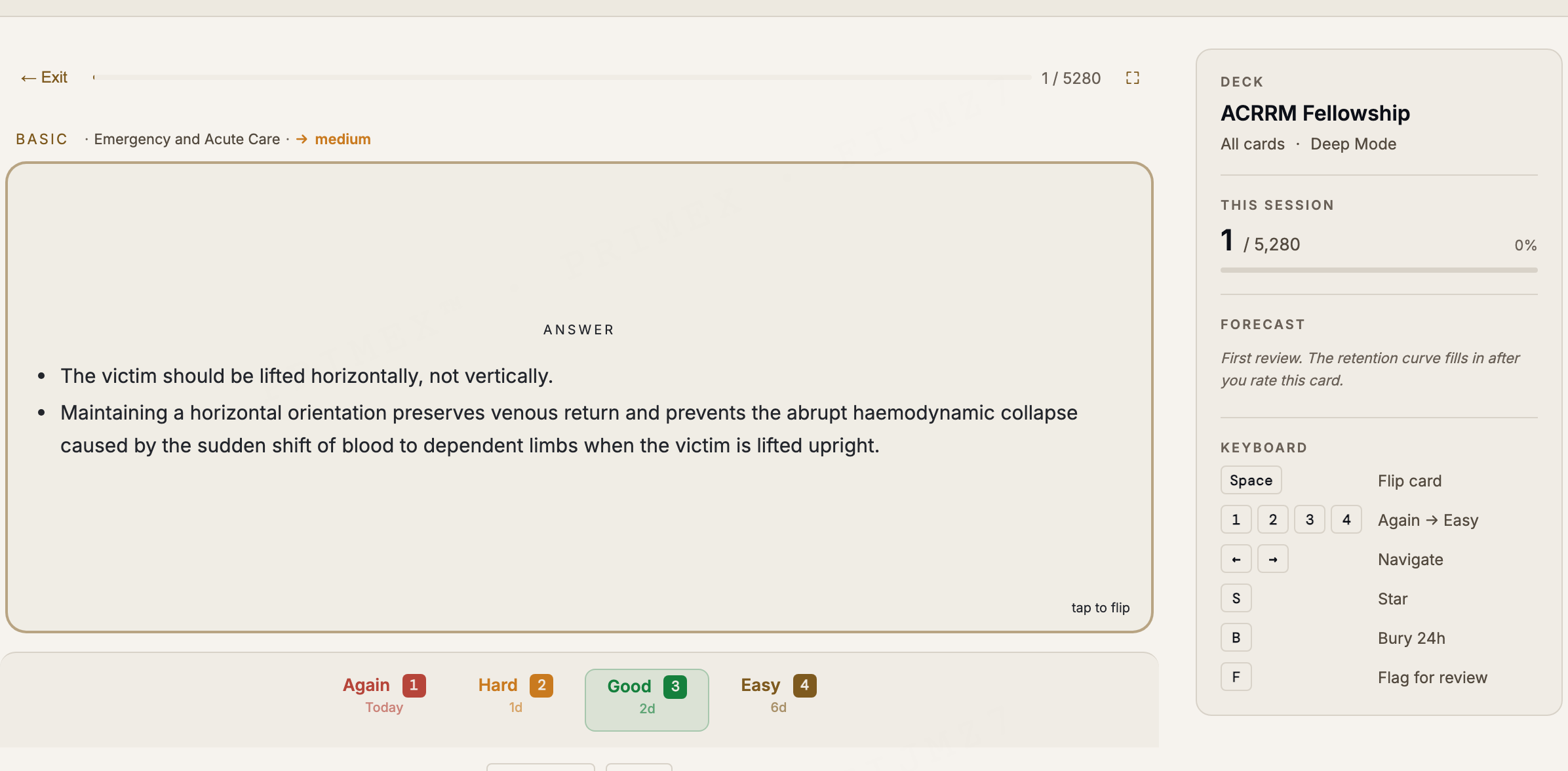
Curriculum-mapped flashcard decks covering rural and remote medicine, tropical disease, ATSI health priorities, and procedural medicine. Cards you get right come up less often; cards you miss come back sooner. Covers drug doses, diagnostic criteria, management algorithms, and rural-specific clinical decision thresholds.
- 5,151 cards built from the same rural medicine curriculum as the study notes
- Spaced repetition: targeted practice on what you're forgetting
- Rural-specific: remote retrieval criteria, tropical disease ID, ATSI health
- Drug doses and emergency protocols: ketamine, procedural sedation, PPH
- MCQ drill mode for rapid-fire practice
- One click from card to full study note
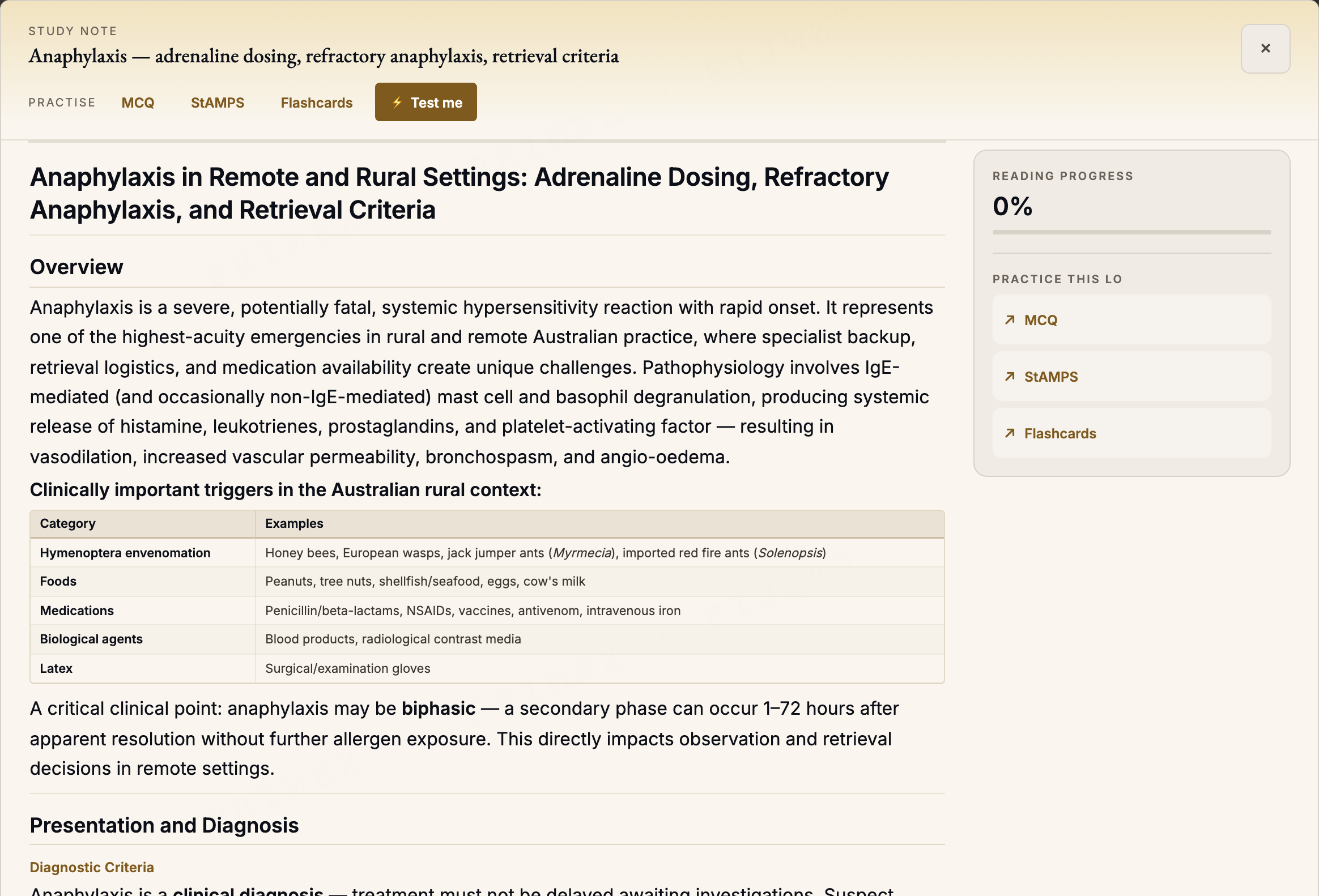
Sourced, structured study notes for all 112 topics in the ACRRM curriculum. Written to a consistent seven-section format with rural-specific management considerations throughout: retrieval thresholds, resource-limited investigations, and population-specific disease patterns for remote and ATSI communities.
- All 112 ACRRM curriculum topics across all 8 domains
- Rural context throughout: resource limitations, retrieval, RFDS
- Referenced to ACRRM curriculum, eTG, CARPA Standard Treatment Manual
- Full-text search across all notes
- Linked from MCQ explanations, station feedback, and flashcards
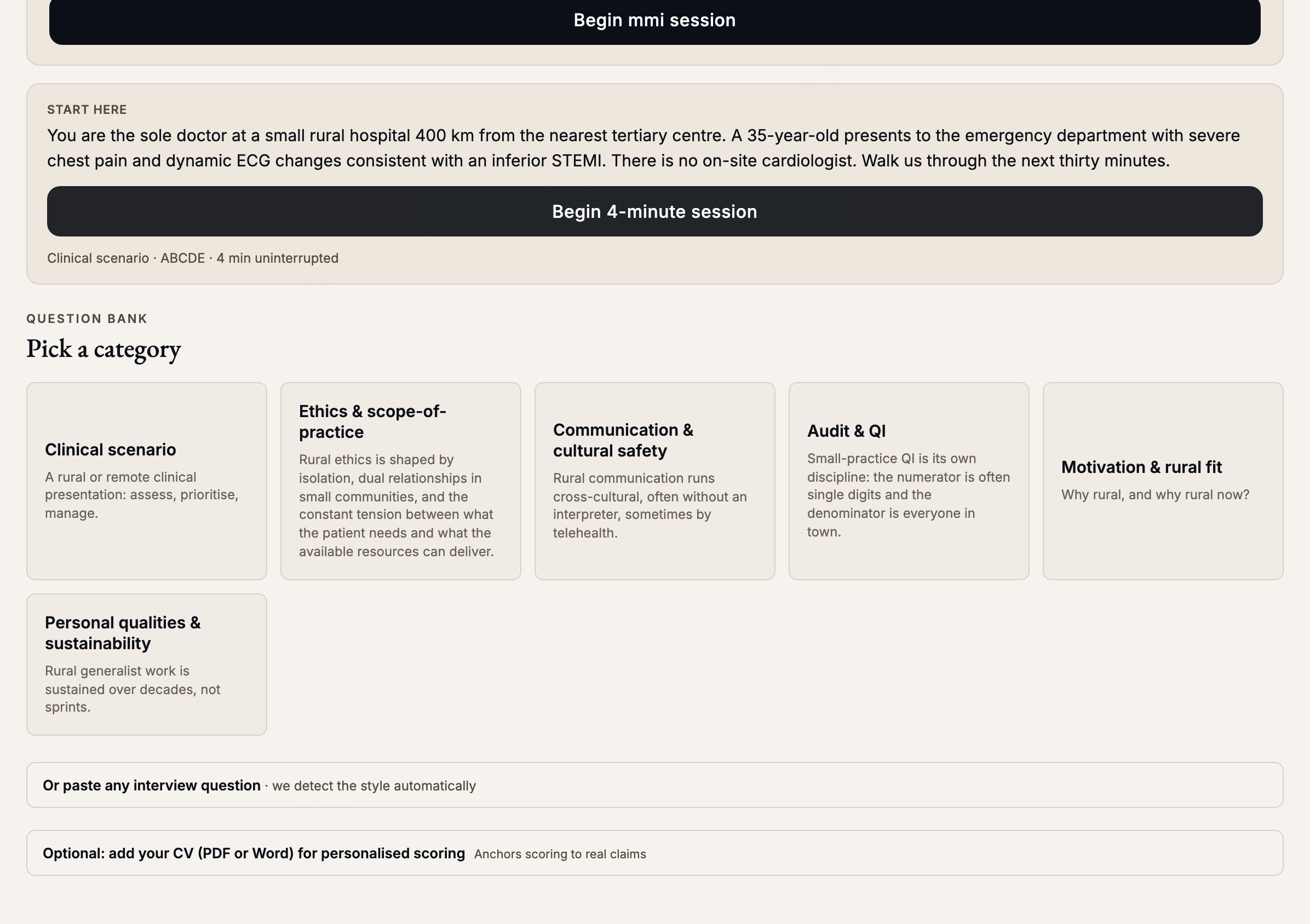
The ACRRM Fellowship training selection interview is a 6-station multiple mini-interview (MMI). Each station gives 2 minutes of reading time followed by 8 minutes of uninterrupted response. Stations are scored against ACRRM's published 8 Domains of Rural and Remote Practice on a 0-7 linear scale. PRIMEX replicates that format: pick a station, read the stem, then answer without prompting. At the end you receive a calibrated debrief covering rubric dimensions, named framework beats (STAR-FR, SPIES, PEARLS, PDSA, ABCDE, ISBAR) hit or missed, and a breakdown of which ACRRM Domains your answer demonstrated.
- 6-station MMI format matched to the ACRRM Fellowship training selection interview
- 2-minute reading time per station, 8 minutes of uninterrupted response
- Rubric scoring against Expert Medical Care, Medical Emergencies, Primary Care, Secondary Medical Care, Population Health, Aboriginal and Torres Strait Islander and Culturally Diverse Communities, Ethics and Professional Framework, and Geographic and Professional Isolation
- Framework beat checks: STAR-FR for behavioural stations, ABCDE for clinical emergencies, ISBAR for handover scenarios, SPIES for ethics, PDSA for audit and quality improvement questions
- Station library weighted toward rural-specific scenarios: low-resource emergencies, telehealth triage, scope-of-practice judgement, culturally safe consultation in remote communities
- Save your CV for grounded model answers tied to your own placements and experience
ACRRM Fellowship format and structure: MCQ and StAMPS
The ACRRM Fellowship examination (FACRRM) assesses competence in rural and remote generalist medicine through two summative exams. The MCQ paper is the written assessment, a multiple-choice test of applied medical knowledge across the curriculum. The Structured Assessment using Multiple Patient Scenarios (StAMPS) is the oral component: eight stations, each with a reading period and three structured examiner questions delivered orally via Zoom. Stations are set in rural and remote clinical contexts and assess clinical reasoning, procedural decision-making, and management under resource constraints. The Rural Generalist Curriculum spans 8 Domains of Rural and Remote Practice, from expert medical care and emergencies through population health, Aboriginal and Torres Strait Islander health, professional ethics, and geographic isolation. PRIMEX is built by Dr Jay Marshall, an anaesthetics registrar in Taree, NSW.
- OrganiserAustralian College of Rural and Remote Medicine (ACRRM)
- FormatMCQ written paper, plus the StAMPS oral assessment: 8 scenarios of 10 minutes each via Zoom, with reading time between scenarios and 3 structured examiner questions per scenario
- CurriculumRural Generalist Curriculum (v5.2): 8 Domains of Rural and Remote Practice, 61 competencies, mapped across 112 PRIMEX study-note topics
- SittingsTwice yearly, typically February and August
- Pass rate70.6% StAMPS overall in the most recent published sitting (2025B); 59-71% per sitting across 2024A, 2025B. Source: ACRRM Public Assessment Reports.
- Other pathway componentsCBD (Case-Based Discussion) - 6 cases across 3 x 1-hour assessor sessions; MSF (Multi-Source Feedback); MiniCEX (9 clinical observations); Procedural Skills Logbook. These workplace-based components are completed during training and are not assessable via PRIMEX.
- SourceFormat, terminology and pass-mark figures are taken from the official ACRRM curriculum at curriculum.acrrm.org.au and the ACRRM Public Assessment Reports.
Free notes are just the start.
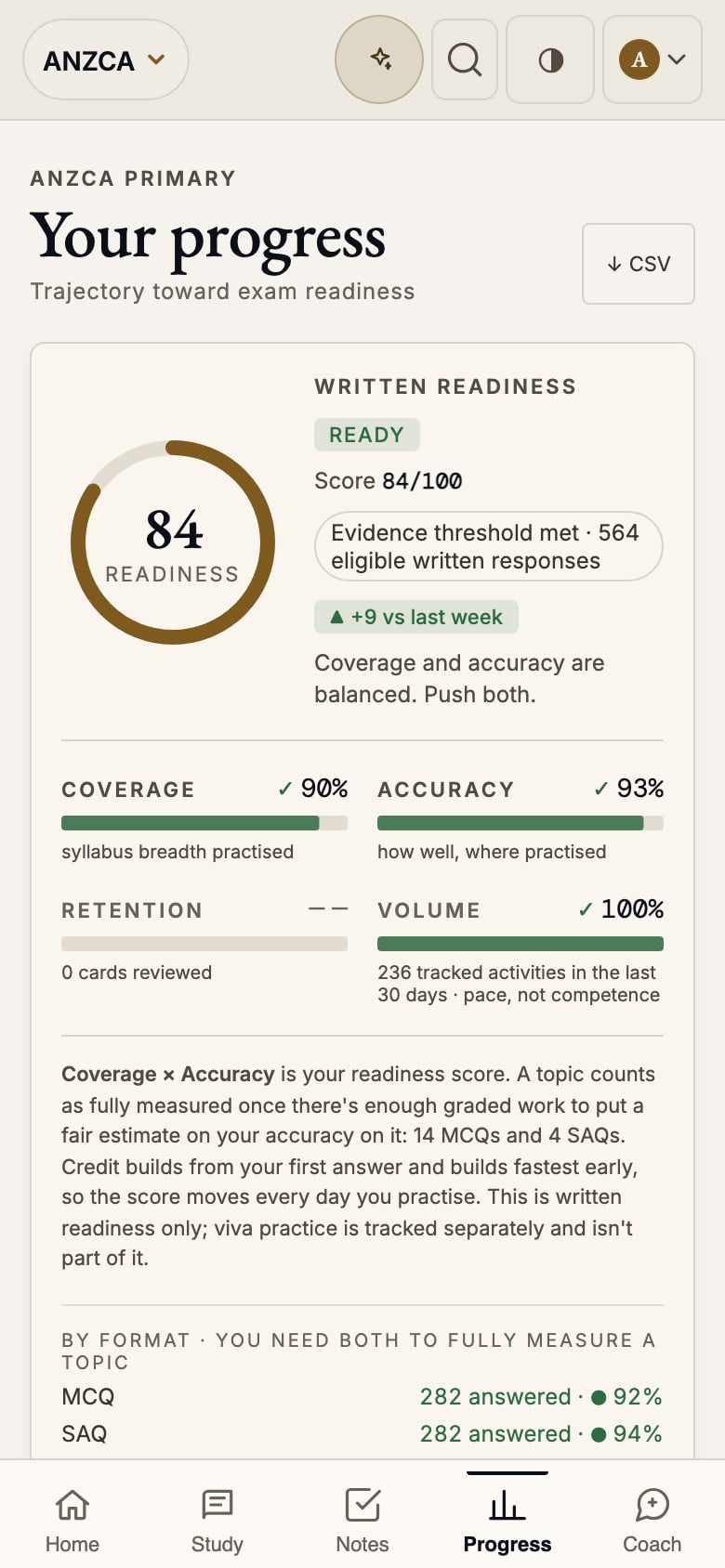
Get 112 study notes, 5,151 spaced-repetition flashcards, unlimited question practice and the full exam simulator. Free for 7 days, then from A$44.99/month.
Start free trial, 7 days free Cancel anytime · no commitmentCommon questions about the ACRRM Fellowship exam
Specialist pricing and 7-day free trial
Specialist unlocks every PRIMEX exam track: the specialist pathways, AMC and Medical Student. Every study tool is included, with no per-feature paywalls.
- ✓ Every exam track: specialist pathways, AMC & Medical Student
- ✓ Flashcards with spaced repetition & MCQ drill
- ✓ Study notes for every curriculum topic
- ✓ SAQ library & sessions
- ✓ Study plan with pace tracking
- ✓ Curriculum tracker & readiness insights
- ✓ Every exam track: specialist pathways, AMC & Medical Student
- ✓ Flashcards with spaced repetition & MCQ drill
- ✓ Study notes for every curriculum topic
- ✓ SAQ library & sessions
- ✓ Study plan with pace tracking
- ✓ Curriculum tracker & readiness insights
- ✓ Every exam track: specialist pathways, AMC & Medical Student
- ✓ Flashcards with spaced repetition & MCQ drill
- ✓ Study notes for every curriculum topic
- ✓ SAQ library & sessions
- ✓ Study plan with pace tracking
- ✓ Curriculum tracker & readiness insights
You'll land on a confirmation page. Tap the sign-up button (or sign in if you already have an account) and your subscription links automatically. If you close the page first, just use the same email when you sign up and it'll still link.