
Built by an anaesthetics registrar in regional Australia.
CICM First Part
mastered.
267 sourced study notes across 267 learning objectives and 8,305 spaced-repetition flashcards across the CICM First Part curriculum. AI SAQ grading on the Fail / Borderline / Pass / Distinction tier, a cross-table viva simulator, and an unlimited MCQ library. Built around the four domains of the First Part.
Your PRIMEX account, now in your pocket.
Specialist unlocks every PRIMEX exam track. Accessible is limited to AMC and Medical Student. Subscribe on the website or in the iPhone app, then use the same account to keep your access and progress together.
CICM First Part Exam Dates 2026-2027
Published dates for the upcoming sittings. Always confirm against the official CICM First Part Examination page before scheduling. I refresh this section quarterly as new windows are announced.
- Application Window, Sitting 16-20 Jan 2026 (online)
- Written Section, Sitting 125 Feb 2026 (various AU/NZ cities)
- Oral Section, Sitting 129-30 Apr 2026 (Melbourne)
- Application Window, Sitting 29-23 Jun 2026 (online)
- Written Section, Sitting 25 Aug 2026 (various AU/NZ cities)
- Oral Section, Sitting 214-15 Oct 2026 (Melbourne)
- Application Window, 2027 Sitting 16-20 Jan 2027 (online)
- Written Section, 2027 Sitting 124 Feb 2027 (various AU/NZ cities)
- Oral Section, 2027 Sitting 15-6 May 2027 (Melbourne)
- Application Window, 2027 Sitting 29-23 Jun 2027 (online)
- Written Section, 2027 Sitting 228 Jul 2027 (various AU/NZ cities)
- Oral Section, 2027 Sitting 213-14 Oct 2027 (Melbourne)
Written sections may be sat in various AU and Aotearoa NZ cities; oral sections are generally Melbourne. Updated First Part Syllabus (Fifth Edition) is active from the 2026.2 sitting.
Inside PRIMEX, in under a minute
Recorded in the app, with real CICM First Part questions and notes. No sound needed to follow it.
Topics tested in the CICM First Part exam
How candidates prepare for the CICM First Part
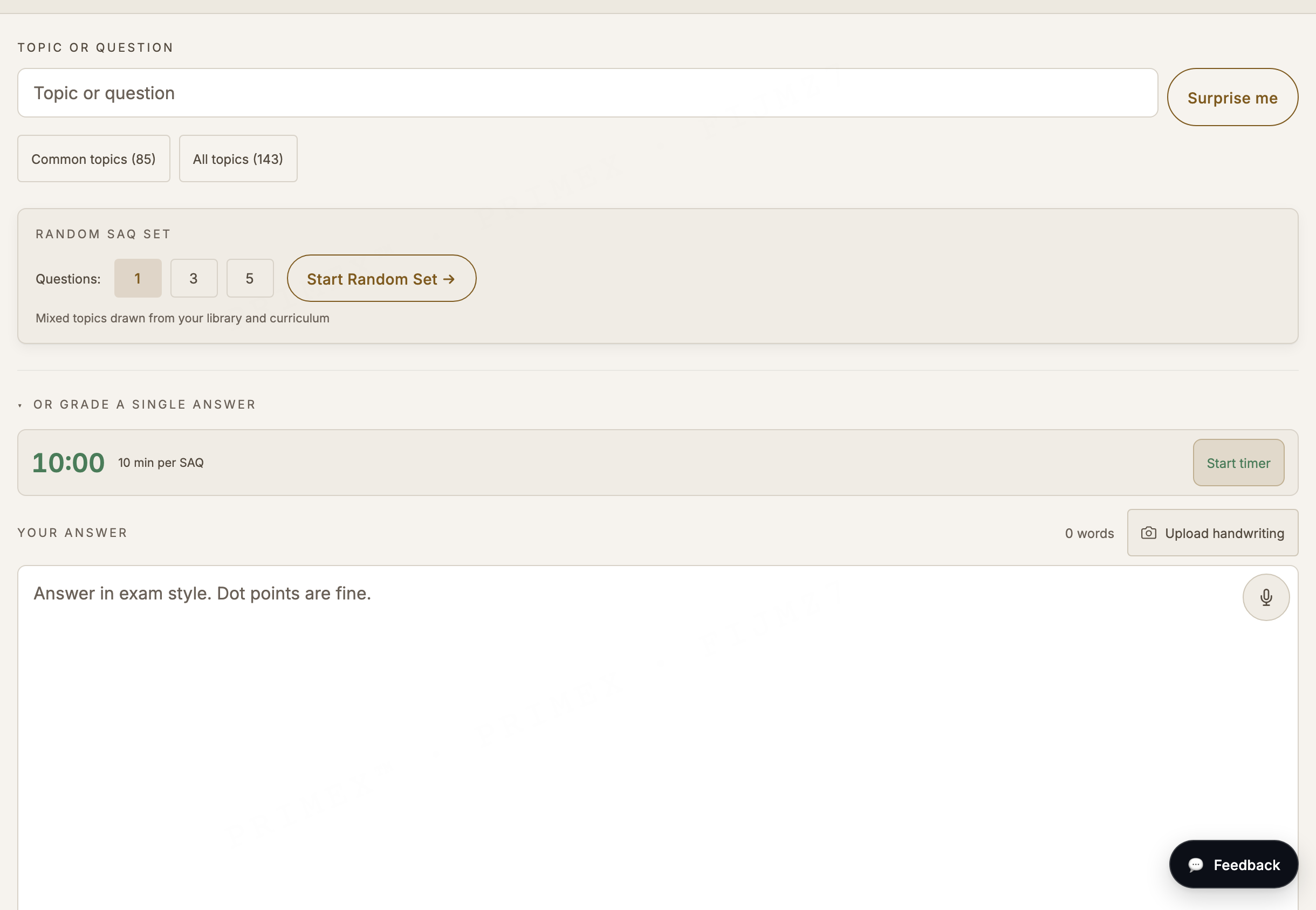
Write a First Part SAQ and get an examiner-style debrief: tier (Fail / Borderline / Pass / Distinction), score estimate out of 20, a marking checklist with every point flagged as hit or missed, an examiner comment, and a full model answer. Written to the standard of CICM exam reports.
- Fail / Borderline / Pass / Distinction tier with score out of 20
- Every marking point checked against CICM examiner report themes
- Model answer with specific values, normal ranges, and ICU application
- Topic sessions or random sets from the question library
- AI question generation in First Part SAQ format
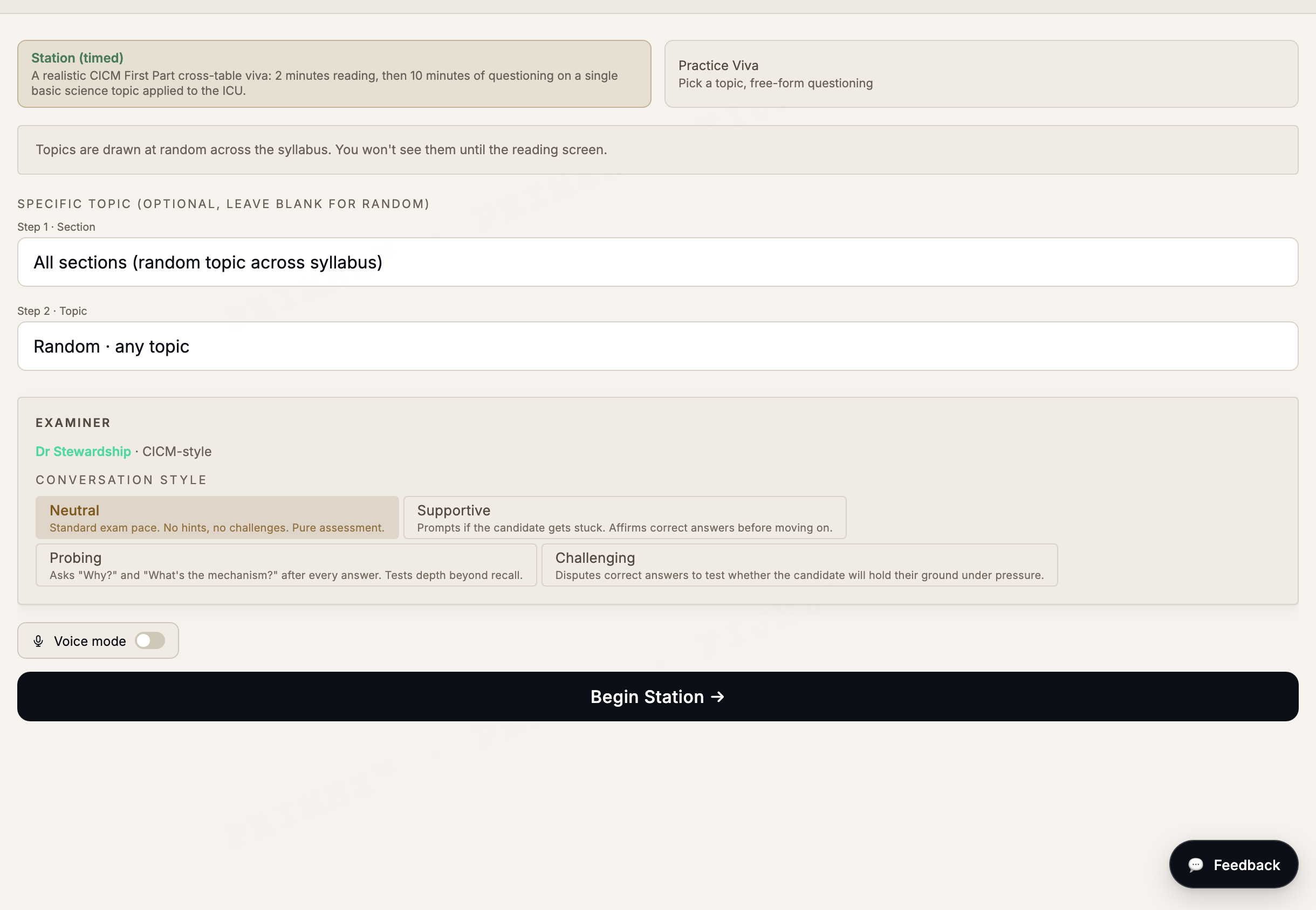
Runs sessions in First Part cross-table viva format: 2-minute reading time on a single basic science topic, then 10 minutes of ICU-applied probing with a structured debrief. Voice mode transcribes spoken answers using medical speech recognition.
- Timed cross-table format: 2 min reading, 10 min viva on one topic
- ICU-specific follow-ups: sepsis, ARDS, organ failure scenarios
- Voice mode: speak your answer, no typing needed
- Debrief with tier, strengths, gaps, and key learning after each session
- Covers all physiology, pharmacology, and measurement topics
Work through a full mock viva out loud with this college's AI examiner, in real time. Answer by voice, get probed and interrupted like you would in the real viva, then step out to a graded debrief: how you performed on the station, the topics you covered, your strengths and gaps, and how you handled the pressure. Every mock viva feeds your weak-topic plan, so what to practise next is always clear.
- Real-time spoken viva in this college's examiner voice, fully interruptible
- Graded debrief on every station: your performance tier, the topics you covered, and the gaps to close
- Communication and composure feedback: pacing, hesitation, clarity under pressure
- Weak topics flow straight into your study plan and daily practice
- Part of PRIMEX Pro, with monthly mock vivas included
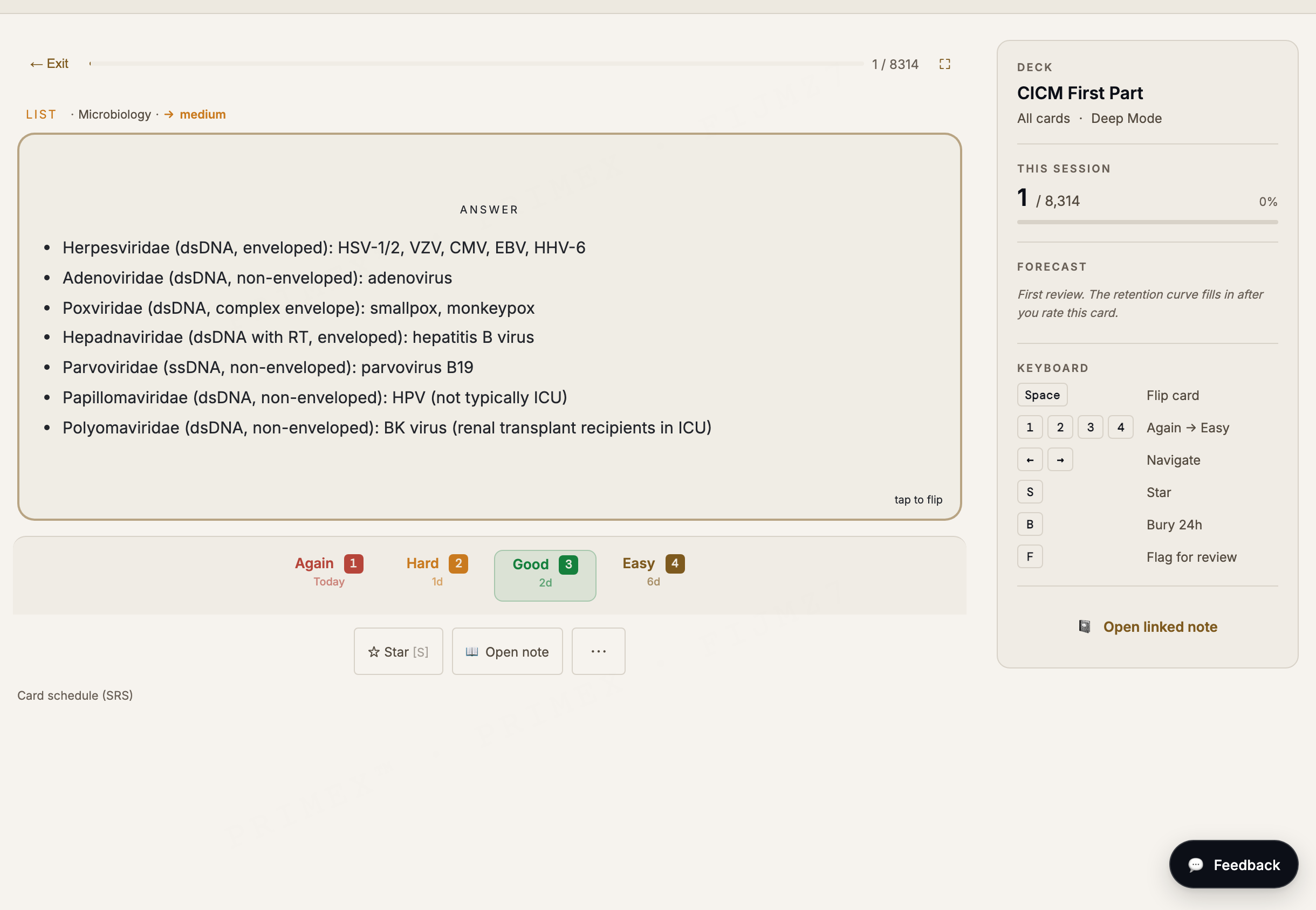
8,305 curriculum-mapped flashcards across the CICM First Part curriculum, with spaced repetition: cards you get right come up less often, cards you miss come back sooner. Card types include mechanism, drug profile, pharmacokinetics, normal values, and ICU clinical correlates.
- 8,305 cards across all four First Part domains
- Card types: mechanism, PK/PD, normal values, drug comparison, equations
- MCQ drill mode for rapid-fire practice
- One click from card to full study note
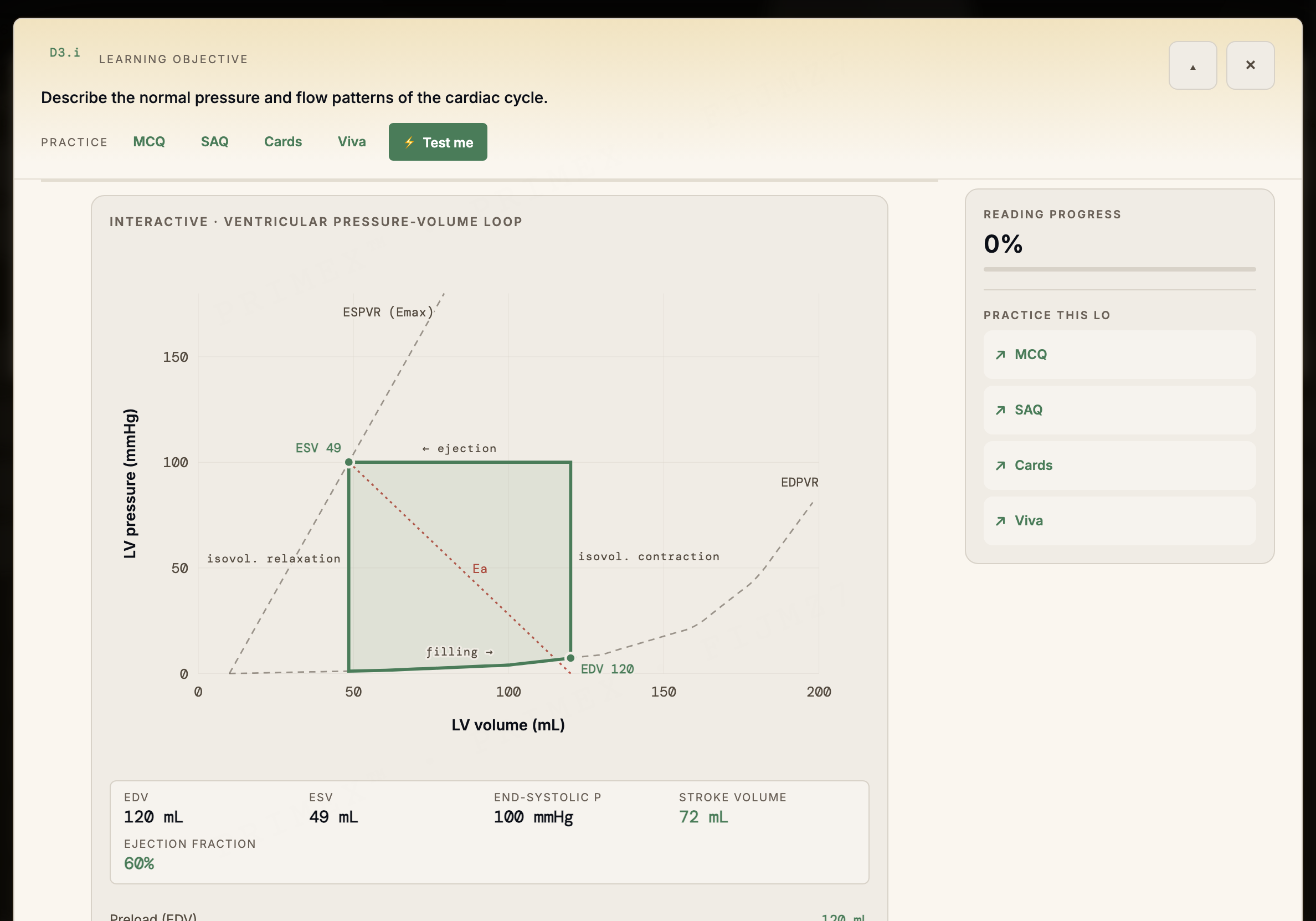
- Image cards: pressure-volume loops, waveforms, pharmacokinetic curves
267 sourced study notes across the CICM First Part curriculum, covering the 267 learning objectives mapped across 19 sections. Written to a consistent seven-section format and aligned to the published CICM First Part curriculum, Australian guidelines and primary literature. They surface automatically alongside SAQ and viva debriefs.
- 267 study notes covering 267 LOs across 19 sections
- Consistent 7-section structure: scannable, not a wall of text
- Aligned to the published CICM First Part curriculum and Australian guidelines
- Full-text search across all notes
- Linked from SAQ debrief, viva feedback, and flashcards
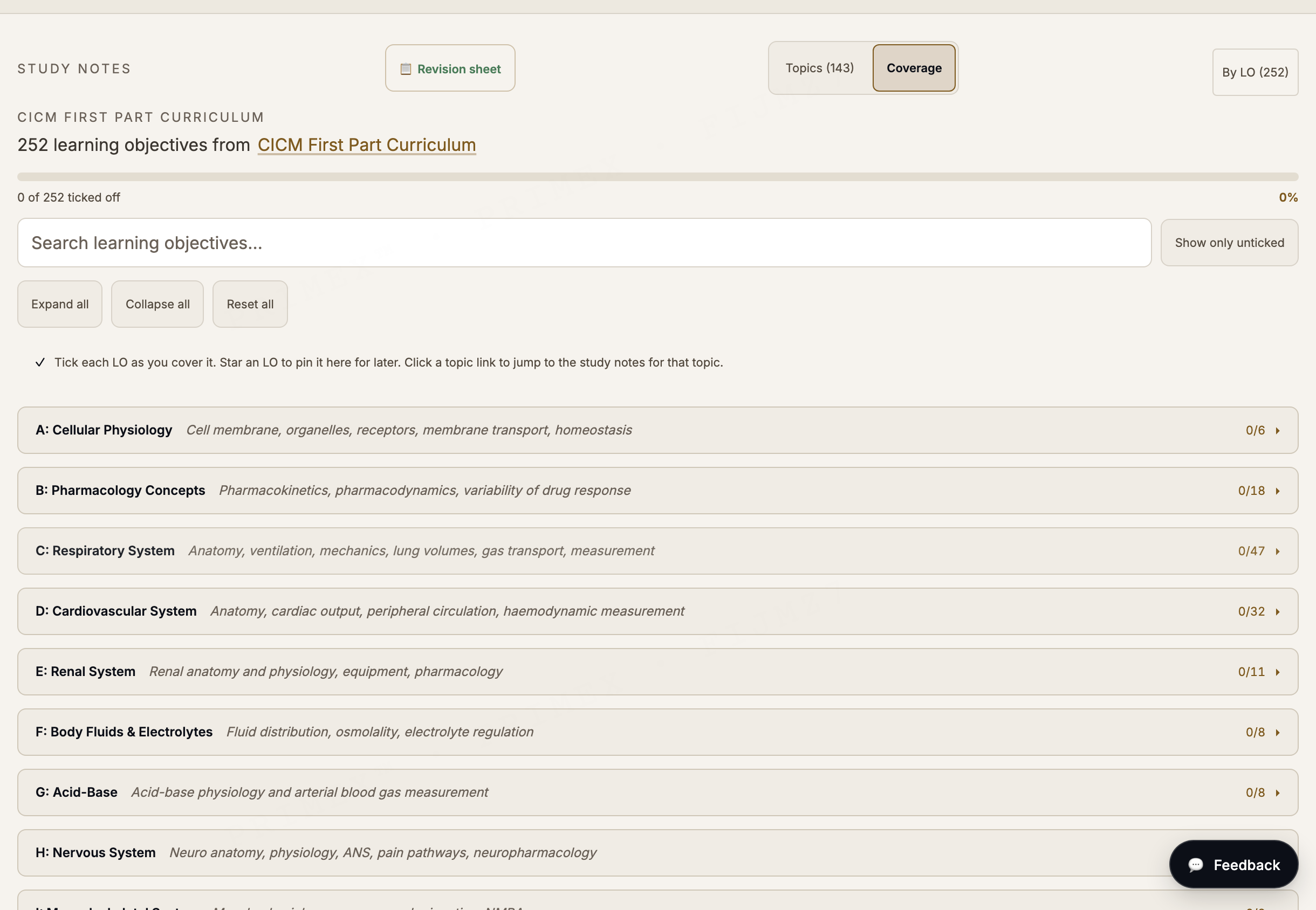
The CICM First Part curriculum defines 267 learning objectives across 19 sections. PRIMEX maps every LO to the study notes and flashcards that cover it, with a Curriculum tab showing a checkbox checklist and progress bar so you know exactly how much of the syllabus you've covered.
- All 267 CICM First Part LOs across 19 sections
- Checkbox completion persisted across sessions
- Click any LO to jump directly to the relevant study note
- Per-section and overall progress bars at a glance
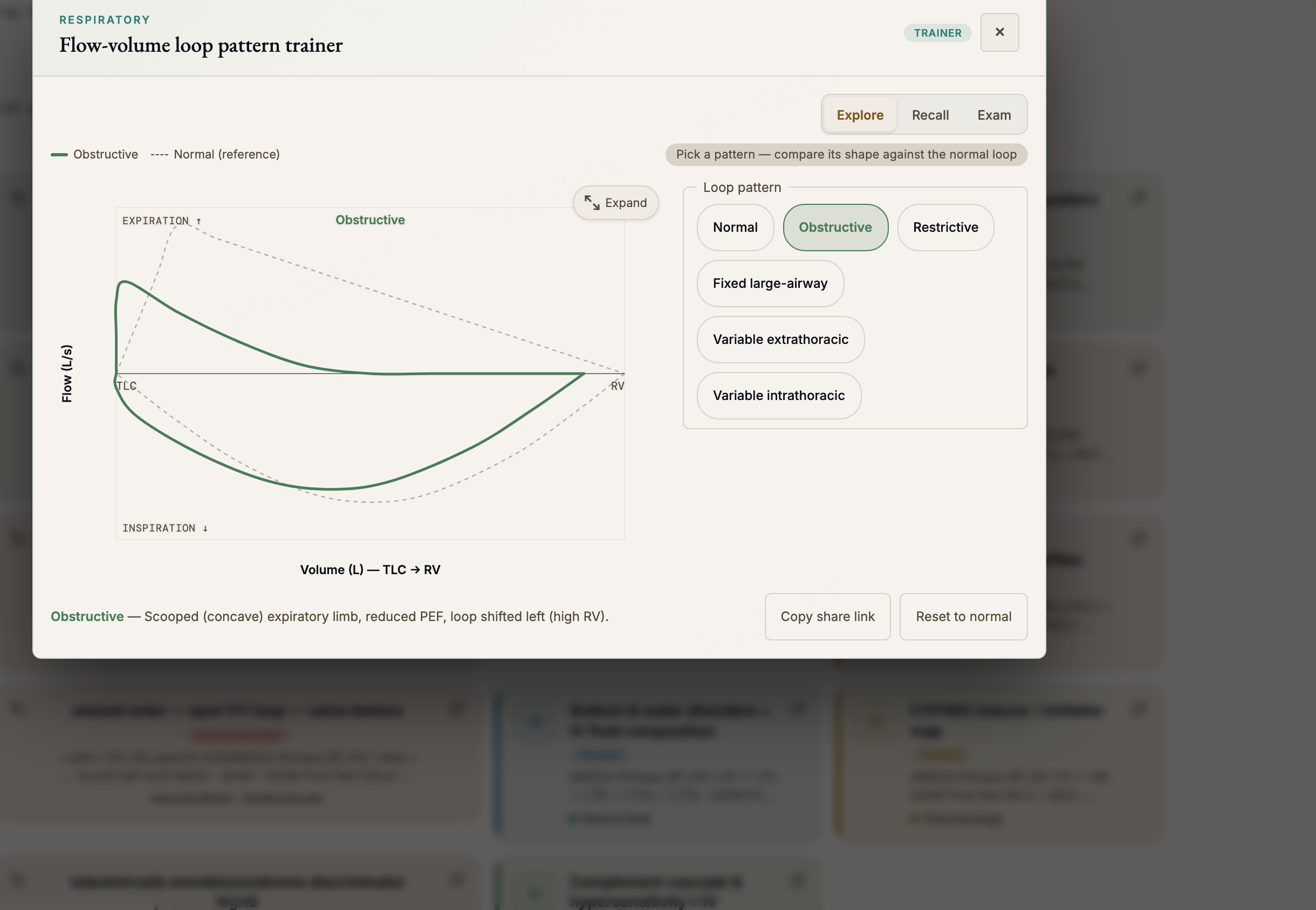
Interactive, active-recall trainers built for the physics and physiology the First Part leans on. Tap and drag the live model (flow-volume loops, ventricular pressure-volume loops, ABG interpretation, the oxygen cascade, vasopressor and inotrope selection) and watch the traces, values, and interpretation update in real time, then test yourself in Recall and Exam modes.
- Trainers across respiratory, cardiovascular, acid-base, and pharmacology
- Flow-volume loops, PV loops, ABG, and the oxygen cascade
- Explore freely, then test recall against the model in Recall and Exam modes
- Embedded directly in the matching study notes
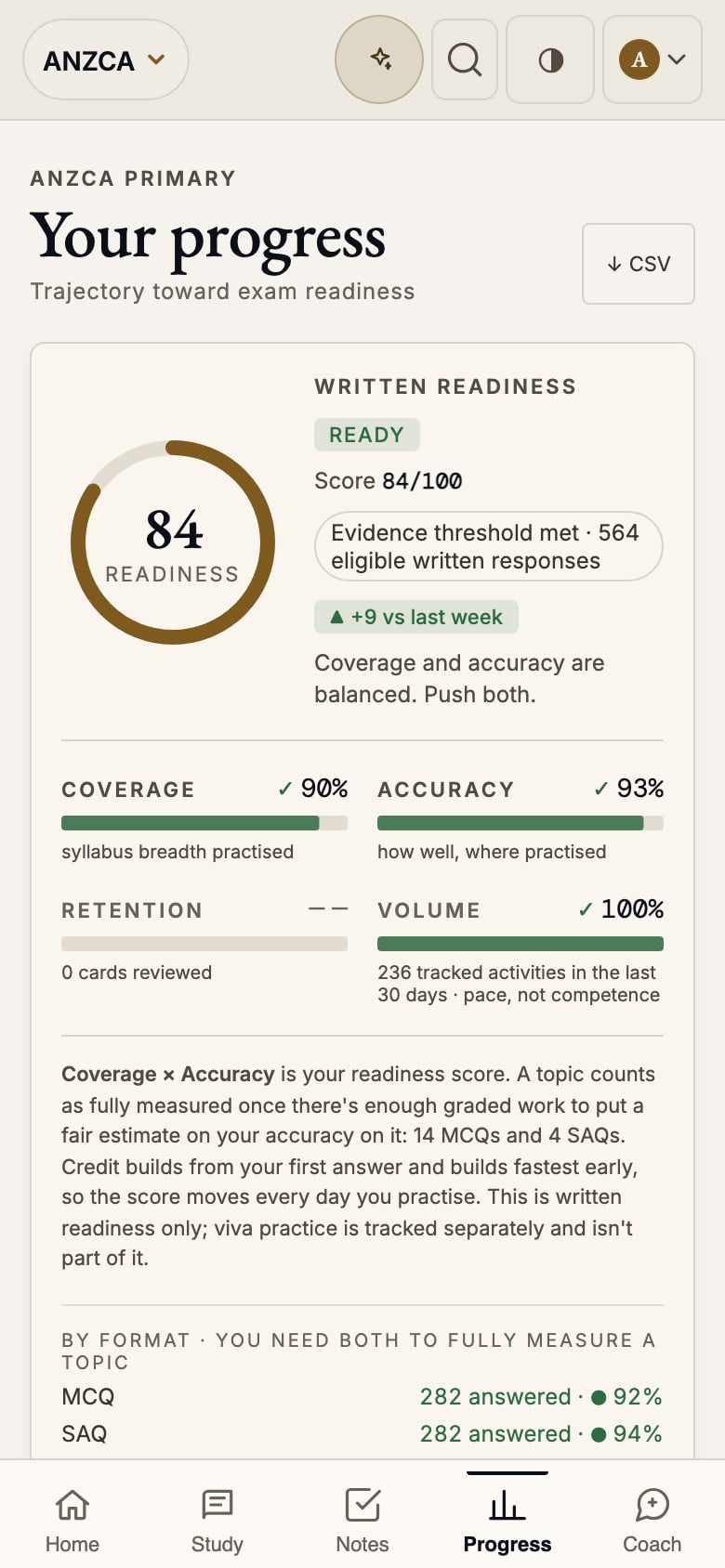
An adaptive study plan counts down to your CICM First Part exam date and tells you what to study next. The written-readiness score combines eligible syllabus coverage with accuracy from recognised written results. Activity pace and supplemental practice are shown separately and do not change the score.
- Days-to-exam countdown and pace tracking, ahead or behind
- Written-readiness score backed by eligible written assessments
- Coverage and accuracy broken out with evidence context
- Activity pace and weekly target shown separately from readiness
- Study this next: the topic queued for today, one tap to open
CICM First Part format and structure: MCQ, SAQ and viva
The CICM First Part Examination tests the scientific foundations of intensive care medicine: physiology, pharmacology, and clinical measurement. It is the gateway to the Fellowship examination and to advanced ICU training. The exam sits twice yearly; CICM publishes per-sitting examiner reports with component pass marks rather than a single headline figure (for example, the 2025.2 sitting set the MCQ pass mark at 65% and the SAQ pass mark at 47.81%, with about 45% of candidates successful overall). PRIMEX is built by Dr Jay Marshall, an anaesthetics registrar in Taree, NSW.
- OrganiserCollege of Intensive Care Medicine of Australia and New Zealand (CICM)
- FormatWritten section of two 2.5-hour papers, each 50 MCQs + 10 SAQs (100 MCQs + 20 SAQs total); the MCQ section has its own Angoff pass mark and must be passed to progress to the orals, which are 8 cross-table vivas of 10 min each
- DomainsPhysiology (~55%), Pharmacology (~25%), Measurement & Equipment (~10%), Microbiology & Research (~10%)
- SittingsTwice yearly, typically March and September
- Pass rateCICM publishes per-sitting examiner reports with component pass marks (2025.2: MCQ 65%, SAQ 47.81%, oral 59.2%; ~45% of candidates successful overall). There is no single headline figure
Practice every topic with the same AI grader the in-app uses
Five high-yield learning objectives. Free MCQ practice, graded against college-standard marking points. No signup needed.
Anti-Arrhythmic Drugs - CICM First Part Study Notes
Anti-arrhythmic drugs are classified by the Singh-Vaughan Williams system based on their primary electrophysiological mechanism.
Drug Interactions: Classification and Mechanisms
Drug interactions are ubiquitous in the ICU.
Neuromuscular Junction: Structure and Physiology
The neuromuscular junction (NMJ) is the highly specialised synapse between a motor neuron and a skeletal muscle fibre.
Liked those five? That's a sliver of what's inside.
Get 267 study notes, 8,305 spaced-repetition flashcards, unlimited question practice and the full exam simulator. Free for 7 days, then from A$44.99/month.
Start free trial, 7 days free Cancel anytime · no commitmentCommon questions about the CICM First Part exam
Specialist pricing and 7-day free trial
Specialist unlocks every PRIMEX exam track: the specialist pathways, AMC and Medical Student. Every study tool is included, with no per-feature paywalls.
- ✓ Every exam track: specialist pathways, AMC & Medical Student
- ✓ Flashcards with spaced repetition & MCQ drill
- ✓ Study notes for every curriculum topic
- ✓ SAQ library & sessions
- ✓ Study plan with pace tracking
- ✓ Curriculum tracker & readiness insights
- ✓ Every exam track: specialist pathways, AMC & Medical Student
- ✓ Flashcards with spaced repetition & MCQ drill
- ✓ Study notes for every curriculum topic
- ✓ SAQ library & sessions
- ✓ Study plan with pace tracking
- ✓ Curriculum tracker & readiness insights
- ✓ Every exam track: specialist pathways, AMC & Medical Student
- ✓ Flashcards with spaced repetition & MCQ drill
- ✓ Study notes for every curriculum topic
- ✓ SAQ library & sessions
- ✓ Study plan with pace tracking
- ✓ Curriculum tracker & readiness insights
You'll land on a confirmation page. Tap the sign-up button (or sign in if you already have an account) and your subscription links automatically. If you close the page first, just use the same email when you sign up and it'll still link.