
Built by an anaesthetics registrar in regional Australia.
CICM Fellowship
consultant-ready.
139 sourced study notes and 4,587 spaced-repetition flashcards across the CICM Second Part curriculum (139 LOs). AI SAQ grading at consultant standard, a hot case simulator, and a structured oral viva simulator with voice mode. Built for the Second Part.
Your PRIMEX account, now in your pocket.
Specialist unlocks every PRIMEX exam track. Accessible is limited to AMC and Medical Student. Subscribe on the website or in the iPhone app, then use the same account to keep your access and progress together.

CICM Fellowship (Second Part) Exam Dates 2026-2027
Published dates for the upcoming sittings. Always confirm against the official CICM Second Part Examination page before scheduling. I refresh this section quarterly as new windows are announced.
- Application Window, Sitting 16-20 Jan 2026 (online)
- Written Section, Sitting 111 Mar 2026 (various AU/NZ cities)
- Oral Section, Sitting 118-22 May 2026 (Sydney) + 26 May TBC (Canberra or Newcastle, hot-cases)
- Application Window, Sitting 29-23 Jun 2026 (online)
- Written Section, Sitting 219 Aug 2026 (various AU/NZ cities)
- Oral Section, Sitting 228-30 Oct 2026 (Melbourne) + 4 Nov TBC (Adelaide, hot-cases)
- Written Section, 2027 Sitting 110 Mar 2027 (various AU/NZ cities)
- Oral Section, 2027 Sitting 119-21 May 2027 (Brisbane) + 25 May backup clinical day
- Written Section, 2027 Sitting 218 Aug 2027 (various AU/NZ cities)
- Oral Section, 2027 Sitting 227-29 Oct 2027 (Sydney) + 3 Nov backup (Canberra)
Two-city hot-cases model may apply for the oral section depending on candidate numbers. Confirmation lands with written-section results.
Inside PRIMEX, in under a minute
Recorded in the app, with the real CICM Second Part surfaces. No sound needed to follow it.
Topics tested in the CICM Second Part exam
How candidates prepare for the CICM Second Part
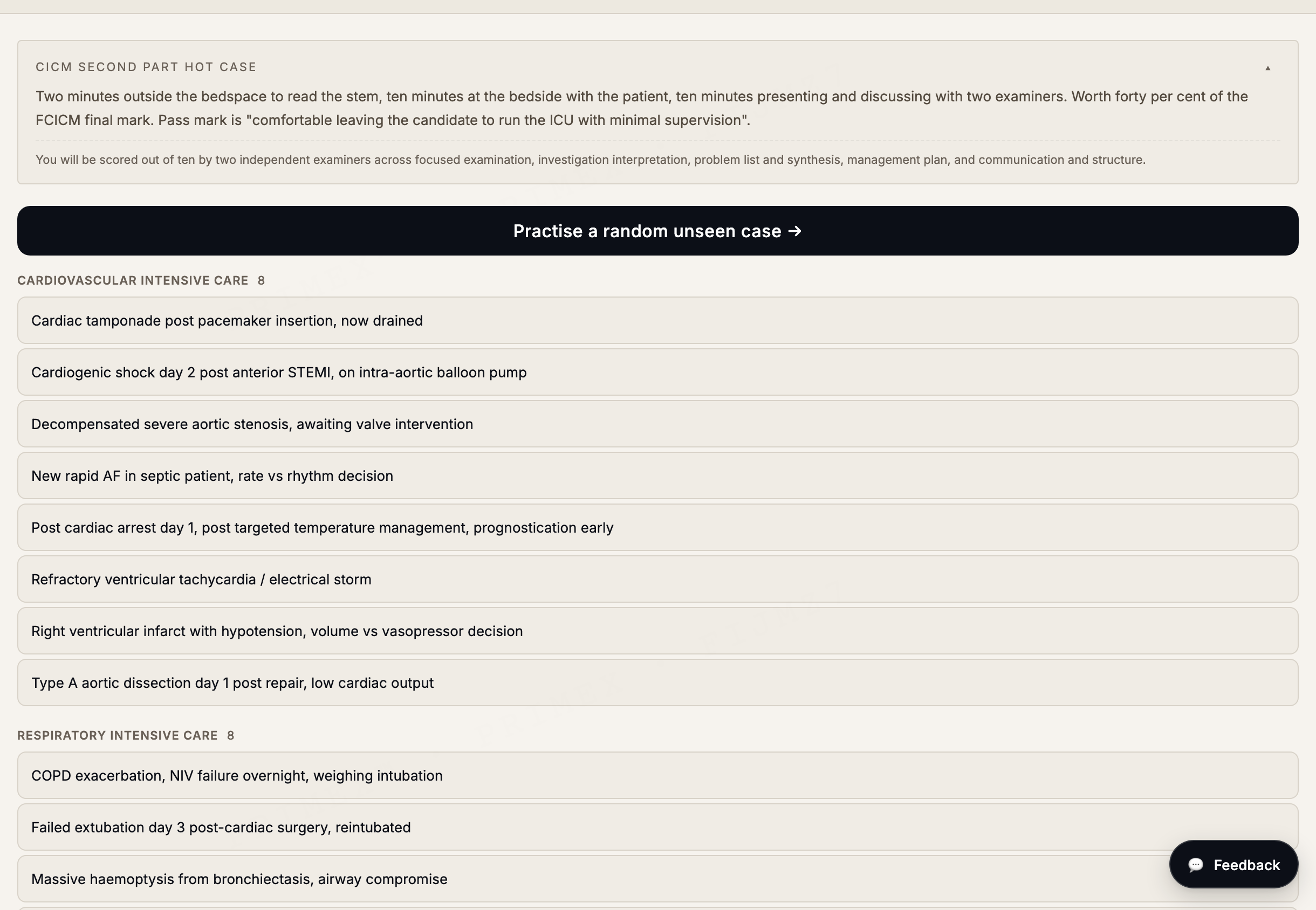
The clinical hot cases sit at the heart of the oral section: to pass the orals you need at least half of the oral marks and no severe fail in the Clinical component, so a weak hot case can end an otherwise strong attempt. PRIMEX runs the full 20-minute format: 2 minutes outside the bedspace reading a written stem, 10 minutes at the bedside performing a focused examination, then 10 minutes presenting to two examiners. The AI plays the patient with documented findings revealed only when you ask for the specific manoeuvre or piece of data, then switches to examiner role for the discussion. Scored independently by two examiners out of ten using the supervision-anchored scale: five out of ten is "comfortable leaving the candidate to run the ICU with minimal supervision".
- 46 hand-authored cases across 9 ICU domains: respiratory and ventilation, cardiovascular, sepsis and infection, neurocritical care, renal and metabolic, trauma and surgical, toxicology, obstetric critical care, endocrine
- 2-minute stem, 10-minute bedside, 10-minute discussion timers enforced on screen
- Bedside reveal-on-ask: state a specific manoeuvre and you get the documented finding, nothing more. Vague requests get pushed back, like a real examiner
- Investigations released individually on request: vent settings, ABG, CXR, echo, bloods, microbiology, fluid balance
- Discussion phase probes problem list, management plan, escalation triggers, drug doses, complications, ethics
- Debrief: two examiner scores out of 10 with independent rationales, anchored rationale across all five marking domains, list of common pitfalls actually hit, single most important learning point
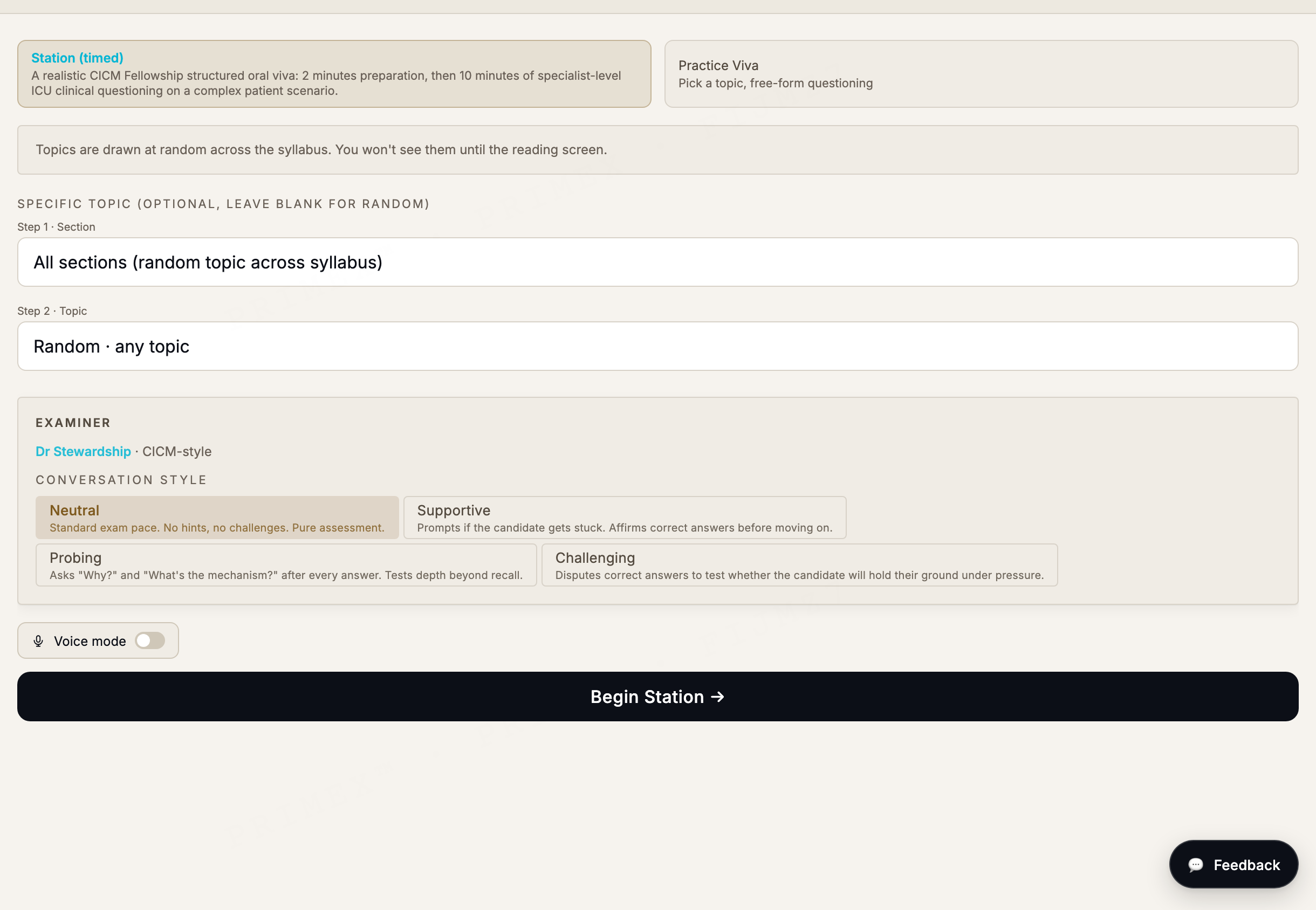
Runs sessions in FCICM oral exam format: clinical scenario opening, prioritised management probing, integration across organ systems. Expects consultant-level responses with specific drug doses, targets, and awareness of ethical dimensions. Voice mode available so you can practise speaking the answer, not typing it.
- FCICM oral format with consultant-level examiner persona
- Opens on a clinical ICU scenario, then probes management priorities
- Expects doses, MAP targets, KDIGO staging, and landmark trial names
- Voice mode: speak your answers, no typing needed
- Debrief flags missing ethics, complication management, and MDT components
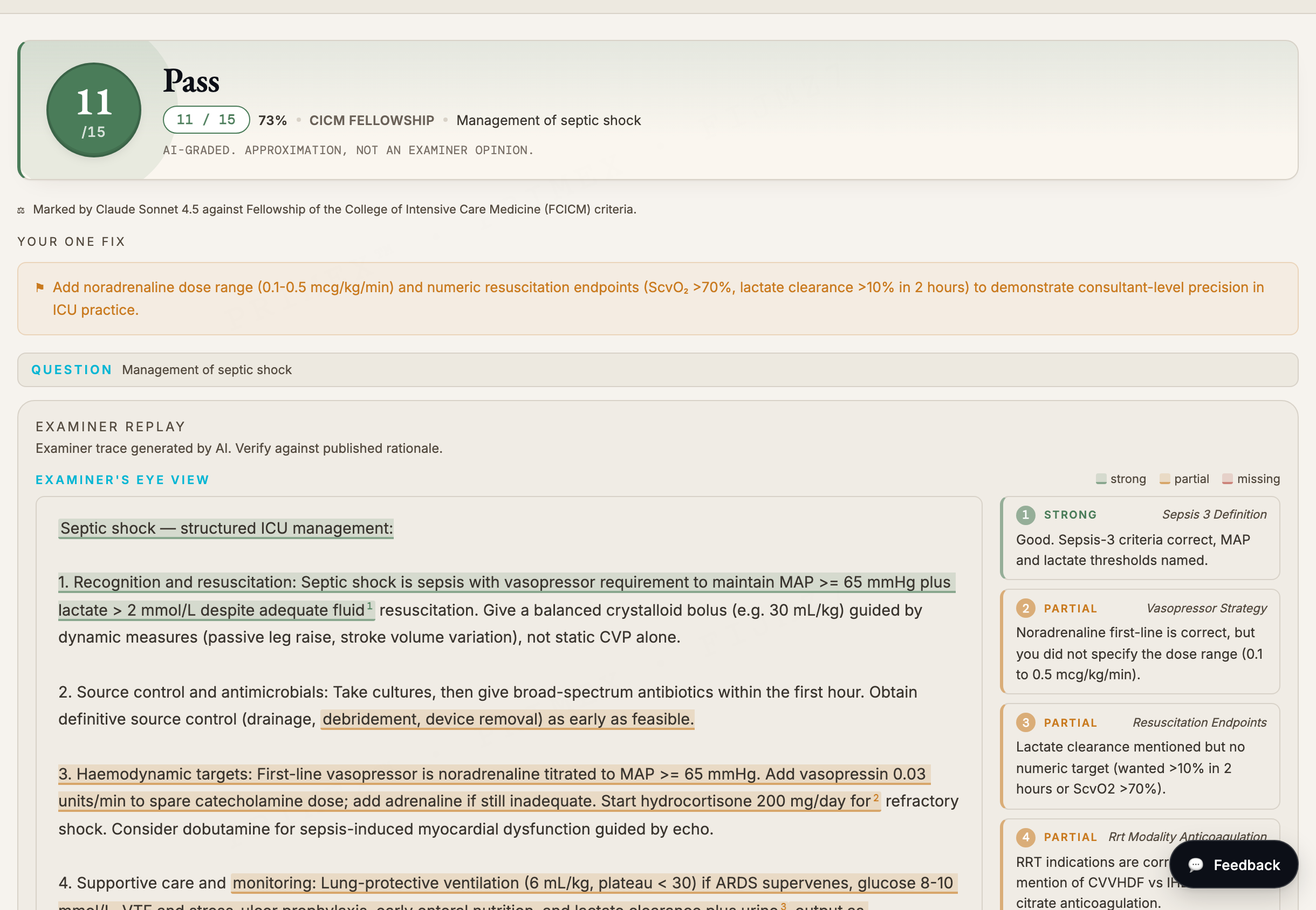
Write a Fellowship SAQ and get specialist-level feedback: tier (Fail, Borderline, Pass, Distinction), a marking checklist, an examiner comment written in the style of CICM Fellowship reports, and a model answer demonstrating consultant-level ICU reasoning with specific drug doses, targets, and management hierarchies.
- Fail, Borderline, Pass, or Distinction tier at specialist depth
- Marking points include doses, targets, monitoring, and complication management
- Model answer with drug dosing, infusion rates, and management hierarchy
- Flags missing ethical and communication components, which examiners penalise
- References landmark ICU trial evidence where relevant
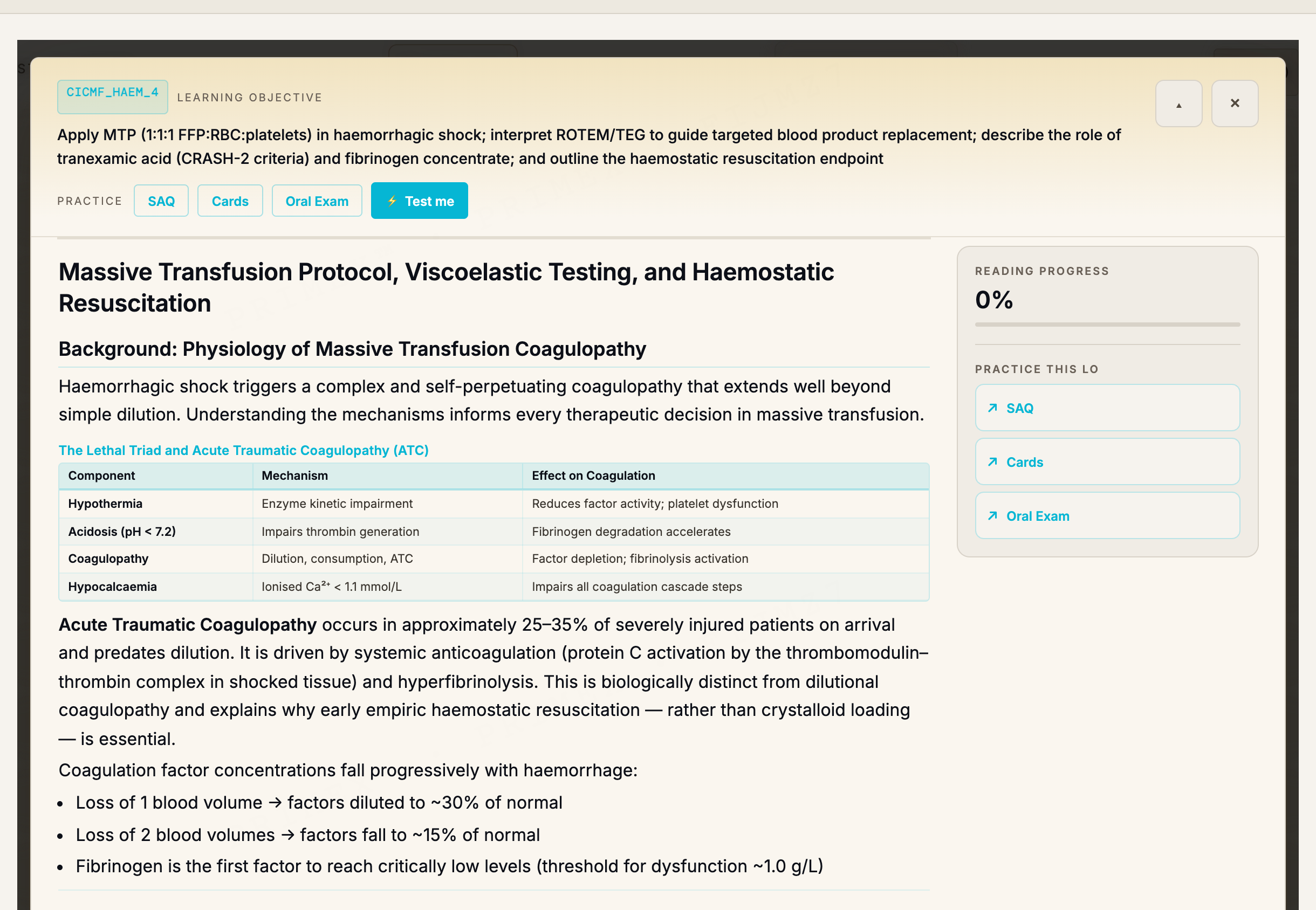
139 sourced study notes across the Second Part curriculum, one for every covered learning objective. Consistent seven-section format, referenced to landmark trial evidence and current guidelines. Notes surface automatically alongside SAQ, hot case, and oral exam debriefs, so you move from feedback to the relevant note in one click.
- 139 study notes across the Second Part curriculum, one per covered LO
- Consistent 7-section structure: scannable, not a wall of text
- Landmark trial evidence cited by acronym (ARISE, ARDSNet, NICE-SUGAR, PROSEVA, EOLIA, ACURASYS)
- Full-text search across all notes
- Linked from SAQ debrief, oral exam feedback, and flashcards
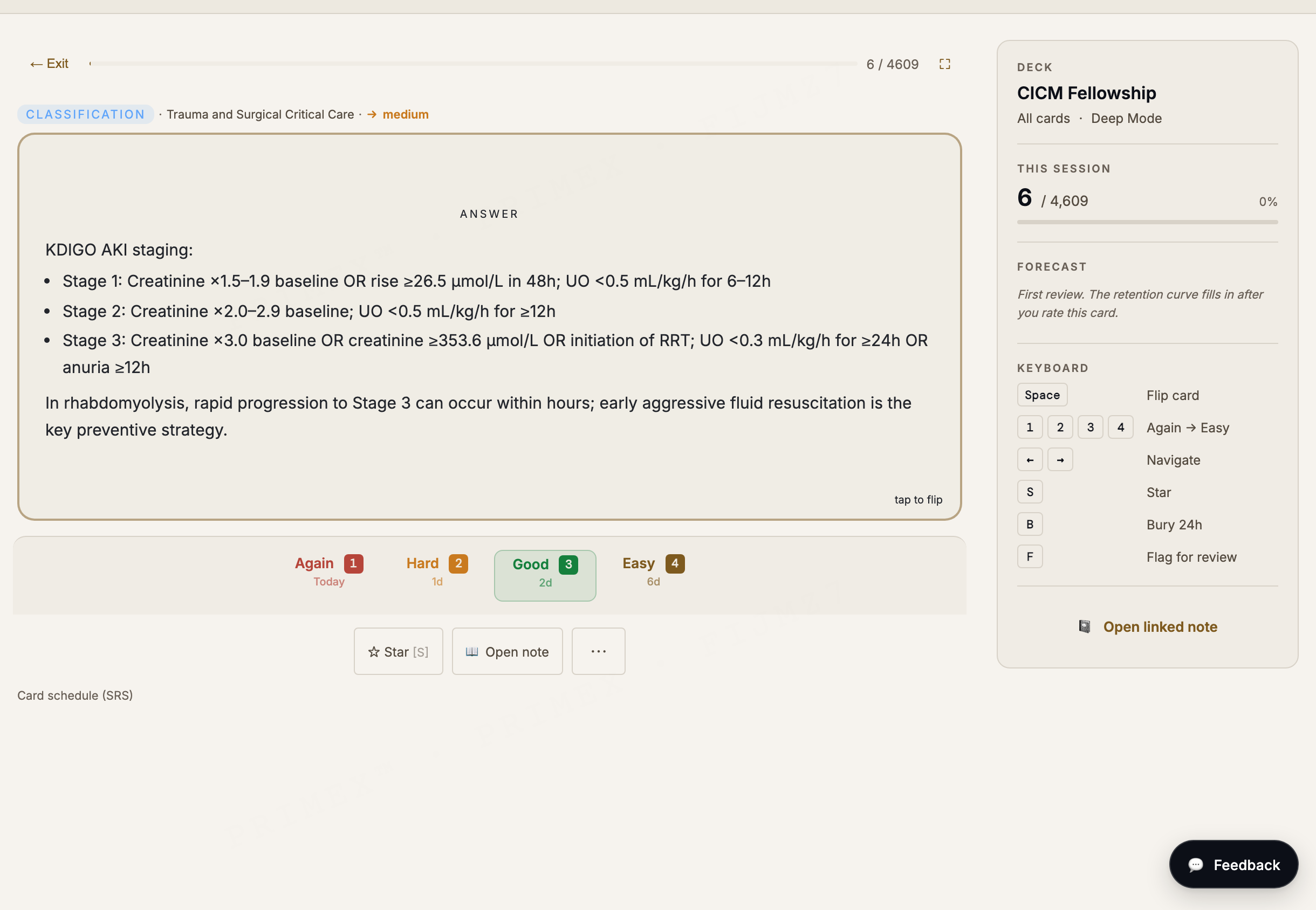
4,587 Fellowship-level flashcards with spaced repetition. Card types include management algorithm, drug dosing, guideline threshold, landmark trial, clinical decision, and ethics framework. Review what you're forgetting, not what you already know.
- 4,587 cards with spaced repetition: review what you're forgetting, not what you know
- Card types: management algorithm, drug dosing, guideline threshold, trial evidence
- Ethics and communication framework cards for end-of-life topics
- One click from any card to the full study note
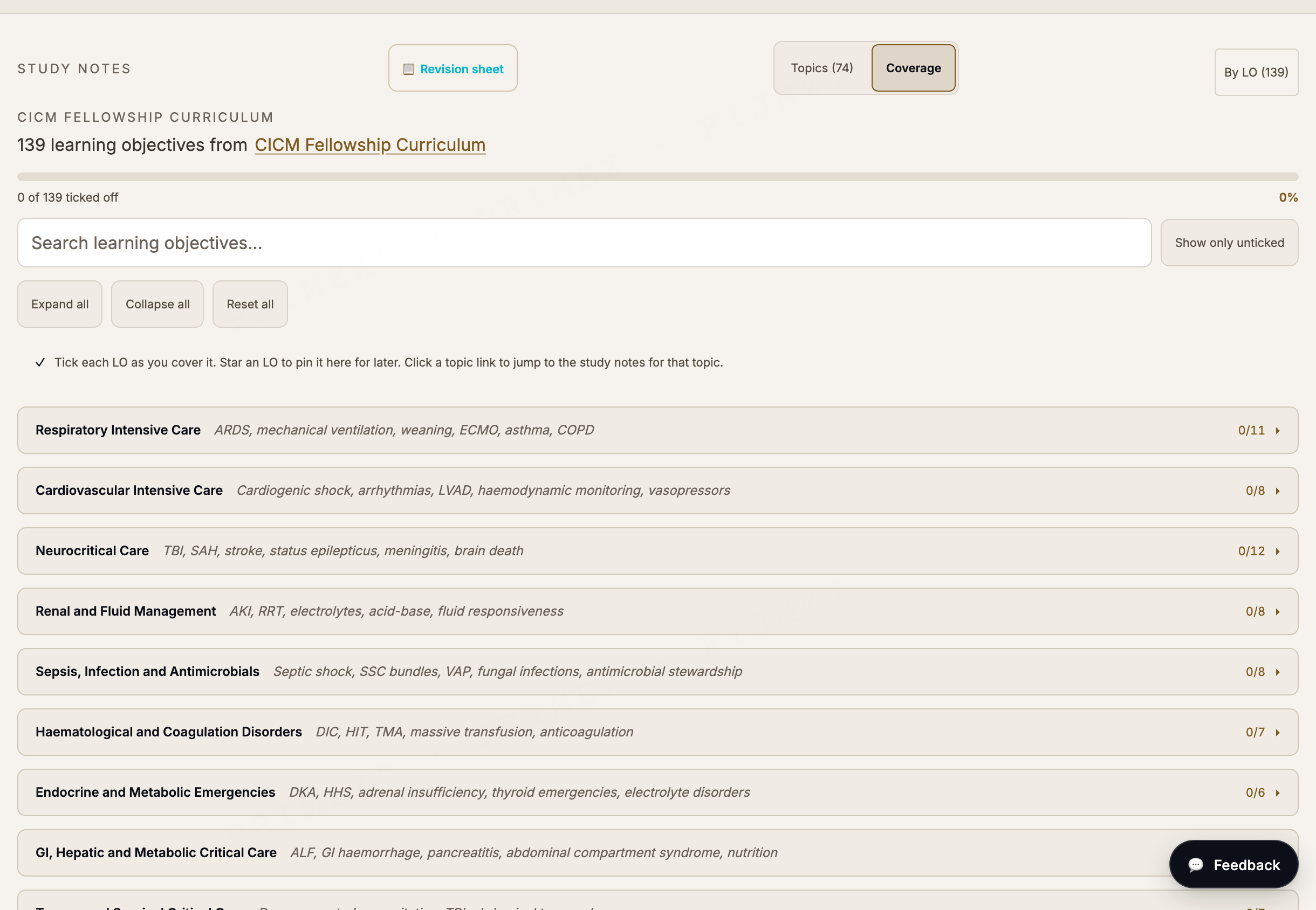
The CICM Fellowship curriculum defines 139 learning objectives across the core ICU domains. PRIMEX maps every LO to the study notes and flashcards that cover it. Work through them systematically with per-section progress bars and one-click jump to the relevant note.
- All 139 CICM Fellowship LOs mapped to study notes
- Checkbox completion persisted across sessions
- Click any LO to jump directly to the relevant study note
- Per-section and overall progress bars at a glance
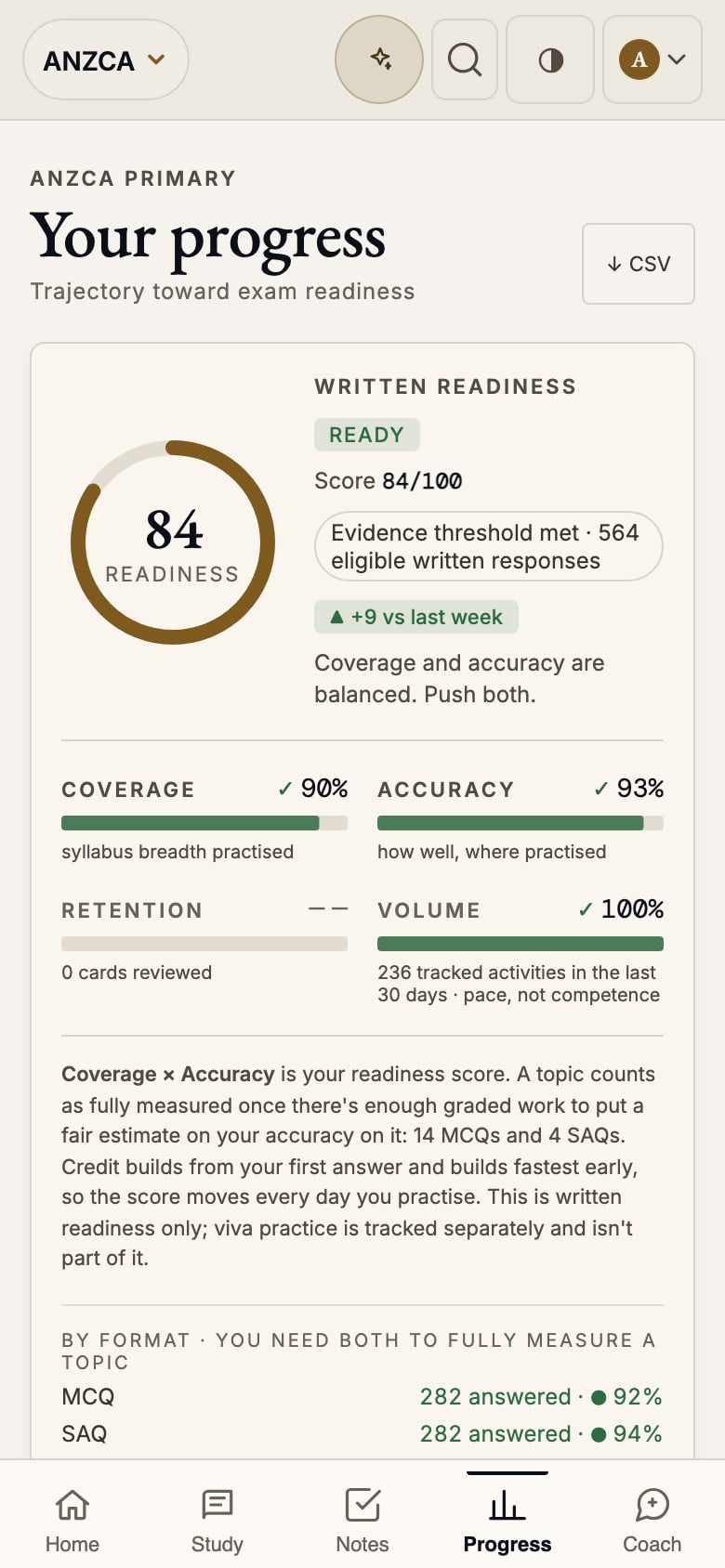
An adaptive study plan counts down to your CICM Fellowship exam date and tells you what to study next. The written-readiness score combines eligible syllabus coverage with accuracy from recognised written results. Activity pace and supplemental practice are shown separately and do not change the score.
- Days-to-exam countdown and pace tracking, ahead or behind
- Written-readiness score backed by eligible written assessments
- Coverage and accuracy broken out with evidence context
- Activity pace and weekly target shown separately from readiness
- Study this next: the topic queued for today, one tap to open
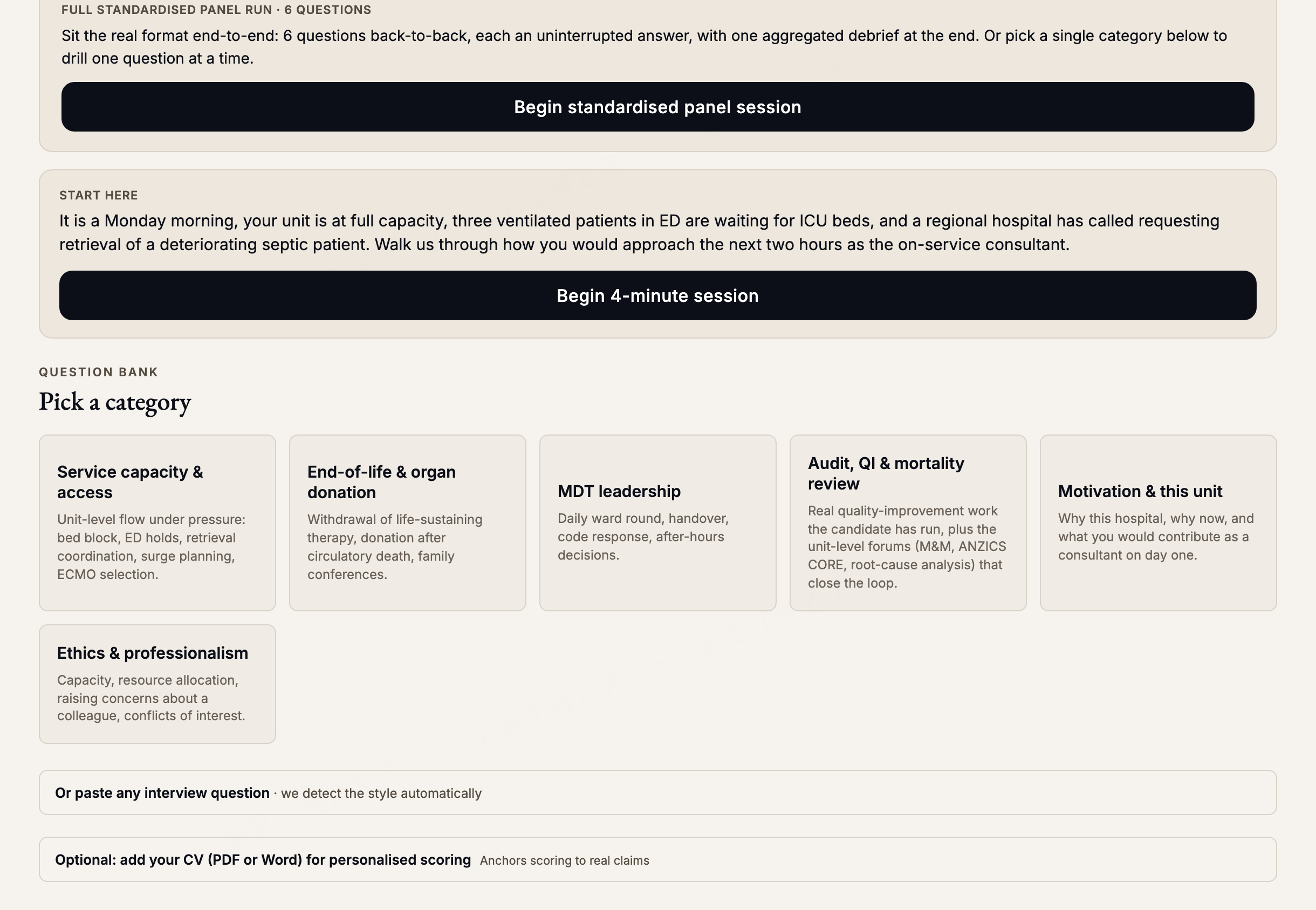
Rehearse the standardised panel interview format hospitals use for ICU staff specialist appointments. Six standardised questions cover service-level capacity and access (bed block, retrieval coordination, surge planning), end-of-life decision-making and organ donation, multidisciplinary team leadership, audit and quality improvement, ethical conflict, and credible motivation for the unit you are applying to. The panel stays silent until your answer is complete. The debrief returns a tier band, per-dimension rubric scores against CICM Domains of Practice mapped to CanMEDS, framework beat checks, and the moments your answer demonstrated each role.
- Standardised panel format mirrored from NSW Health PD2023_024 and equivalent state recruitment policies
- Six questions covering service capacity, end-of-life, MDT leadership, audit, ethics, motivation
- Calibrated rubric scoring per dimension with full band descriptions
- CICM Domains of Practice (CanMEDS-aligned) demonstrated and missed per answer
- Framework beat tracking for STAR-FR, SPIES, PEARLS, PDSA, ISBAR
- Save your CV for grounded model answers tied to your real ICU trajectory
CICM Second Part format and structure: written, hot case and viva
The CICM Fellowship Examination (FCICM) assesses readiness to practice as a consultant intensivist. Unlike the First Part, it is not a basic science exam: it expects structured management plans at specialist level, with specific drug doses, clinical targets, ethical reasoning, and awareness of the evidence base. CICM publishes per-sitting, per-component pass rates rather than a single headline figure (for example, May 2024: vivas 82%, hot cases 72%, written 59%). PRIMEX is built by Dr Jay Marshall, an anaesthetics registrar in Taree, NSW.
- OrganiserCollege of Intensive Care Medicine of Australia and New Zealand (CICM)
- FormatTwo written papers of 15 SAQs each (30 SAQs total), two hot cases, and eight structured oral vivas of approximately 10 min each for candidates who pass the written component
- DomainsCritical Care Management (~40%), Neurocritical Care & Infection (~25%), Special Situations (~20%), Ethics, Systems & Research (~15%)
- SittingsTwice yearly: written in March and August, orals in May and October
- Pass rateCICM publishes per-sitting, per-component pass rates (e.g. May 2024: vivas 82%, hot cases 72%, written 59%). There is no single headline figure; rates vary by component and sitting
Liked those five? That's a sliver of what's inside.
Get 139 study notes, 4,587 spaced-repetition flashcards, unlimited question practice and the full exam simulator. Free for 7 days, then from A$44.99/month.
Start free trial, 7 days free Cancel anytime · no commitmentCommon questions about the CICM Second Part exam
Specialist pricing and 7-day free trial
Specialist unlocks every PRIMEX exam track: the specialist pathways, AMC and Medical Student. Every study tool is included, with no per-feature paywalls.
- ✓ Every exam track: specialist pathways, AMC & Medical Student
- ✓ Flashcards with spaced repetition & MCQ drill
- ✓ Study notes for every curriculum topic
- ✓ SAQ library & sessions
- ✓ Study plan with pace tracking
- ✓ Curriculum tracker & readiness insights
- ✓ Every exam track: specialist pathways, AMC & Medical Student
- ✓ Flashcards with spaced repetition & MCQ drill
- ✓ Study notes for every curriculum topic
- ✓ SAQ library & sessions
- ✓ Study plan with pace tracking
- ✓ Curriculum tracker & readiness insights
- ✓ Every exam track: specialist pathways, AMC & Medical Student
- ✓ Flashcards with spaced repetition & MCQ drill
- ✓ Study notes for every curriculum topic
- ✓ SAQ library & sessions
- ✓ Study plan with pace tracking
- ✓ Curriculum tracker & readiness insights
You'll land on a confirmation page. Tap the sign-up button (or sign in if you already have an account) and your subscription links automatically. If you close the page first, just use the same email when you sign up and it'll still link.