
FRANZCOG Written
mastered.
285 per-LO study notes across the high-yield FRANZCOG curriculum: obstetrics, high-risk pregnancy, gynaecology, and oncology. AI SAQ grading with marking points per sub-part, a 100-question MCQ paper, and a Structured Oral simulator with voice mode. 10,254 LO-aligned flashcards across 103 topics.
Your PRIMEX account, now in your pocket.
Specialist unlocks every PRIMEX exam track. Accessible is limited to AMC and Medical Student. Subscribe on the website or in the iPhone app, then use the same account to keep your access and progress together.

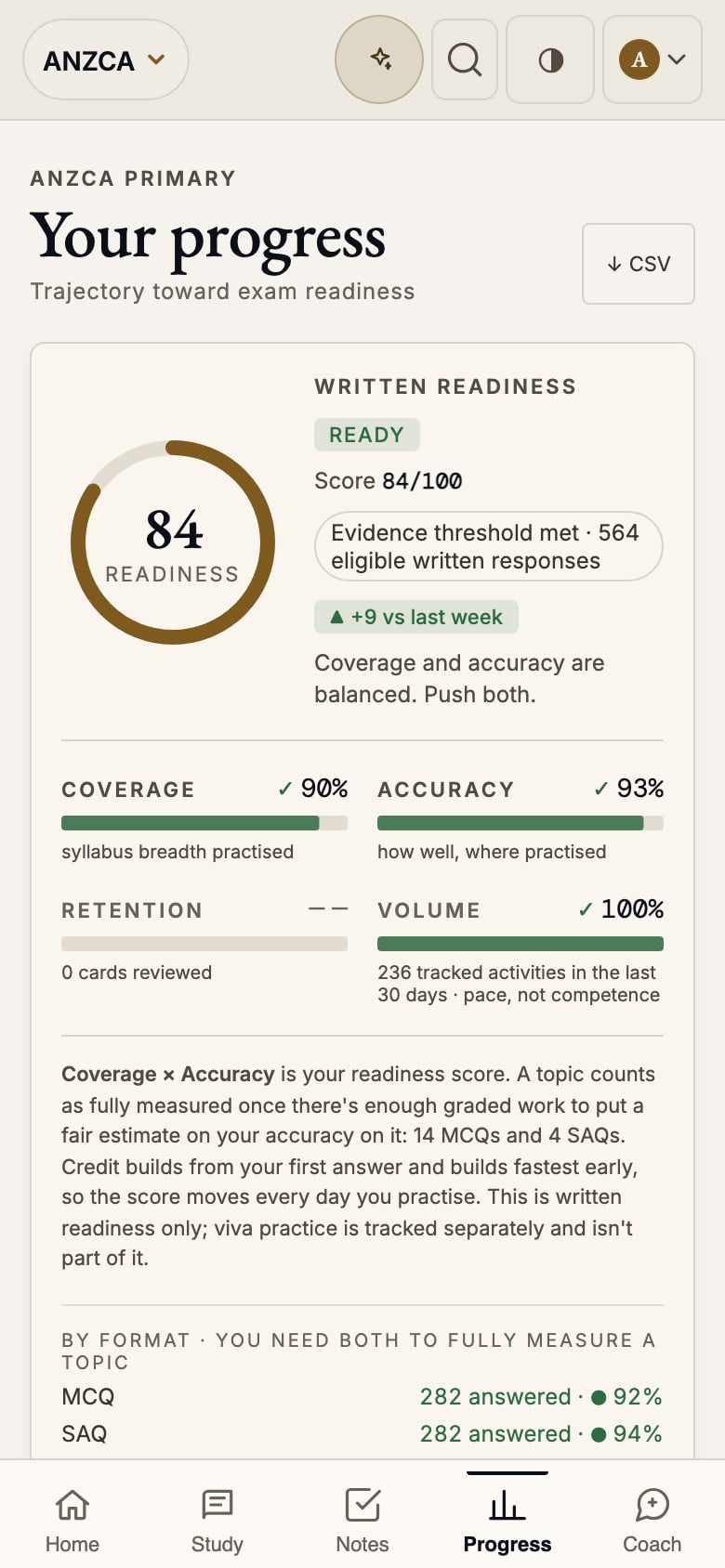
FRANZCOG Exam Dates 2026-2027
Published dates for the upcoming sittings. Always confirm against the official RANZCOG FRANZCOG examinations page before scheduling. I refresh this section quarterly as new windows are announced.
- Written Cycle 130 Jan 2026
- Written Cycle 23 Jul 2026
- Oral Cycle 2 (ALEC, Melbourne)9 Aug 2026
- Oral Cycle 3 (ALEC, Melbourne)29 Nov 2026
- Written Cycle 1 (2027)12-13 Apr 2027
- Written Cycle 2 (2027)11-12 Oct 2027
- Oral Cycle 1 (2027, ALEC Melbourne)13-14 Mar 2027
- Oral Cycle 2 (2027, ALEC Melbourne)11-12 Sep 2027
Cycle 1 written applications closed 22 Sep 2025; Cycle 2 close 23 Mar 2026. From 2027 the Written and Oral are 2-day sittings; 2027 Written Cycle 1 applications 30 Nov - 21 Dec 2026, Oral Cycle 1 applications 9 - 30 Nov 2026.
Inside PRIMEX, in under a minute
Recorded in the app, with real FRANZCOG Written questions and notes. No sound needed to follow it.
Topics tested in the FRANZCOG exam
How candidates prepare for the FRANZCOG
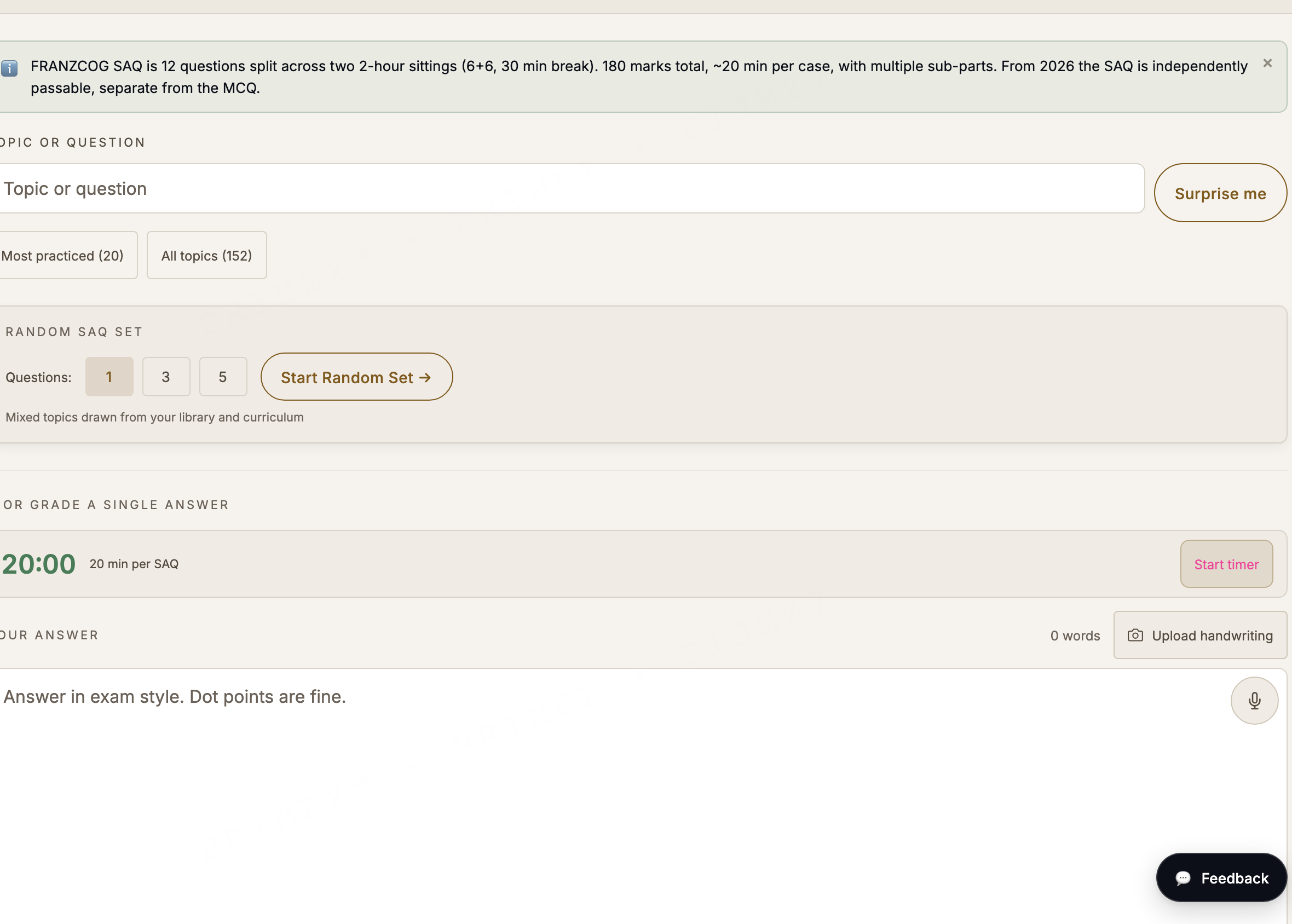
The FRANZCOG Written Examination includes 12 SAQs across two 2-hour sittings (6+6), each case with multiple sub-parts worth different marks. From 2026 the SAQ is an independent gate, separately passable from the MCQ component. The PRIMEX SAQ grader generates cases in authentic FRANZCOG format, marks every sub-part against a model answer at FRANZCOG examiner standard, and gives a tier (Pass to Distinction) with a commentary for each response.
- FRANZCOG-format cases: multiple sub-parts, variable mark allocation
- Pass / Borderline / Distinction tier with marks per sub-part
- Every marking point checked across obstetrics, gynaecology, and oncology
- Model answer written at FRANZCOG examiner standard
- Timed mock: 12 cases, ~20 min each
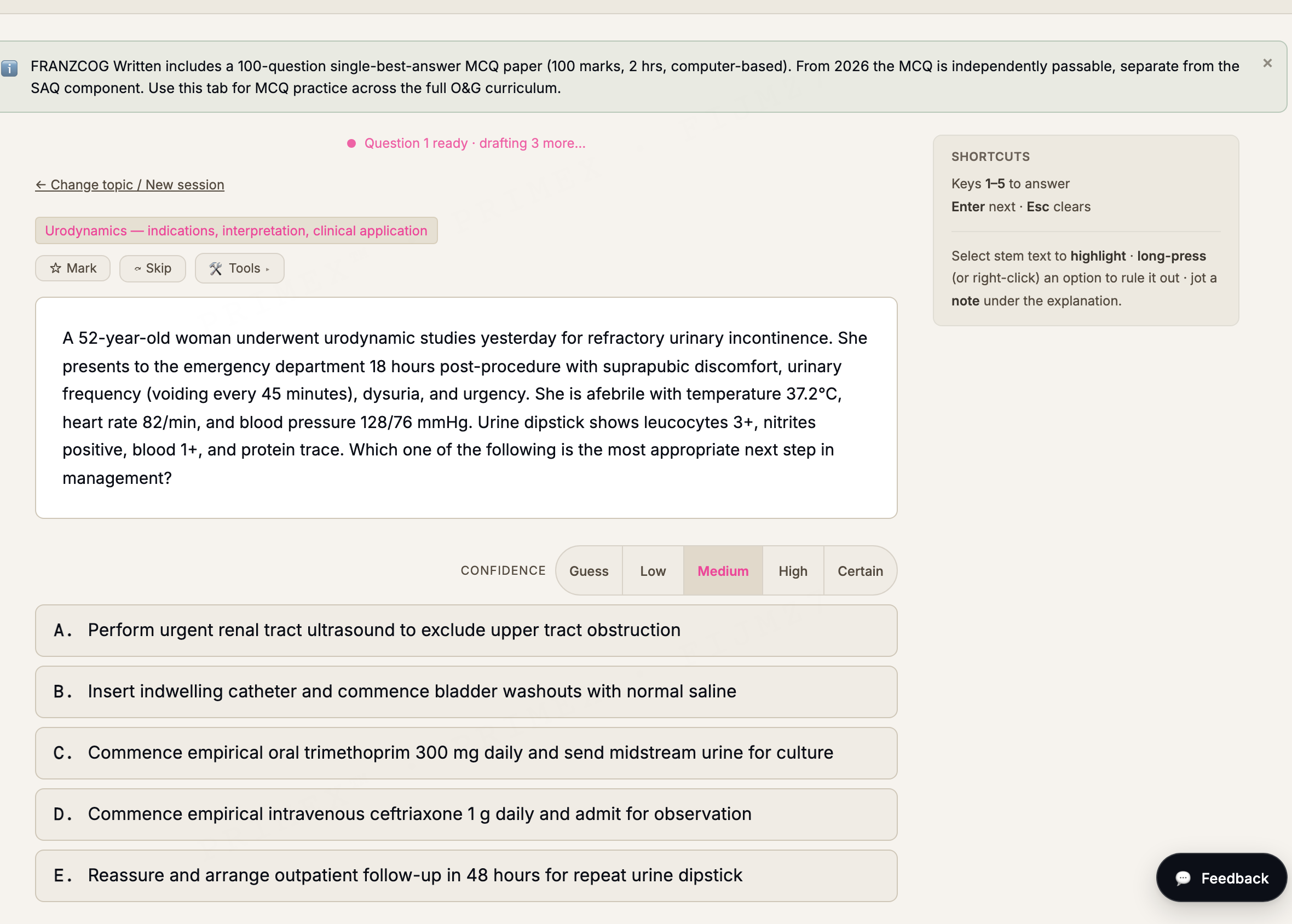
From 2026 the FRANZCOG Written includes a 100-question single-best-answer MCQ paper (100 marks, 2 hours, computer-based) that is independently passable, separate from the SAQ component. PRIMEX MCQs span all FRANZCOG domains: obstetrics, gynaecology, oncology, urogynaecology, and reproductive medicine, with explanations for every option and community answer distributions after each question.
- FRANZCOG-level SBA questions across all exam domains
- Covers RANZCOG, SOMANZ, and NHMRC guideline content throughout
- Explanation for every option, including the distractors
- Community answer distribution after each question
- AI-generated, curriculum-mapped, endless supply
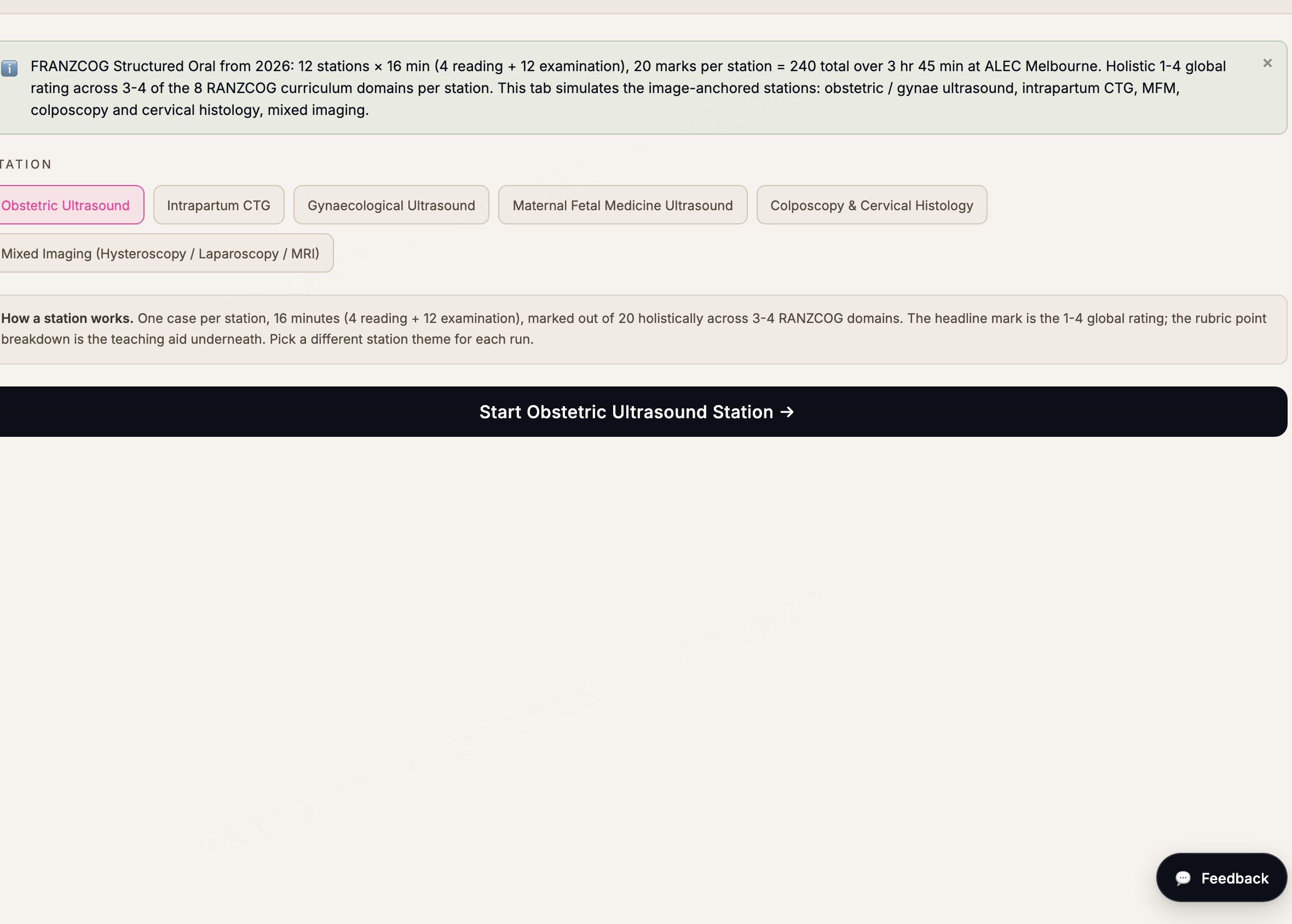
The FRANZCOG Structured Oral (RANZCOG's name for what some call an OSCE) is 12 stations of 4 min reading + 12 min examination each, held at ALEC Melbourne with simulated patients. No procedural or mannequin stations: stations test communication, counselling, consent, emergency management by discussion, ethics, and team leadership. The PRIMEX simulator generates authentic stations across all domains and conducts them via voice mode.
- Station types: communication, counselling, consent, emergency discussion, ethics
- Voice mode: speak your response, examiner and simulated patient reply live
- Covers high-stakes scenarios: shoulder dystocia debrief, bad news, consent
- Holistic debrief after each station: an overall verdict with strengths, gaps, and a key learning point
- Timed mode: 16 min per station (4 reading + 12 exam), automatic advance
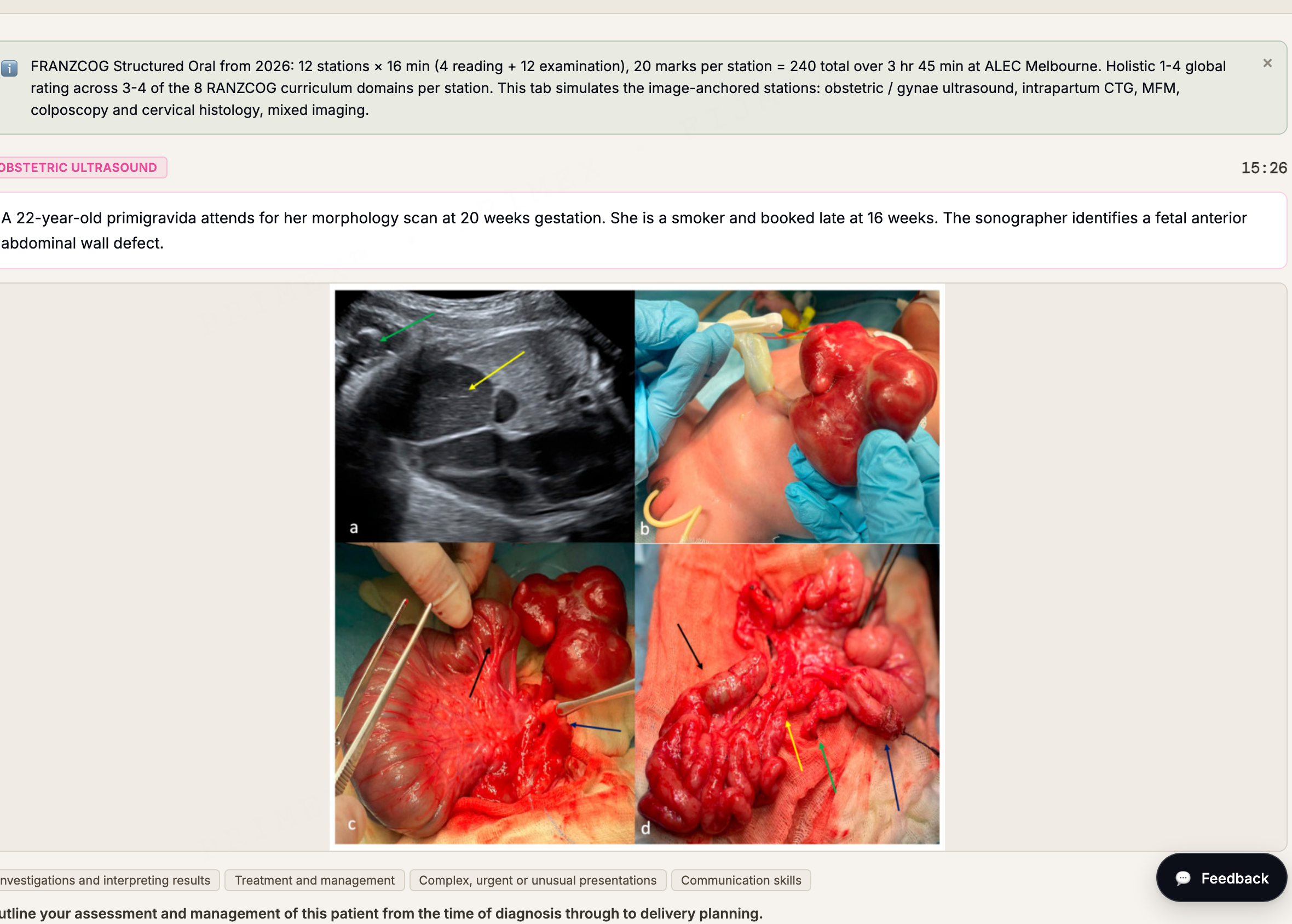
Six FRANZCOG Oral station themes are image-anchored: obstetric ultrasound, intrapartum CTG, MFM ultrasound, gynaecological ultrasound, colposcopy with cervical histology, and mixed imaging. This tab runs each station against a curated per-exam image library, including real PhysioNet CTU-CHB cardiotocograph renders for the CTG station, then grades your typed structured response holistically across the 1-4 global rating that RANZCOG uses, weighted across the 3-4 of the 8 RANZCOG curriculum domains the station hits.
- Six image themes covered: obstetric US, intrapartum CTG, gynae US, MFM US, colposcopy with cervical histology, mixed imaging
- Real PhysioNet CTU-CHB cardiotocograph renders for the intrapartum CTG station; sourced ultrasound, colposcopy, and histology with credit attribution
- 16 minutes per station (4 reading + 12 examination), matches the 2026 ALEC Melbourne format
- Holistic 1-4 global rating across 3-4 of the 8 RANZCOG curriculum domains per station
- Anti-leniency calibration ensures a misinterpreted image or unsafe management plan fails even when the percentage maths would land in a pass band
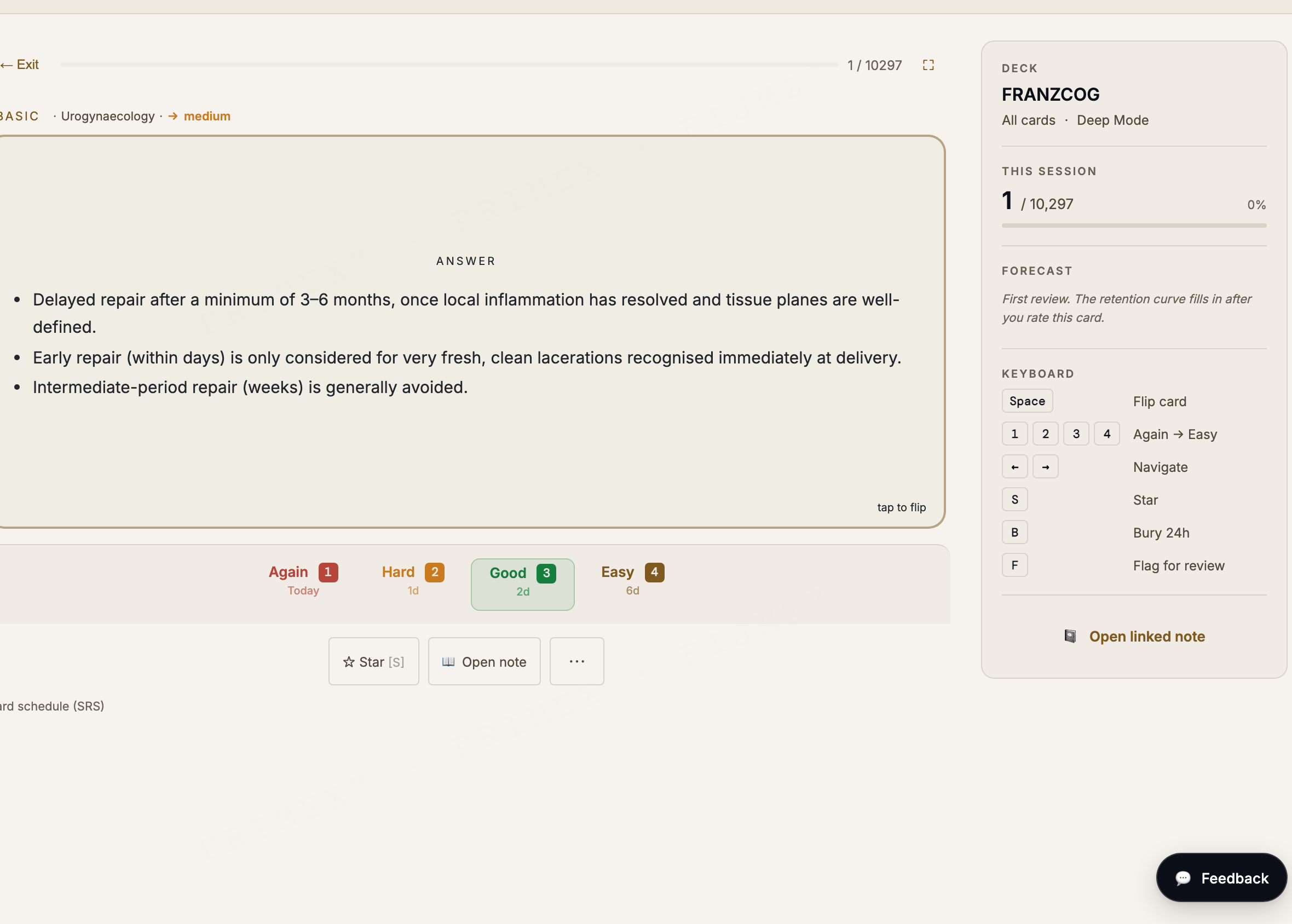
10,254 spaced-repetition flashcards aligned to the v4.7 curriculum across 103 topic buckets. The deck mirrors the per-LO note structure with mechanism, value, distinguishing, and vignette card types. RANZCOG C-Obs and SOMANZ references are woven into card explanations.
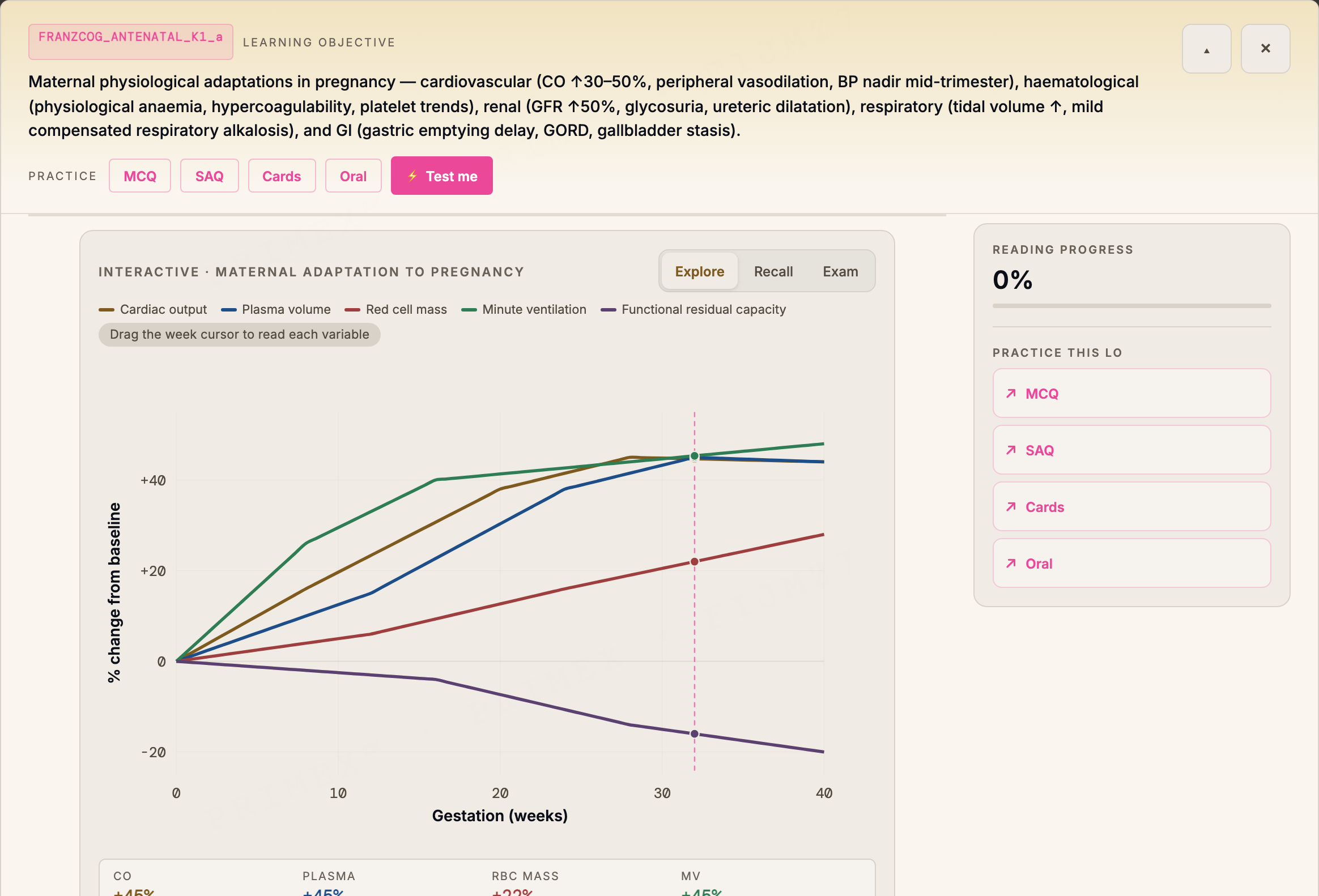
285 sourced per-LO study notes across the FRANZCOG curriculum. Written to a consistent seven-section format with RANZCOG and SOMANZ guideline references throughout. Management notes include emergency protocols, surgical decision trees, and drug dosing at obstetric level.
- 285 per-LO study notes across all exam domains
- Referenced to RANZCOG, SOMANZ, RCOG, and FIGO guidelines
- Emergency protocols: PPH escalation, eclampsia, amniotic fluid embolism
- Full-text search across all notes
- Linked from MCQ explanations, SAQ feedback, and flashcards
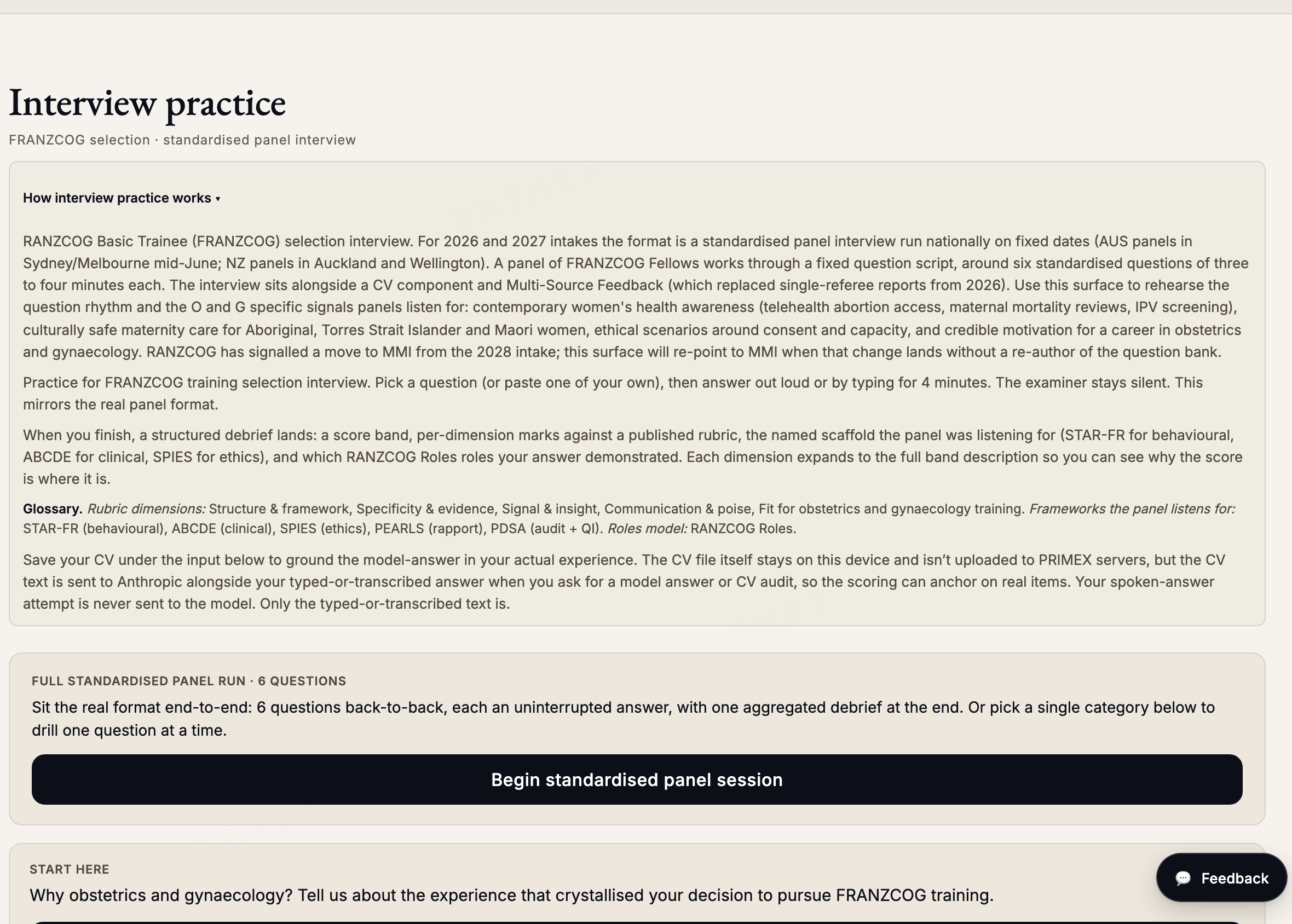
Rehearse the RANZCOG standardised panel interview format used for FRANZCOG training selection. Six standardised questions cover motivation for obstetrics and gynaecology, contemporary women's health issues, ethics around consent and capacity, communication and breaking news, teamwork and audit, and reflection on a difficult experience. The panel stays silent until your answer is complete. The debrief returns a tier band, per-dimension rubric scores against the seven RANZCOG Roles, framework beat checks, and the moments your answer demonstrated each role. RANZCOG has signalled a transition to MMI from the 2028 intake; the data model accommodates a re-point without rebanking your practice history.
- Standardised panel format mirrored from the RANZCOG 2026 Trainee Selection Process documentation
- Six questions covering motivation, women's health, ethics, communication, teamwork, reflection
- Calibrated rubric scoring per dimension with full band descriptions
- RANZCOG Roles (seven CanMEDS-derived) demonstrated and missed per answer
- Framework beat tracking for STAR-FR, SPIES, PEARLS, PDSA, ISBAR
- Designed for the 2028 MMI flip per the published selection process changes
FRANZCOG format and structure: Written and Structured Oral
The FRANZCOG examination pathway includes the Written Examination and the Structured Oral. The Written Examination (7.5 hours, one day) comprises 12 SAQs across two 2-hour sittings (6+6) plus a 100-question MCQ paper (2 hours). From 2026 the SAQ and MCQ are independently passable, each up to 3 attempts. The Structured Oral is 12 stations of 4 min reading + 12 min examination, held at ALEC Melbourne with simulated patients, testing communication, counselling, consent, ethics, and emergency management by discussion. The curriculum spans normal and high-risk pregnancy, intrapartum care, operative obstetrics, gynaecological medicine, reproductive medicine, and oncology. PRIMEX is built by Dr Jay Marshall, an anaesthetics registrar in Taree, NSW.
- OrganiserRoyal Australian and New Zealand College of Obstetricians and Gynaecologists (RANZCOG)
- Written format12 SAQs in two 2-hr sittings (6+6) + 100 MCQ in 2 hrs. ~20 min per SAQ case. From 2026: SAQ and MCQ each independently passable.
- Structured Oral12 stations, 4 min reading + 12 min exam each. Simulated patients at ALEC Melbourne. No procedural/mannequin stations.
- DomainsNormal & High-Risk Pregnancy, Intrapartum Care, Operative Obstetrics, Gynaecology, Gynaecological Oncology, Urogynaecology, Reproductive Medicine
- SittingsWritten Examination: two sittings per year (in 2026, 30 January and 3 July)
- Pass rateWritten Examination 77% and Oral Examination 91% in 2024, per the RANZCOG Activities Report 2024 (all-attempt rates; standard-set each sitting)
Free notes are just the start.
Get 10,254 spaced-repetition flashcards, unlimited question practice and the full exam simulator. Free for 7 days, then from A$44.99/month.
Start free trial, 7 days free Cancel anytime · no commitmentCommon questions about the FRANZCOG exam
Specialist pricing and 7-day free trial
Specialist unlocks every PRIMEX exam track: the specialist pathways, AMC and Medical Student. Every study tool is included, with no per-feature paywalls.
- ✓ Every exam track: specialist pathways, AMC & Medical Student
- ✓ Flashcards with spaced repetition & MCQ drill
- ✓ Study notes for every curriculum topic
- ✓ SAQ library & sessions
- ✓ Study plan with pace tracking
- ✓ Curriculum tracker & readiness insights
- ✓ Every exam track: specialist pathways, AMC & Medical Student
- ✓ Flashcards with spaced repetition & MCQ drill
- ✓ Study notes for every curriculum topic
- ✓ SAQ library & sessions
- ✓ Study plan with pace tracking
- ✓ Curriculum tracker & readiness insights
- ✓ Every exam track: specialist pathways, AMC & Medical Student
- ✓ Flashcards with spaced repetition & MCQ drill
- ✓ Study notes for every curriculum topic
- ✓ SAQ library & sessions
- ✓ Study plan with pace tracking
- ✓ Curriculum tracker & readiness insights
You'll land on a confirmation page. Tap the sign-up button (or sign in if you already have an account) and your subscription links automatically. If you close the page first, just use the same email when you sign up and it'll still link.