
ANZCA Primary
passed first time.
313 sourced study notes (one per learning objective) and 10,283 flashcards across the ANZCA Primary curriculum. AI SAQ grading on the Fail / Borderline / Pass / Distinction tier, a voice viva simulator, and an unlimited MCQ library. Built for the basic sciences of the Primary.
- 313 LOs mapped
- AI SAQ grading
- Voice viva simulator
- 7-day free trial
Your PRIMEX account, now in your pocket.
Specialist unlocks every PRIMEX exam track. Accessible is limited to AMC and Medical Student. Subscribe on the website or in the iPhone app, then use the same account to keep your access and progress together.

ANZCA Primary Exam Dates 2026-2027
Published dates for the upcoming sittings. Always confirm against the official ANZCA exam calendar before scheduling. I refresh this section quarterly as new windows are announced.
- Primary Written 2026.124 Feb 2026
- Primary Viva 2026.1 (Melbourne)18-20 May 2026
- Primary Written 2026.218 Aug 2026
- Primary Viva 2026.2 (Brisbane)19-21 Oct 2026
- Primary Written 2027.12 Mar 2027
- Primary Viva 2027.1 (Melbourne)17-19 May 2027
- Primary Written 2027.210 Aug 2027
- Primary Viva 2027.2 (Brisbane)11-13 Oct 2027
2026.2 applications close 16 Jun 2026. 2027.1 applications close 6 Jan 2027 (special consideration 9 Dec 2026); 2027.2 close 16 Jun 2027.
Inside PRIMEX, in under a minute
Recorded in the app, with real ANZCA Primary questions and notes. No sound needed to follow it.
Topics tested in the ANZCA Primary exam
How candidates prepare for the ANZCA Primary
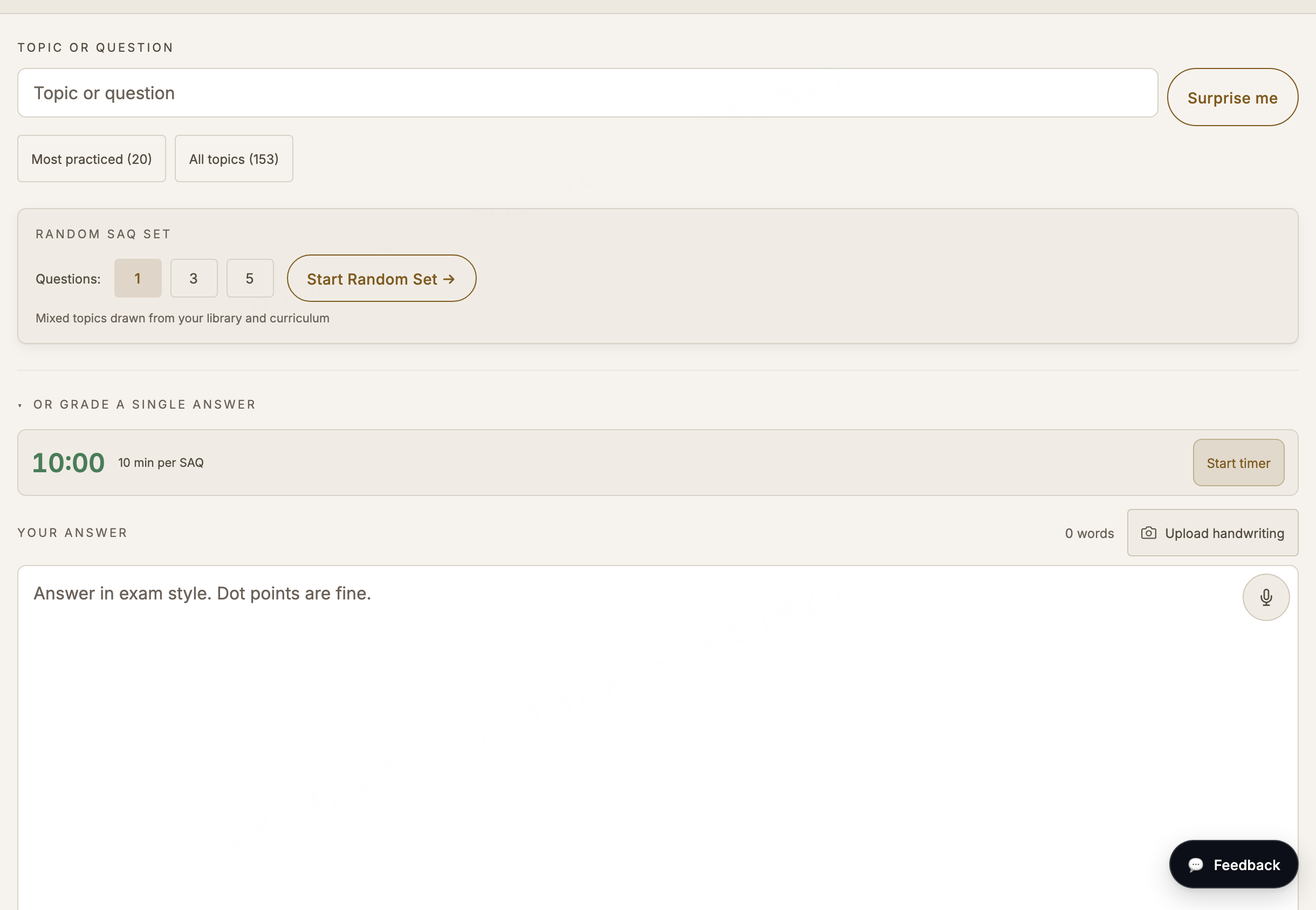
Write a Primary SAQ and get an examiner-style debrief in seconds. A Fail / Borderline / Pass / Distinction tier on the holistic 1-to-5 ANZCA mark, a marking checklist with every point flagged hit or missed, an examiner comment calibrated to published ANZCA Primary reports, and a full model answer at distinction standard.
- Fail / Borderline / Pass / Distinction tier on the holistic 1-to-5 mark
- Every marking point checked, not just a grade
- Model answer written at examiner standard
- Topic sessions or random sets from the question library
- AI question generation in Primary format, no repetition
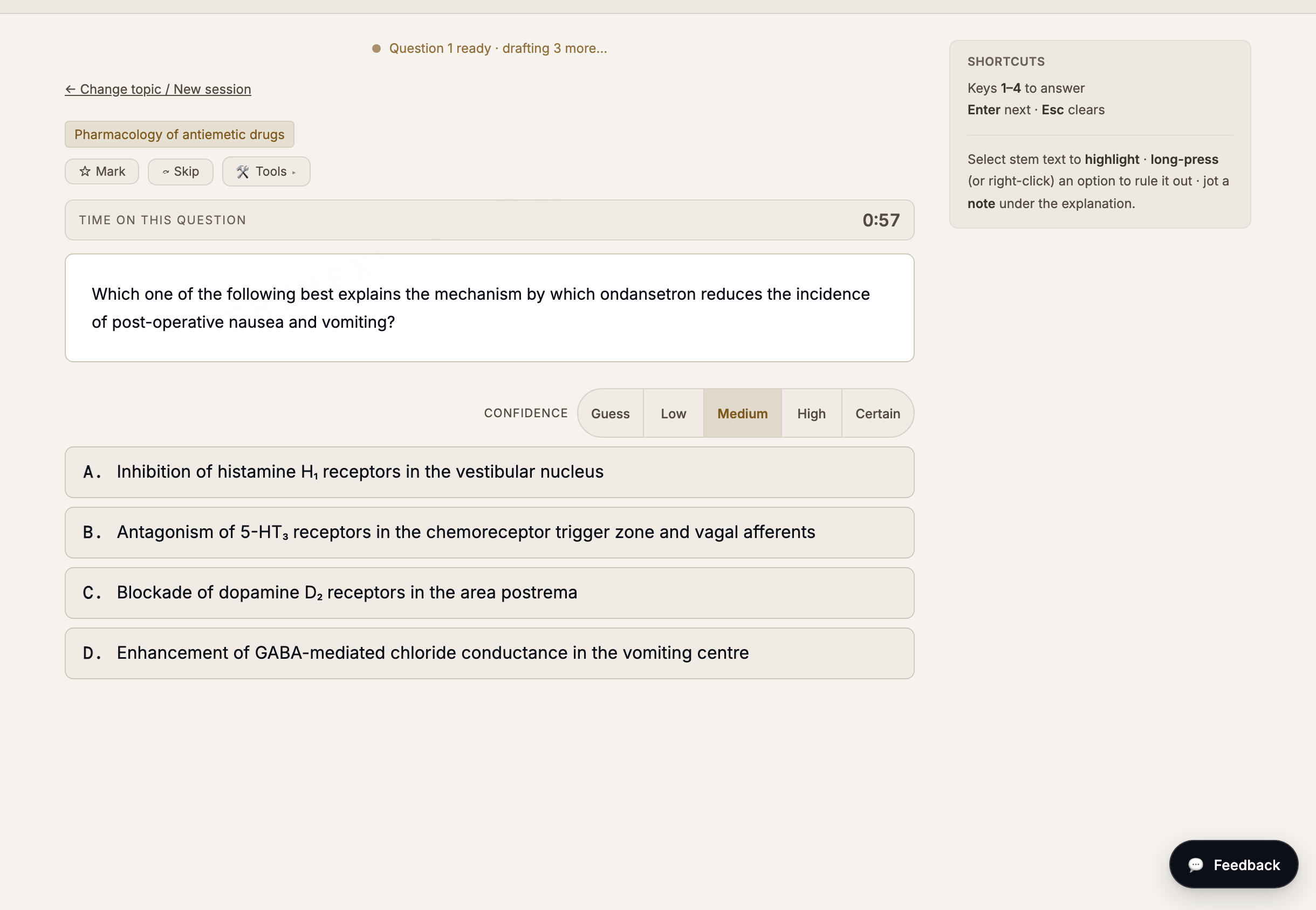
Single-best-answer MCQs across all four Primary domains, mapped to the ANZCA curriculum. Full explanations for every option, including distractors. A community answer distribution shows how other candidates responded after each question.
- Primary-format MCQs across physiology, pharmacology, anatomy, equipment
- Explanation for every option, including the distractors
- Community answer distribution after each question
- AI-generated, curriculum-mapped, endless supply
- Timed mock mode replicating real exam conditions
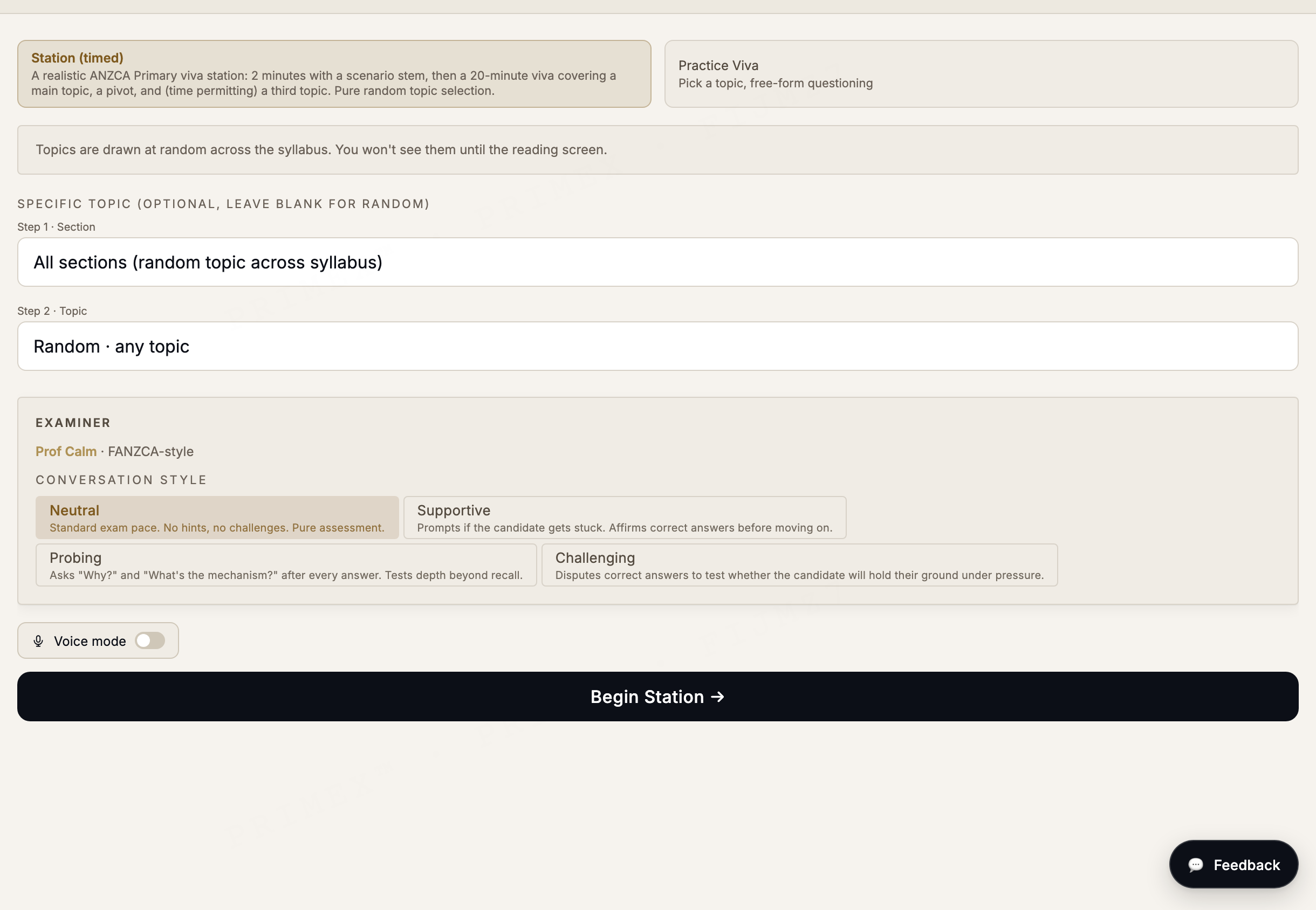
Sessions run in ANZCA Primary viva format: an opening physiology or pharmacology scenario, five to six probing follow-ups from the examiner, and a debrief with a tier and a specific learning point. Voice mode transcribes spoken answers using medical speech recognition. The examiner persona is calibrated to published ANZCA examiner-report language.
- Primary viva format with realistic examiner persona
- Opens on a physiology or pharmacology scenario, then probes deeper
- Voice mode: speak your answer, no typing needed
- Debrief with tier and a specific learning point after each session
- Covers all four Primary domains
Work through a full mock viva out loud with this college's AI examiner, in real time. Answer by voice, get probed and interrupted like you would in the real viva, then step out to a graded debrief: how you performed on the station, the topics you covered, your strengths and gaps, and how you handled the pressure. Every mock viva feeds your weak-topic plan, so what to practise next is always clear.
- Real-time spoken viva in this college's examiner voice, fully interruptible
- Graded debrief on every station: your performance tier, the topics you covered, and the gaps to close
- Communication and composure feedback: pacing, hesitation, clarity under pressure
- Weak topics flow straight into your study plan and daily practice
- Part of PRIMEX Pro, with monthly mock vivas included
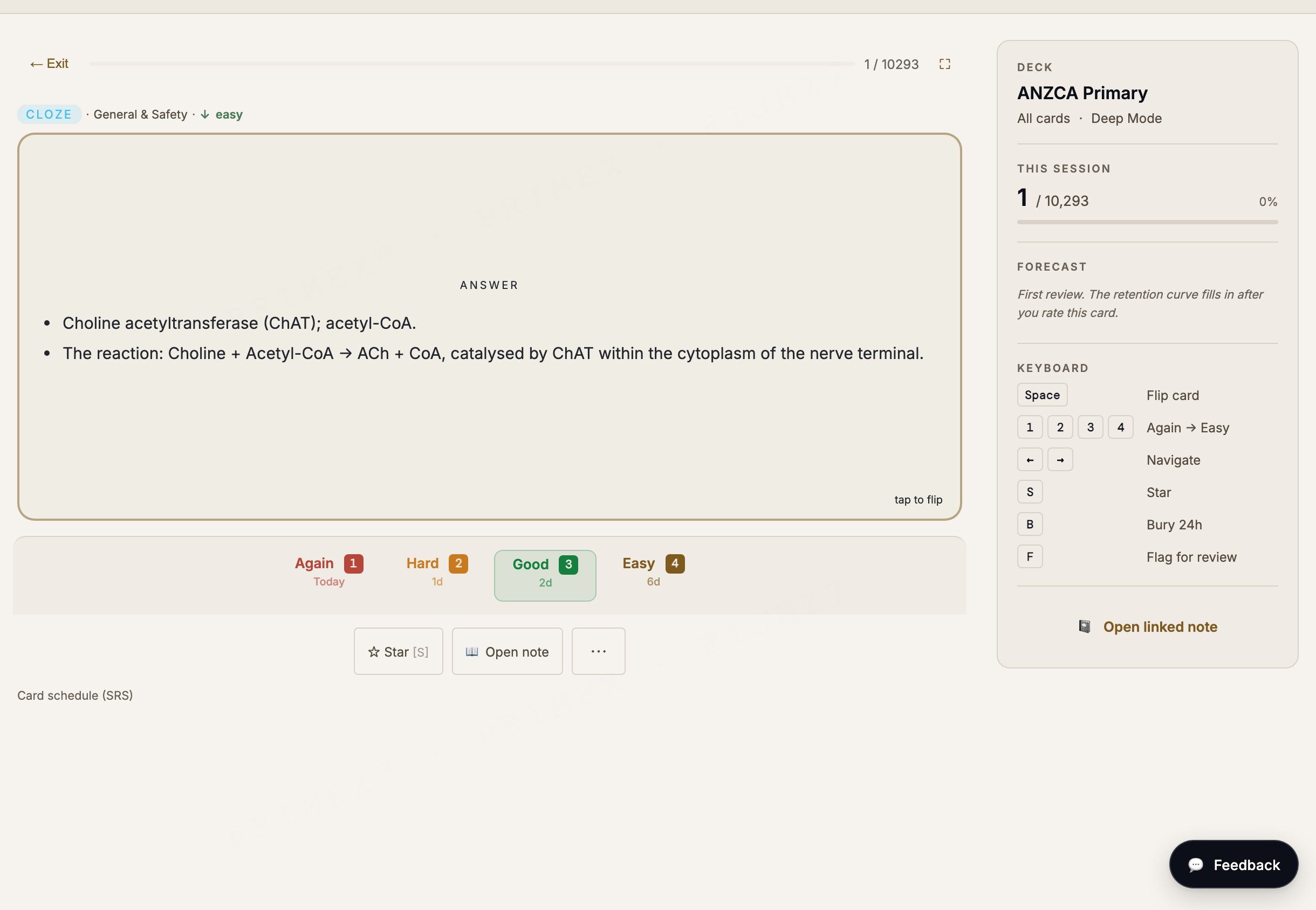
Curriculum-mapped flashcard decks with spaced repetition across the ANZCA Primary curriculum. Cards you get right resurface less often; cards you miss come back sooner. Thirteen card types: mechanism, pharmacokinetics, drug profile, clinical correlate, and more. MCQ drill mode included.
- 10,283 cards mapped to all 313 ANZCA Primary learning objectives
- 13 card types: mechanism, kinetics, drug comparison, anatomy, equipment
- MCQ drill mode for rapid-fire practice
- One click from card to full study note
- Image cards: structure diagrams, curves, monitoring waveforms
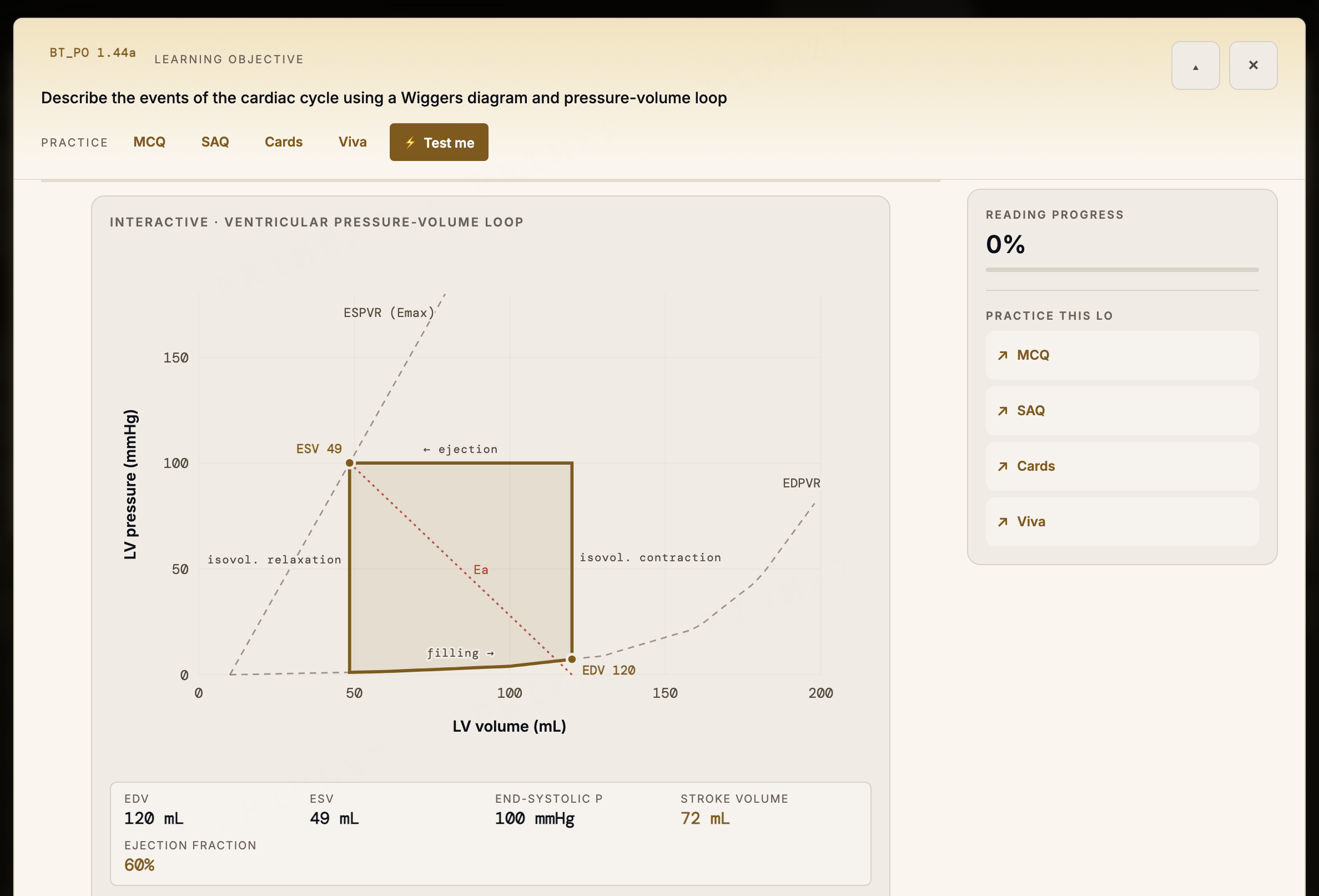
A sourced study note for every one of the 313 ANZCA Primary learning objectives. Consistent seven-section format, referenced to the published ANZCA curriculum, Australian guidelines, and primary literature. Notes surface automatically alongside SAQ and viva debriefs, so you read straight from the result, and the Curriculum tab opens any LO note in one click.
- A focused note for every one of the 313 learning objectives
- Consistent 7-section structure: scannable, not a wall of text
- Aligned to the published ANZCA Primary curriculum and Australian guidelines
- Per-LO focused notes available from the Curriculum tab
- Full-text search across all notes; linked from SAQ debrief, viva feedback, and flashcards
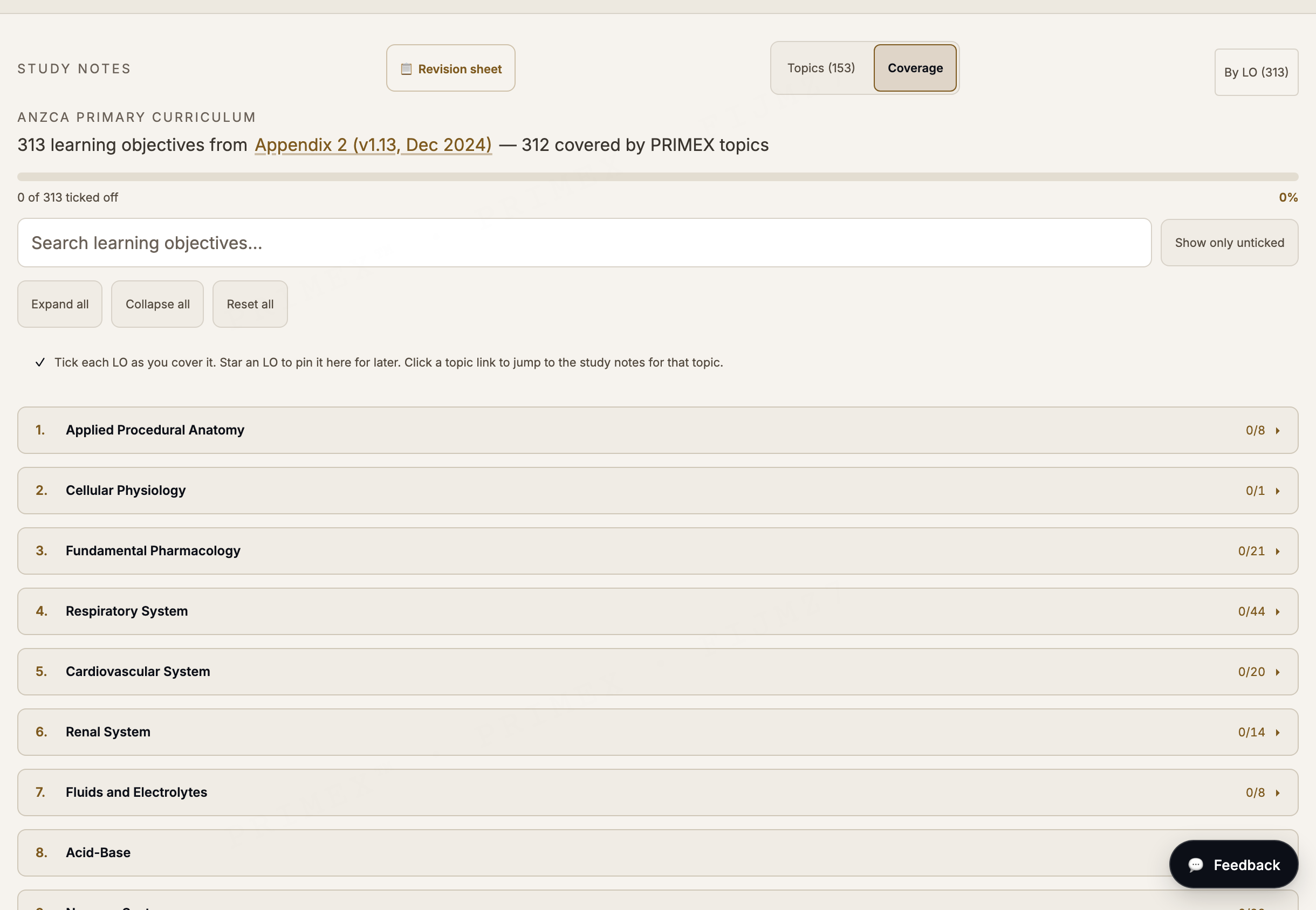
The ANZCA Training Program Curriculum (v1.14) defines 313 Primary-assessed learning objectives. PRIMEX maps every LO to a study note and to flashcards. The Curriculum tab gives you a checkbox checklist with per-section progress bars, so you can see exactly how much of the syllabus you've covered.
- All 313 ANZCA Primary LOs, verbatim from the v1.14 curriculum document, grouped into 15 domains
- Checkbox completion persisted across sessions
- Click any LO to jump to the relevant study note or open a focused per-LO note
- Per-section and overall progress bars at a glance
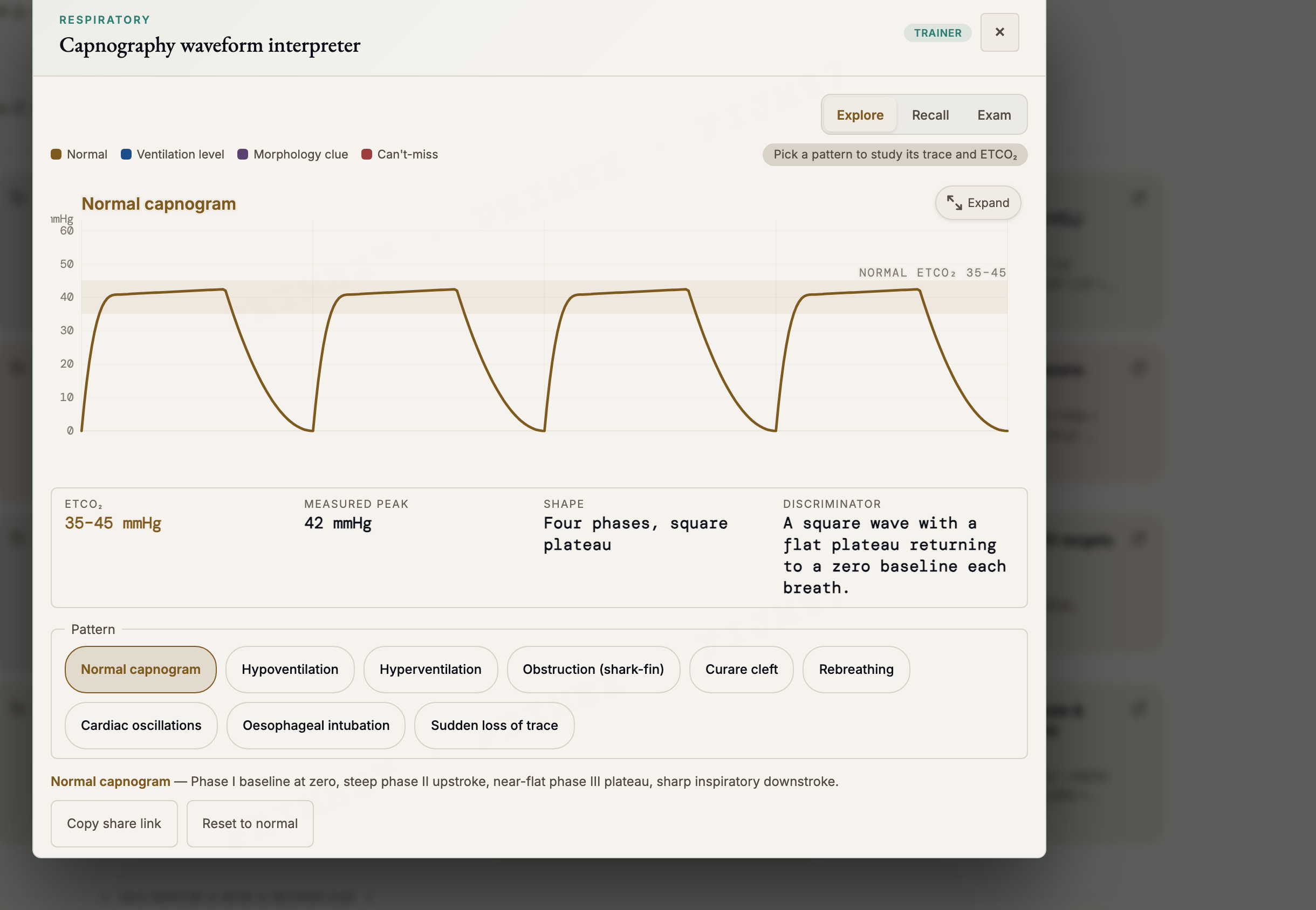
Interactive, active-recall trainers built for the physics and physiology the Primary leans on. Tap and drag the live model (capnography waveforms, ABG interpretation, flow-volume loops, ventricular pressure-volume loops, oxygen delivery and consumption) and watch the traces, values, and interpretation update in real time, then test yourself in Recall and Exam modes.
- Trainers across respiratory, cardiovascular, acid-base, and pharmacology
- Capnography, ABG, flow-volume loops, PV loops, and the oxygen cascade
- Explore freely, then test recall against the model in Recall and Exam modes
- Embedded directly in the matching study notes
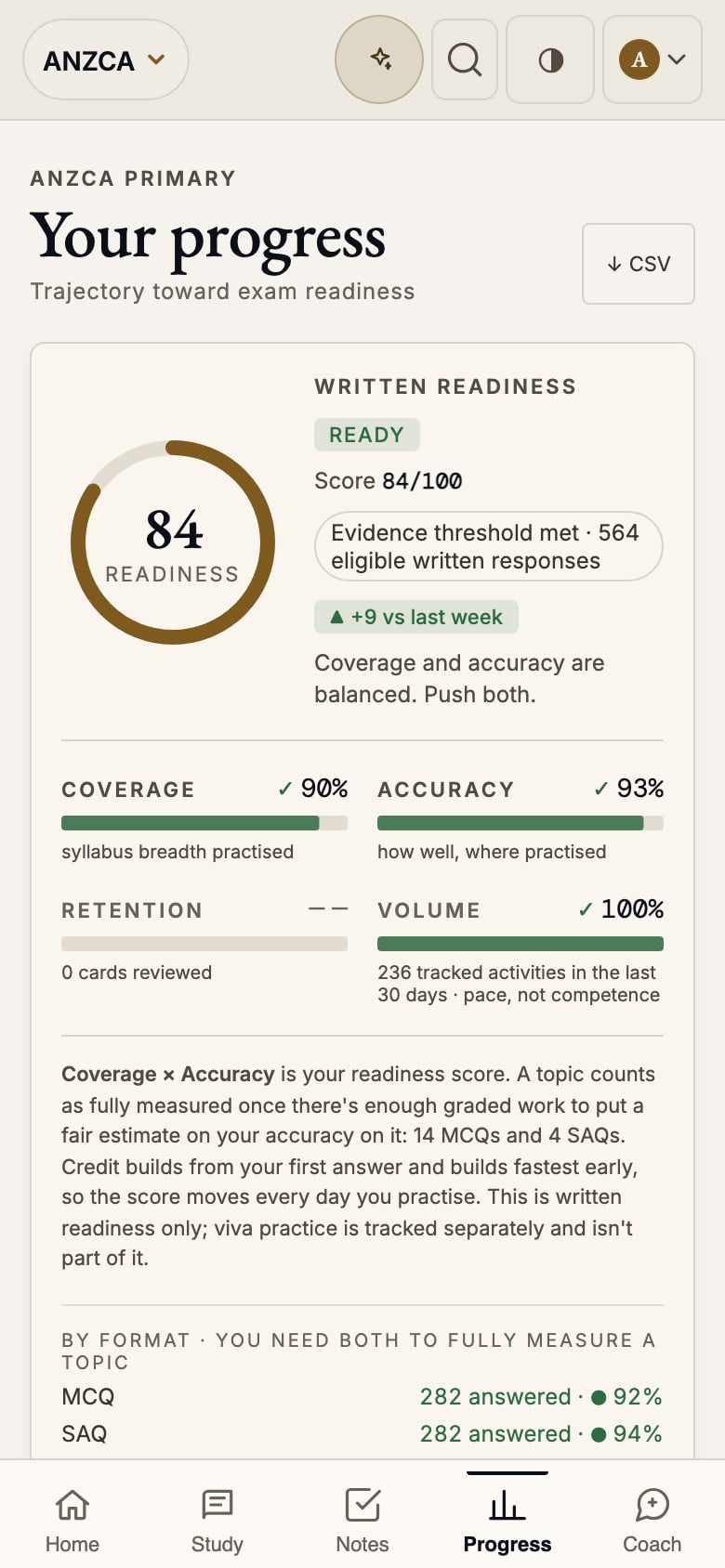
An adaptive study plan counts down to your ANZCA Primary date and tells you what to study next. The written-readiness score combines eligible syllabus coverage with accuracy from recognised written results. Activity pace and supplemental practice are shown separately and do not change the score.
- Days-to-exam countdown and pace tracking, ahead or behind
- Written-readiness score backed by eligible written assessments
- Coverage and accuracy broken out with evidence context
- Activity pace and weekly target shown separately from readiness
- Study this next: the topic queued for today, one tap to open
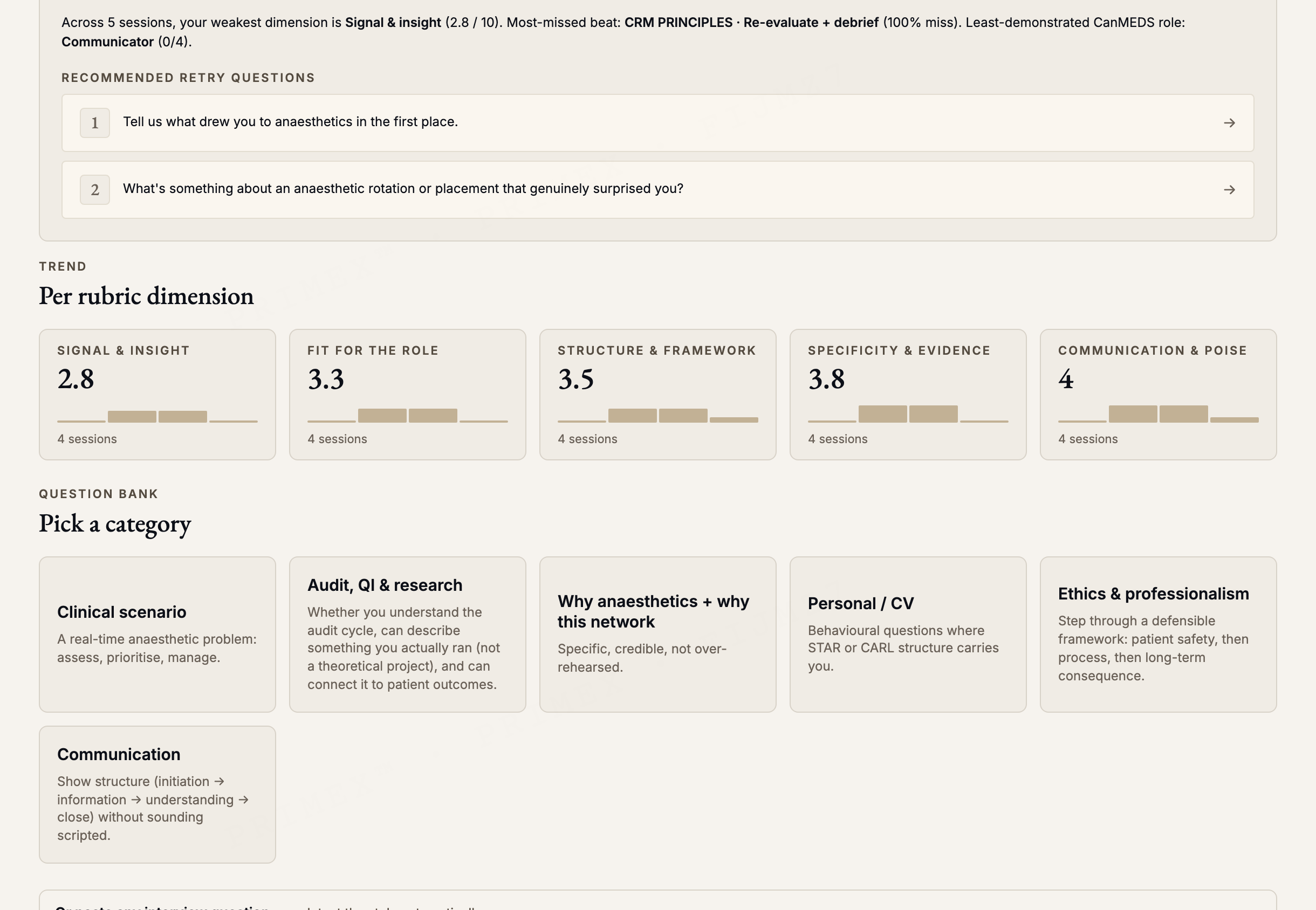
Rehearse the four-minute monologue format real ANZCA reg panels run. Pick a starter question, paste your own, or run a category set. Answer out loud or by typing; the examiner stays silent for the full slot. At the end you get a calibrated debrief: a tier band, per-dimension rubric scores, named framework beats (STAR-FR, ABCDE, SPIES, PEARLS, PDSA) hit or missed, and a CanMEDS / ANZCA Roles in Practice breakdown of what your answer demonstrated.
- 4-minute uninterrupted monologue format, matched to the real ANZCA reg interview
- Calibrated rubric scoring per dimension with full band descriptions
- Framework beat checks for STAR-FR, ABCDE, SPIES, PEARLS, PDSA
- ANZCA Roles in Practice (CanMEDS) coverage breakdown per answer
- Save your CV for grounded model answers tied to your real experience
- Weakness model tracks which dimensions and roles to drill next
ANZCA Primary format and structure: MCQ, SAQ and viva
The ANZCA Primary tests the scientific foundations of anaesthetic practice: physiology, pharmacology, anatomy, and equipment. Passing it is the gateway to Fellowship training. ANZCA's 2023 Training Dashboard reports a first-time written pass rate of 71% (November 2023), with the overall rate including repeat candidates at 60.7%. PRIMEX is built by Dr Jay Marshall, an anaesthetics registrar in Taree, NSW, preparing for the same exam between cases.
- OrganiserAustralian and New Zealand College of Anaesthetists (ANZCA)
- FormatWritten paper (MCQs + SAQs), followed by a clinical viva for candidates who pass the written component
- DomainsPhysiology (~40%), Pharmacology (~40%), Anatomy (~10%), Equipment & Measurement (~10%)
- SittingsTwice yearly, typically February/March and August/September
- Pass rate71% first-time written (Nov 2023), 79% (May 2023); 60.7% overall incl. repeats, per the ANZCA 2023 Training Dashboard
ANZCA Primary pass rates and exam statistics
- Curriculum learning objectives mapped
- 313
- Sourced study notes
- 313 (one per LO)
- Spaced-repetition flashcards
- 10,283
- Curriculum sections covered
- 15
- SAQ grading tier
- Fail / Borderline / Pass / Distinction
- Viva exchanges per session
- 5-6
- Curriculum version
- v1.14
- Trial
- 7 days, free
Every one of the 313 ANZCA Primary learning objectives is taken verbatim from the v1.14 curriculum. Each LO has its own focused study note and is mapped to spaced-repetition flashcards. The Curriculum tab persists checkbox progress across sessions and shows per-section progress bars, so you know exactly how much of the syllabus is covered.
Try the same AI grader our subscribers use.
Five high-yield ANZCA Primary topics. Free MCQ practice, graded against college-standard marking points. No signup.
Blood Groups and Transfusion Reactions
The ABO system is the most clinically significant blood group system, discovered by Karl Landsteiner in 1900.
Perioperative Effects of Radiological Contrast Agents
Radiological contrast agents fall into three main categories based on their chemical composition and clinical application.
Pharmacology of Illicit Drugs and Anaesthetic Interactions
Illicit drug use presents significant challenges in perioperative care through direct pharmacological effects.
Pharmacology of Nitrous Oxide (N₂O)
Nitrous oxide (N2O) is an inorganic inhalational agent that has been used in anaesthetic practice for over 150 years.
Liked those five? That's a sliver of what's inside.
Get 313 study notes, 10,283 spaced-repetition flashcards, unlimited question practice and the full exam simulator. Free for 7 days, then from A$44.99/month.
Start free trial, 7 days free Cancel anytime · no commitmentCommon questions about the ANZCA Primary exam
Specialist pricing and 7-day free trial
Specialist unlocks every PRIMEX exam track: the specialist pathways, AMC and Medical Student. Every study tool is included, with no per-feature paywalls.
- ✓ Every exam track: specialist pathways, AMC & Medical Student
- ✓ Flashcards with spaced repetition & MCQ drill
- ✓ Study notes for every curriculum topic
- ✓ SAQ library & sessions
- ✓ Study plan with pace tracking
- ✓ Curriculum tracker & readiness insights
- ✓ Every exam track: specialist pathways, AMC & Medical Student
- ✓ Flashcards with spaced repetition & MCQ drill
- ✓ Study notes for every curriculum topic
- ✓ SAQ library & sessions
- ✓ Study plan with pace tracking
- ✓ Curriculum tracker & readiness insights
- ✓ Every exam track: specialist pathways, AMC & Medical Student
- ✓ Flashcards with spaced repetition & MCQ drill
- ✓ Study notes for every curriculum topic
- ✓ SAQ library & sessions
- ✓ Study plan with pace tracking
- ✓ Curriculum tracker & readiness insights
You'll land on a confirmation page. Tap the sign-up button (or sign in if you already have an account) and your subscription links automatically. If you close the page first, just use the same email when you sign up and it'll still link.