
RANZCP / formulated.
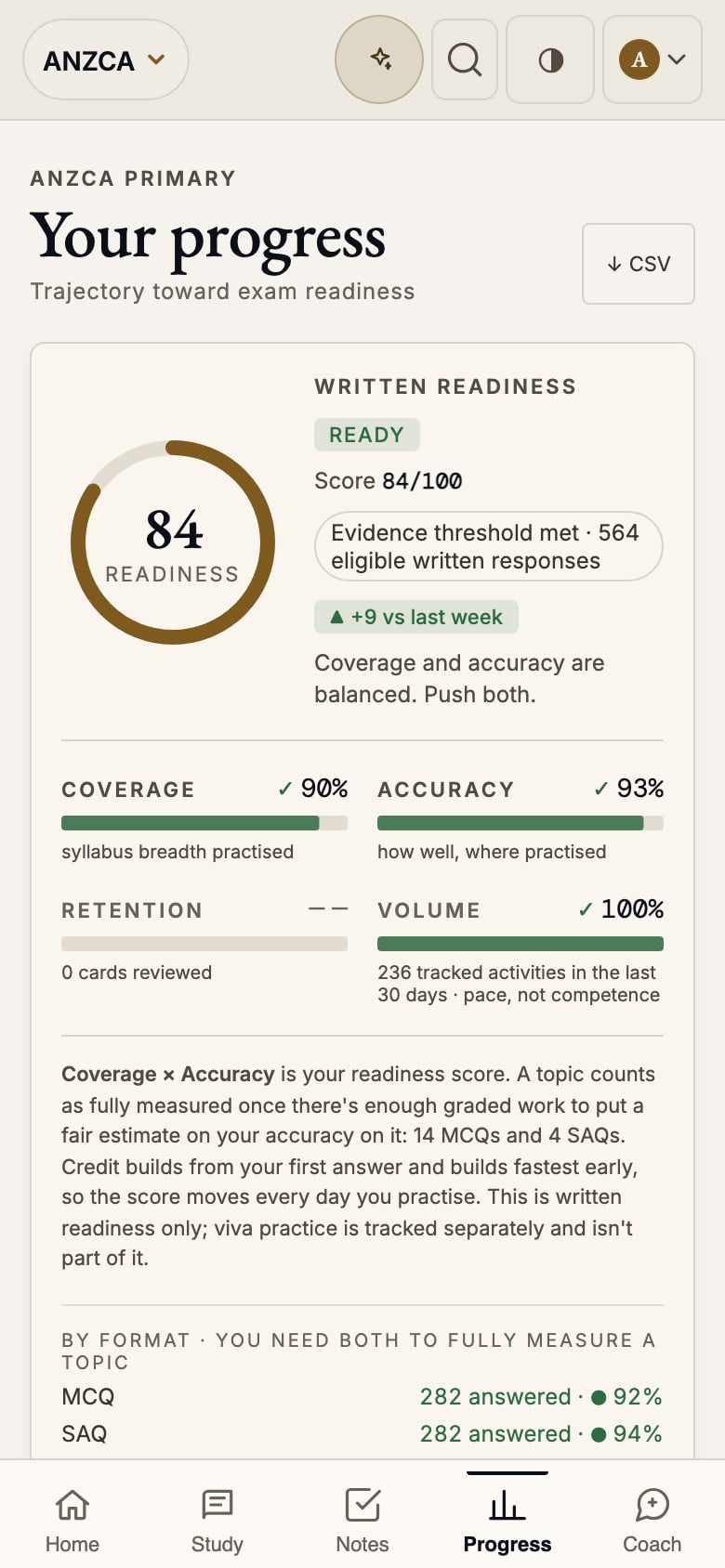
329 sourced study notes across the 347-LO Fellowship curriculum. EMQ themed-set MCQ practice, Critical Analysis Problem mode with abstracts and tables, MEQ Grader with verb-specific rubric marking, and a Fellowship curriculum tracker. Flashcards aligned to learning objectives.
Your PRIMEX account, now in your pocket.
Specialist unlocks every PRIMEX exam track. Accessible is limited to AMC and Medical Student. Subscribe on the website or in the iPhone app, then use the same account to keep your access and progress together.

RANZCP Fellowship Exam Dates 2026
Published dates for the upcoming sittings. Always confirm against the official RANZCP exam timetables before scheduling. I refresh this section quarterly as new windows are announced.
- MCQ Examination, Sitting 1Fri 20 Mar 2026 (results 22 Apr 2026)
- MCQ Examination, Sitting 2Fri 18 Sep 2026 (results 21 Oct 2026)
- MEQ Examination, Sitting 1Tue 3 Mar 2026 (results 20 May 2026)
- MEQ Examination, Sitting 2Tue 1 Sep 2026 (results 4 Nov 2026)
- CCA-MPR (Clinical Competency Assessment)Applications 1-15 Apr 2026
- CCPR (replaces OSCE from Sep 2026)Applications 7-21 Sep 2026
- Psychotherapy Written Case, final submissionFri 13 Feb / 15 May / 14 Aug / 13 Nov 2026
- Scholarly Project, final submissionFri 13 Mar / 10 Jul / 30 Oct 2026
MCQ application windows: Sitting 1, 12 to 30 Jan 2026; Sitting 2, 13 to 31 Jul 2026. OSCE has been replaced by the Clinical Competency Portfolio Review (CCPR) from September 2026.
Inside PRIMEX, in under a minute
Recorded in the app, with real RANZCP Written questions and notes. No sound needed to follow it.
Topics tested in the RANZCP Fellowship exam
How candidates prepare for the RANZCP Fellowship
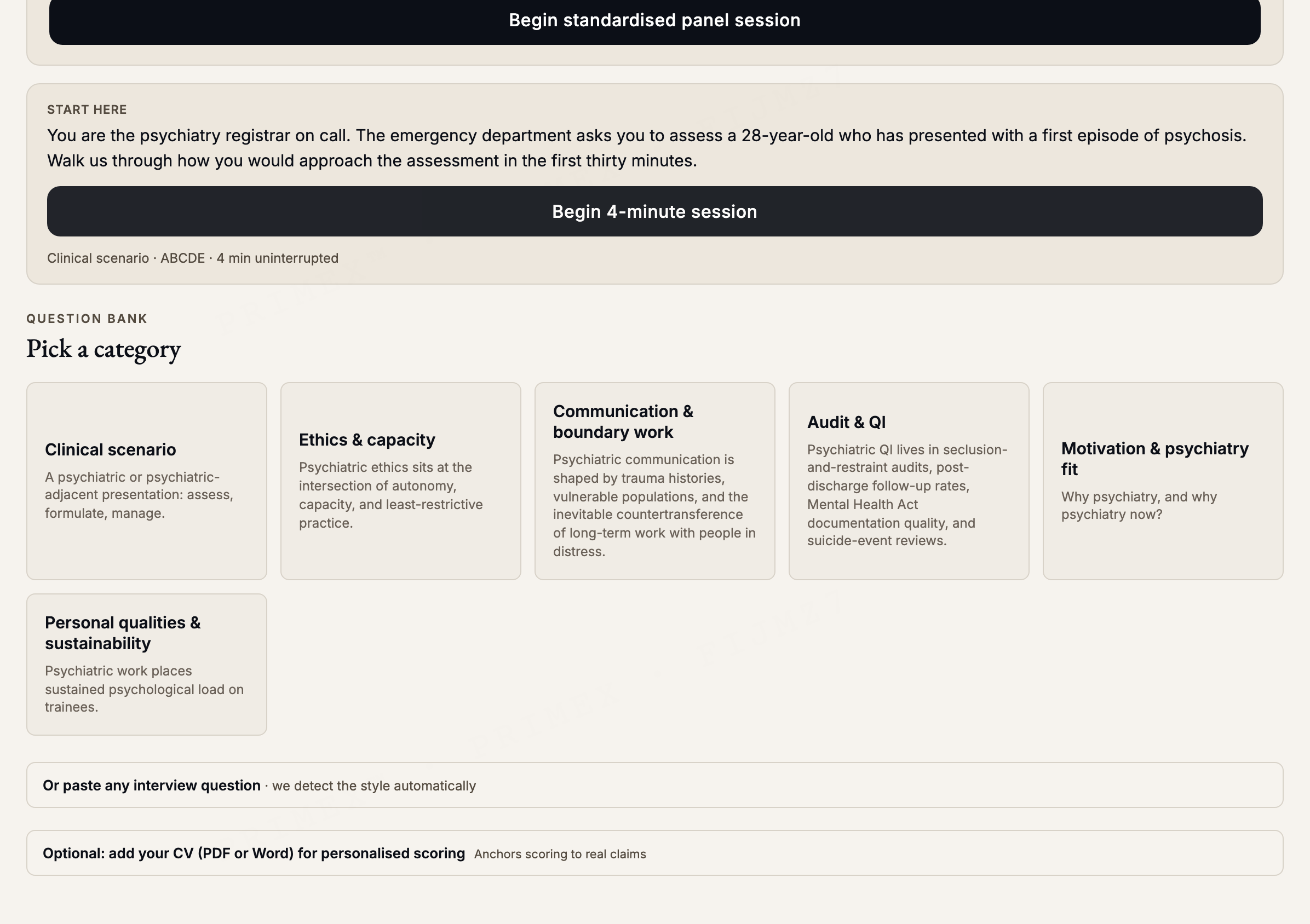
The RANZCP training selection interview is a standardised panel interview of six to eight questions, each two to three minutes, delivered by a panel of experienced psychiatrists working through a fixed question script. Victoria's PMCV process runs a one-way recorded video variant of the same format. The interview contributes 20% of the overall selection score; the remaining 80% comes from academic record, referee reports, psychiatric work experience, and four pre-rated criteria. PRIMEX replicates the panel format: one question at a time, no mid-answer probes, calibrated scoring after each answer.
- Six categories drawn from published selection criteria: motivation for psychiatry, foundations of psychiatric practice, ethics and capacity, communication and rapport, cultural safety (including Aboriginal and Torres Strait Islander health, and Maori health), and reflection and teamwork
- Question bank built around published RANZCP selection criteria and the eight weighted scoring domains: foundations of psychiatric practice, interpersonal and communication skills, teamwork ability, diverse experiences, and interview performance
- Primary frameworks scored per question: STAR-FR for behavioural stations, biopsychosocial formulation for clinical scenarios, SPIES for ethics and capacity stations, PEARLS for relational and communication stations
- CanMEDS roles rubric: scoring surfaces which of the seven RANZCP competency roles each answer demonstrates (Medical Expert, Communicator, Collaborator, Leader and Manager, Health Advocate, Professional, Scholar)
- Debrief after every answer: overall band, per-dimension scores, framework beat-by-beat trace, strongest moment, and the single highest-leverage thing to improve
- Victorian one-way video variant supported: the surface runs in the same uninterrupted monologue mode the PMCV recorded format uses
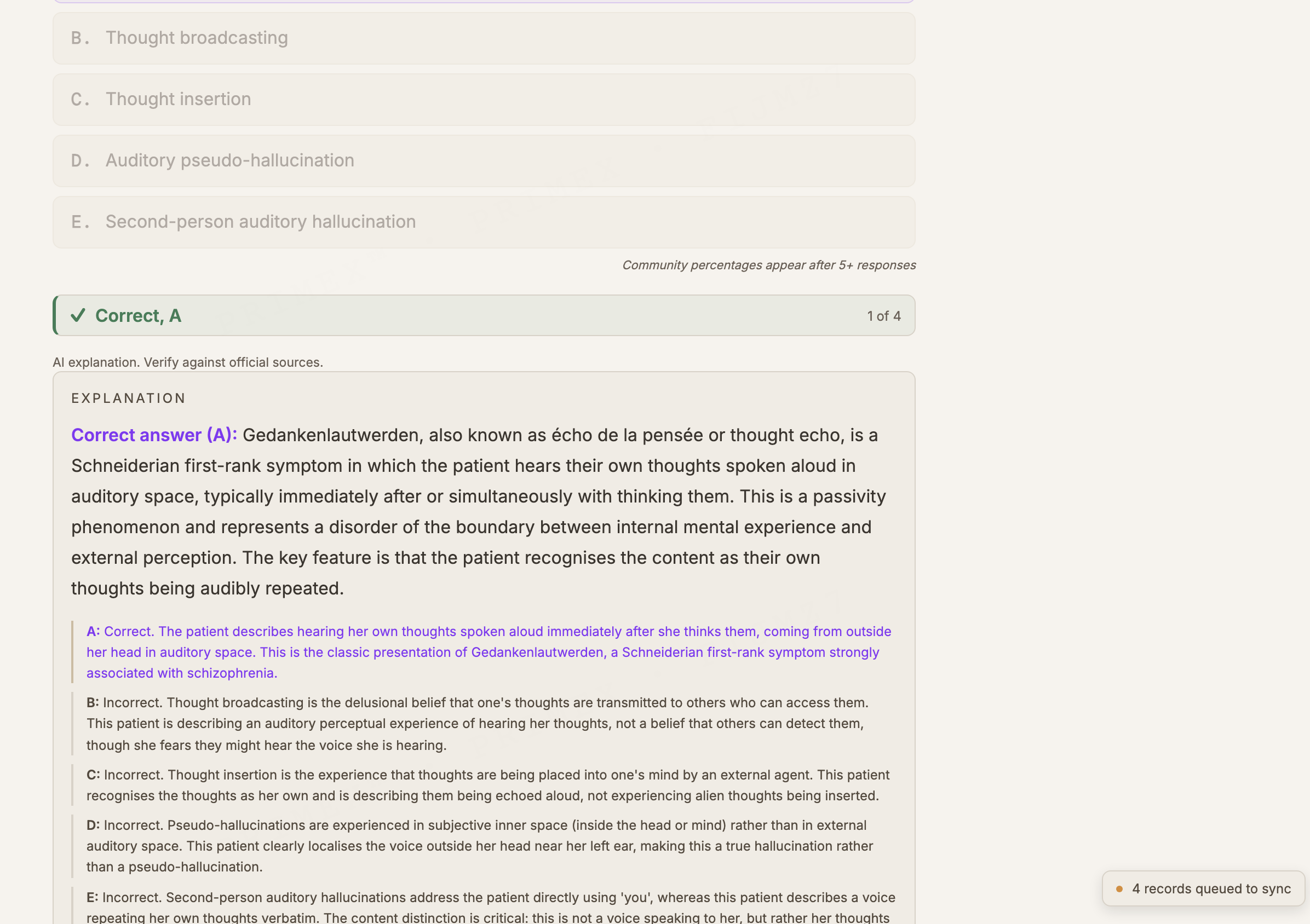
The RANZCP MCQ paper is Extended Matching Questions, not generic single-best-answer items. A themed option list of 7 to 10 diagnoses, drugs, or mechanisms appears once; a set of 3 to 6 short clinical stems each draw from the same list. PRIMEX generates EMQ themed sets across 28 psychiatry domains, covering the full MCQ paper blueprint from psychosis differentials and antipsychotic side effects through forensic, perinatal, and critical appraisal sets.
- EMQ format: shared option list (A to J) with multiple clinical stems per theme
- 28 themed sets covering the full MCQ paper blueprint
- Sourced to AUS/NZ guidelines: PBS, TGA, RANZCP CPGs, state Mental Health Acts
- Keyboard shortcuts A through J for rapid-fire option selection
- Explanation for every option, including the distractors
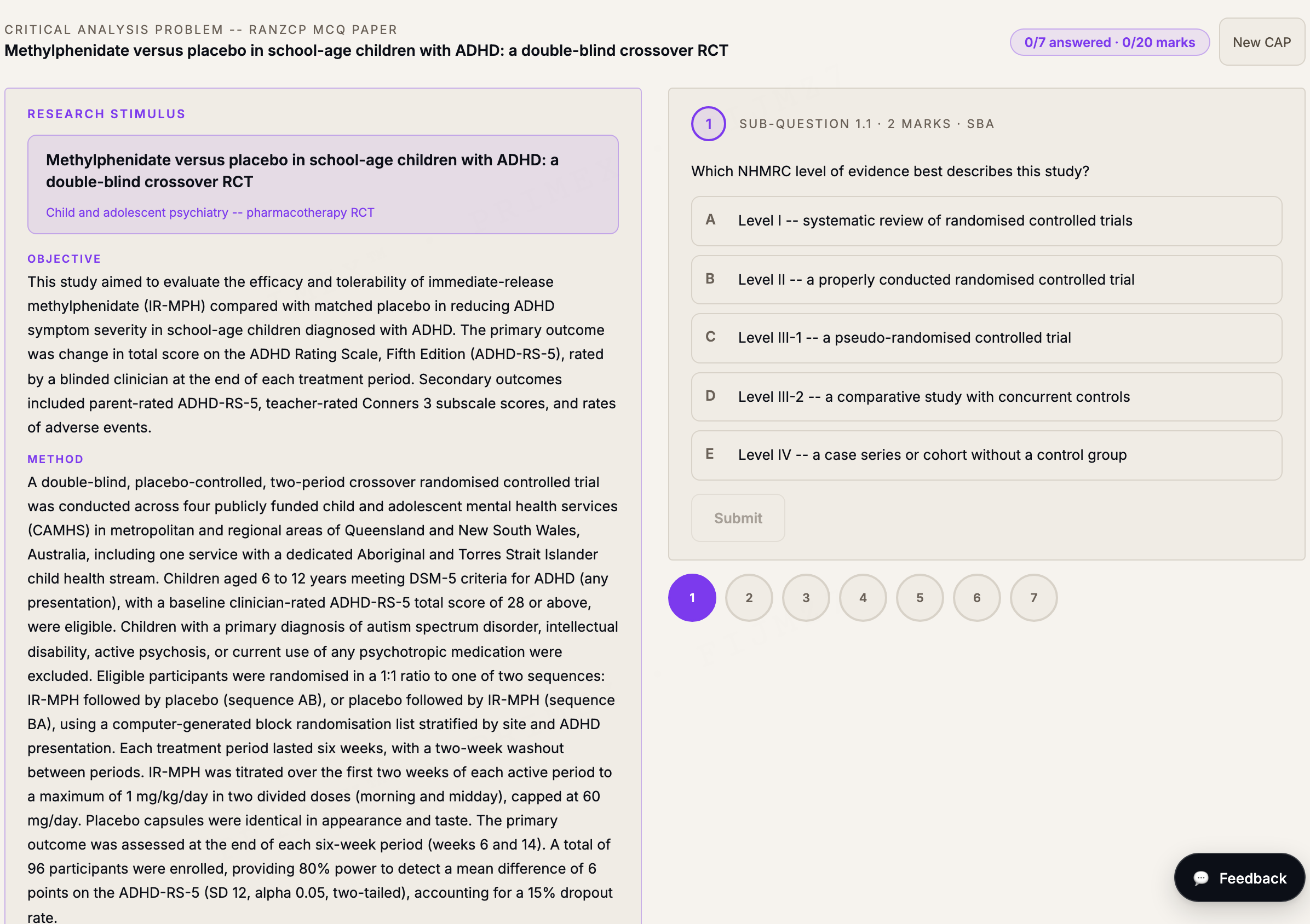
Each RANZCP MCQ paper contains two Critical Analysis Problems, each worth 20 marks. A CAP is a synthetic research abstract with two data tables, followed by 4 to 8 sub-questions on study design, bias type, statistical interpretation, NHMRC evidence levels, applicability, and research ethics. PRIMEX generates full CAPs on-demand across 12 psychiatry research domains, then grades your short-answer responses with examiner-style comments and a model answer.
- Synthetic abstract with two data tables, matching real CAP stimulus format
- 4 to 8 sub-questions on design, bias, statistics, evidence levels, and ethics
- Sub-questions sum to exactly 20 marks per CAP
- Short-answer grading: marks awarded, key points present and missing, model answer
- 12 seed themes across all CAP content domains: mood, psychosis, substance, perinatal, and more
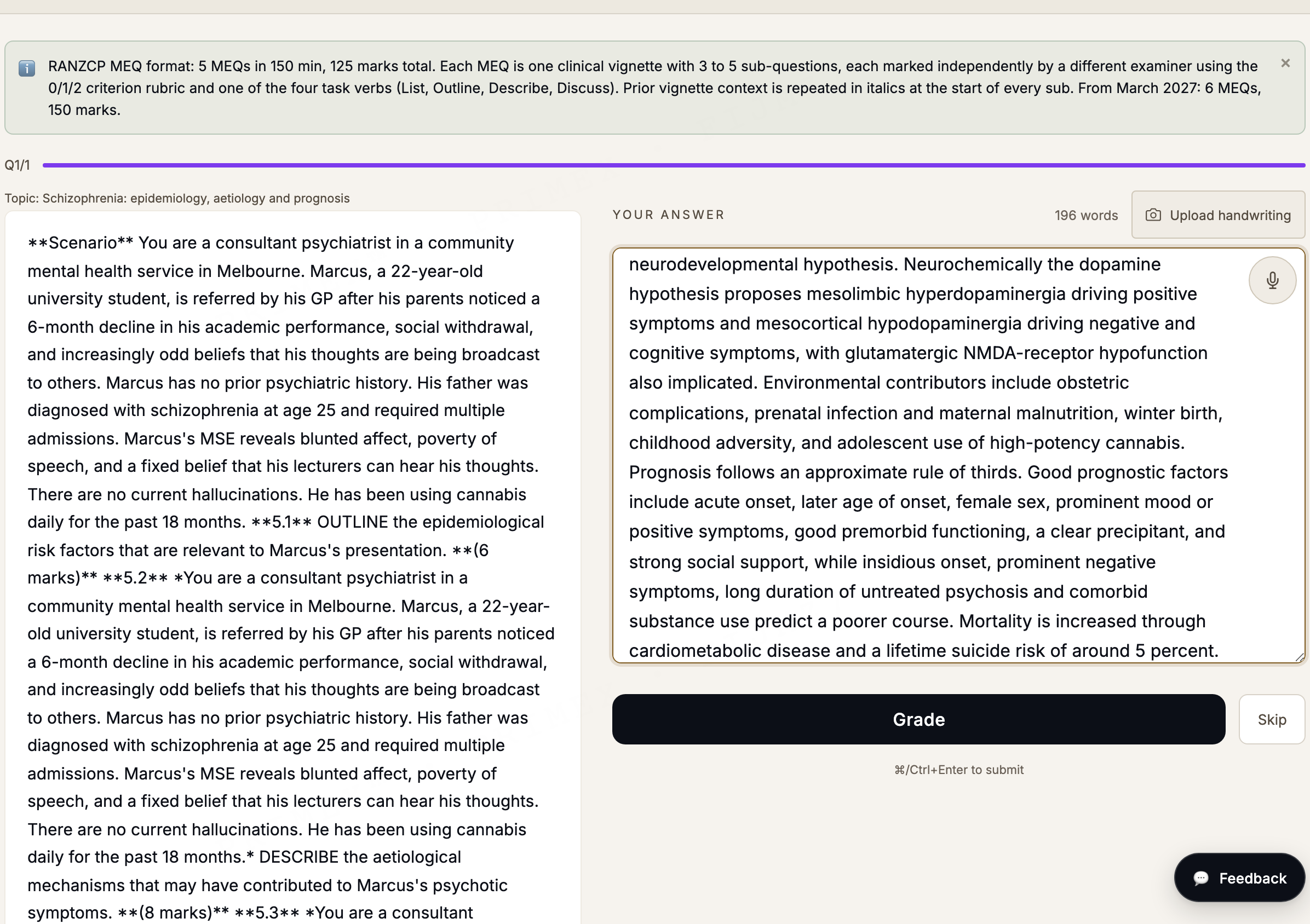
The RANZCP Written Examination is five MEQs in 150 minutes (computer-based from 2026). Each MEQ is a single clinical vignette with 3 to 5 sequential sub-questions, each carrying one of four RANZCP task verbs: List, Outline, Describe, or Discuss. The PRIMEX grader marks each sub independently using the correct verb rubric, shows a 0/1/2 criterion band for each marking point, and flags cross-references between subs as zero-scoring. A model answer at FRANZCP level is shown after each submission.
- Four task verbs: List, Outline, Describe, Discuss, each with its own marking standard
- Per-sub independent marking: cross-references between subs score zero
- 0/1/2 criterion band for each marking point, with a one-line criterion note
- March 2027 format shown in an info banner: 5 MEQs, 150 marks
- Model answer written at FRANZCP examiner standard
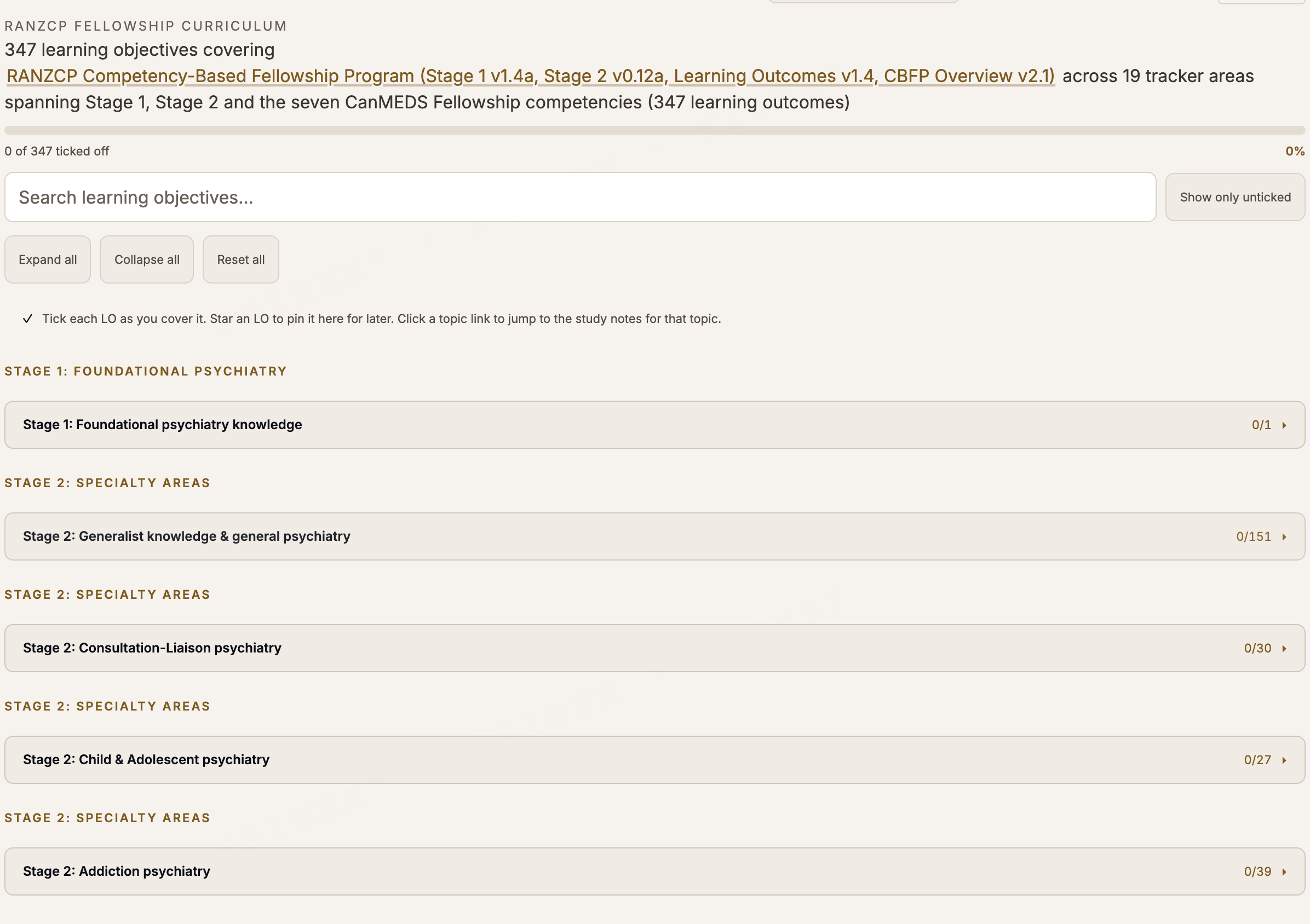
The tracker maps every one of the 347 RANZCP Fellowship learning outcomes across 19 groups: Stage 1 foundational psychiatry, Stage 2 specialty areas (generalist, child/adolescent, addiction, forensic, old age, psychotherapies, indigenous and Maori, rural, intellectual disability, perinatal, consultation-liaison), and the seven CanMEDS competency roles. Tick outcomes as you cover them, filter to unticked only, and track per-section progress. MCQ and MEQ sessions automatically mark linked outcomes.
- 347 LOs sourced directly from Stage 1, Stage 2, and CanMEDS syllabuses
- 19 tracker groups with stage-level dividers (Stage 1, Stage 2, CanMEDS)
- Per-section progress bars with ticked/total counts
- Search, filter to unticked, expand all, collapse all
- MCQ and MEQ activity auto-marks linked curriculum outcomes
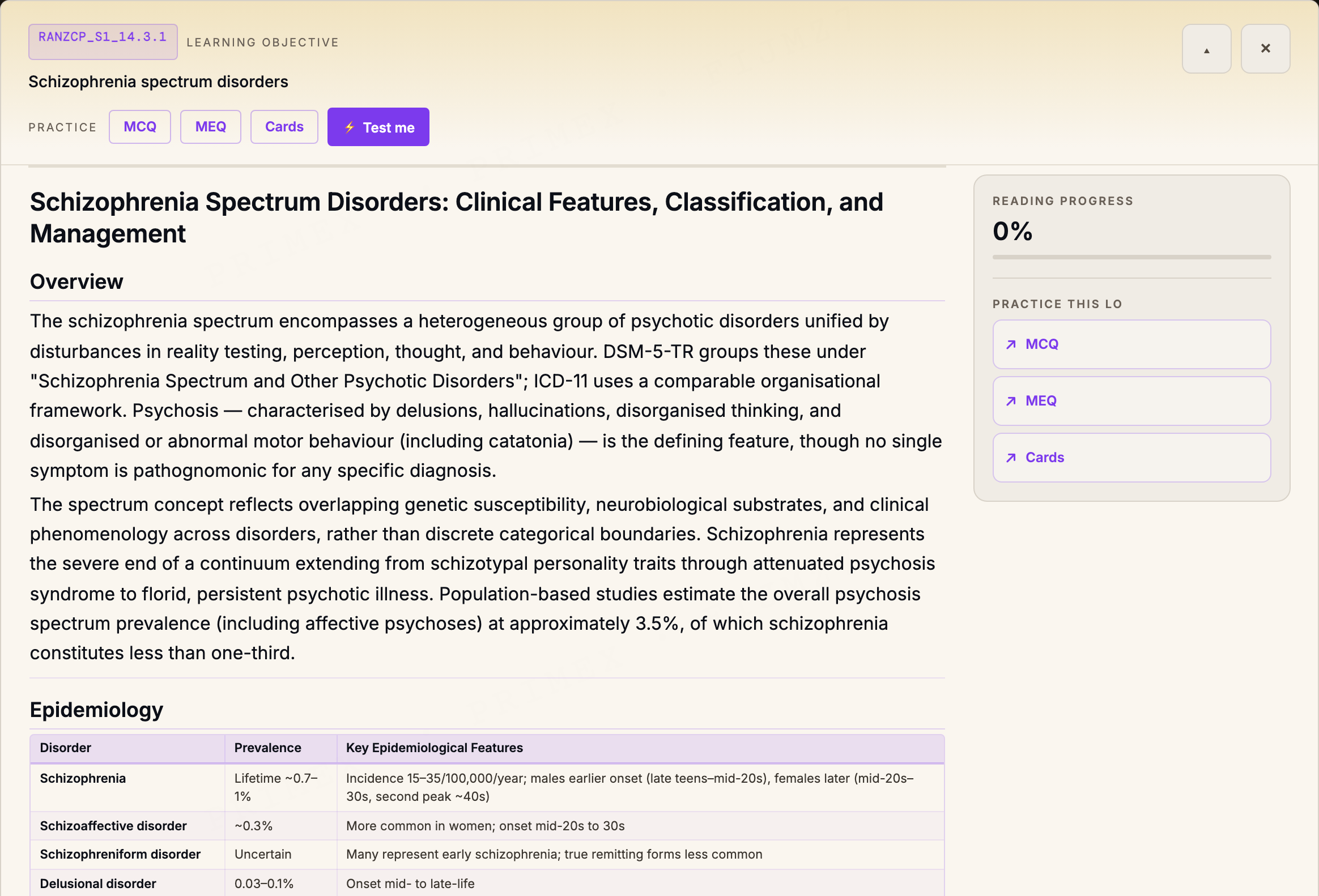
Sourced study notes across the RANZCP Fellowship blueprint: 329 notes spanning the 347 learning outcomes of the Stage 1 syllabus, Stage 2 specialty areas, and the seven CanMEDS competency roles. Each note averages over 2,200 words at FRANZCP examiner standard, structured for clinical application: phenomenology, differential, investigations, management, AUS/NZ medicolegal, and clinical pearls including MEQ traps. Sourced to AUS/NZ guidelines (PBS, TGA, RANZCP CPGs, state Mental Health Acts, NHMRC, Therapeutic Guidelines) with zero textbook citations.
- 329 study notes across the 347 Fellowship LOs
- Average 2,235 words per note, FRANZCP examiner standard
- AUS/NZ legislative and PBS specifics throughout: Mental Health Acts by state, CPMS clozapine monitoring, ATSI Social and Emotional Wellbeing framework, Maori Te Whare Tapa Wha
- Structured sections: phenomenology, criteria, investigations, management, medicolegal, clinical pearls, MEQ traps
- Linked from Curriculum Tracker for direct LO-to-note navigation
RANZCP Fellowship format and structure: MCQ, MEQ and the Clinical Competency Portfolio Review (CCPR)
The RANZCP Fellowship Program is 60 months FTE across three stages (12/24/24 months). The Written Examination has two components sitting in the same session: an MCQ paper of 140 items (Single Best Answer and Extended Matching Questions) plus two Critical Analysis Problems in 190 minutes, and an MEQ paper of five modified essay questions in 150 minutes, each a sequentially unfolding clinical vignette requiring biopsychosocial formulation, risk assessment, and management planning. The MEQ paper moves to computer-based delivery in 2026 and its total marks increase to 150 from March 2027 (five MEQs unchanged). The Fellowship is widely considered one of the most formulation-demanding written exams in Australian specialist training. PRIMEX is built by Dr Jay Marshall, an anaesthetics registrar in Taree, NSW.
- OrganiserRoyal Australian and New Zealand College of Psychiatrists (RANZCP)
- FormatMCQ paper: 140 items (SBA + EMQ) + 2 Critical Analysis Problems, 190 minutes. MEQ paper: 5 MEQs, 150 minutes (computer-based from 2026; total marks increasing to 150 from March 2027, five MEQs unchanged).
- Curriculum347 Fellowship LOs: Stage 1 syllabus (81 LOs, 14 sections), Stage 2 syllabus (230 LOs, areas A to K), and CanMEDS competency outcomes (36 LOs, 7 roles).
- DomainsNeuroscience, Psychopharmacology, Critical Appraisal, Adult Psychiatry, Child and Adolescent, Old Age, Addiction, Forensic, Consultation-Liaison, Intellectual Disability, Research, Ethics and Law
- SittingsWritten Examination: March and September each year (2026 MCQ 20 Mar & 18 Sep; MEQ 3 Mar & 1 Sep)
- Pass rateRANZCP publishes per-sitting pass rates in Post-Examination Reports (e.g. MCQ 79%, Aug 2024); rates vary by component and sitting. See RANZCP exams
Free notes are just the start.
Get 329 study notes, unlimited question practice and the full exam simulator. Free for 7 days, then from A$44.99/month.
Start free trial, 7 days free Cancel anytime · no commitmentCommon questions about the RANZCP Fellowship exam
Specialist pricing and 7-day free trial
Specialist unlocks every PRIMEX exam track: the specialist pathways, AMC and Medical Student. Every study tool is included, with no per-feature paywalls.
- ✓ Every exam track: specialist pathways, AMC & Medical Student
- ✓ Flashcards with spaced repetition & MCQ drill
- ✓ Study notes for every curriculum topic
- ✓ SAQ library & sessions
- ✓ Study plan with pace tracking
- ✓ Curriculum tracker & readiness insights
- ✓ Every exam track: specialist pathways, AMC & Medical Student
- ✓ Flashcards with spaced repetition & MCQ drill
- ✓ Study notes for every curriculum topic
- ✓ SAQ library & sessions
- ✓ Study plan with pace tracking
- ✓ Curriculum tracker & readiness insights
- ✓ Every exam track: specialist pathways, AMC & Medical Student
- ✓ Flashcards with spaced repetition & MCQ drill
- ✓ Study notes for every curriculum topic
- ✓ SAQ library & sessions
- ✓ Study plan with pace tracking
- ✓ Curriculum tracker & readiness insights
You'll land on a confirmation page. Tap the sign-up button (or sign in if you already have an account) and your subscription links automatically. If you close the page first, just use the same email when you sign up and it'll still link.