
RCPA Haem / classify it.
202 sourced study notes across the RCPA Haematology curriculum. AI grading for the Part I Written and Dry Practical, plus an oral viva simulator for the Part I and Part II Oral. 10,468 LO-aligned spaced-repetition flashcards. Built for the precision haematology demands.
Your PRIMEX account, now in your pocket.
Specialist unlocks every PRIMEX exam track. Accessible is limited to AMC and Medical Student. Subscribe on the website or in the iPhone app, then use the same account to keep your access and progress together.

RCPA Haematology Exam Dates 2026
Published dates for the upcoming sittings. Always confirm against the official RCPA examinations page before scheduling. I refresh this section quarterly as new windows are announced.
- Part I, Written PaperFri 29 May 2026 (online, 3h 15m)
- Part I, Digital Slides (Morphology)Sat 30 May 2026 (online/local, 3h 15m)
- Part I, Dry PracticalFri 31 Jul 2026 (online, 3h 15m)
- Part I, Oral ExaminationSat 8 Aug 2026 (local, all day)
- Part II, Oral ExaminationSun 9 Aug 2026 (local, all day)
- Part II Repeat, OralSat 7 Nov 2026 (local, all day)
Written + practical exams delivered online via the College's risr/assess + Proctor Exam platform. 2026 applications closed Sat 28 Feb 2026.
Inside PRIMEX, in under a minute
Recorded in the app, with real RCPA Haematology questions and notes. No sound needed to follow it.
Topics tested in the RCPA Haematology exam
How candidates prepare for the RCPA Haematology
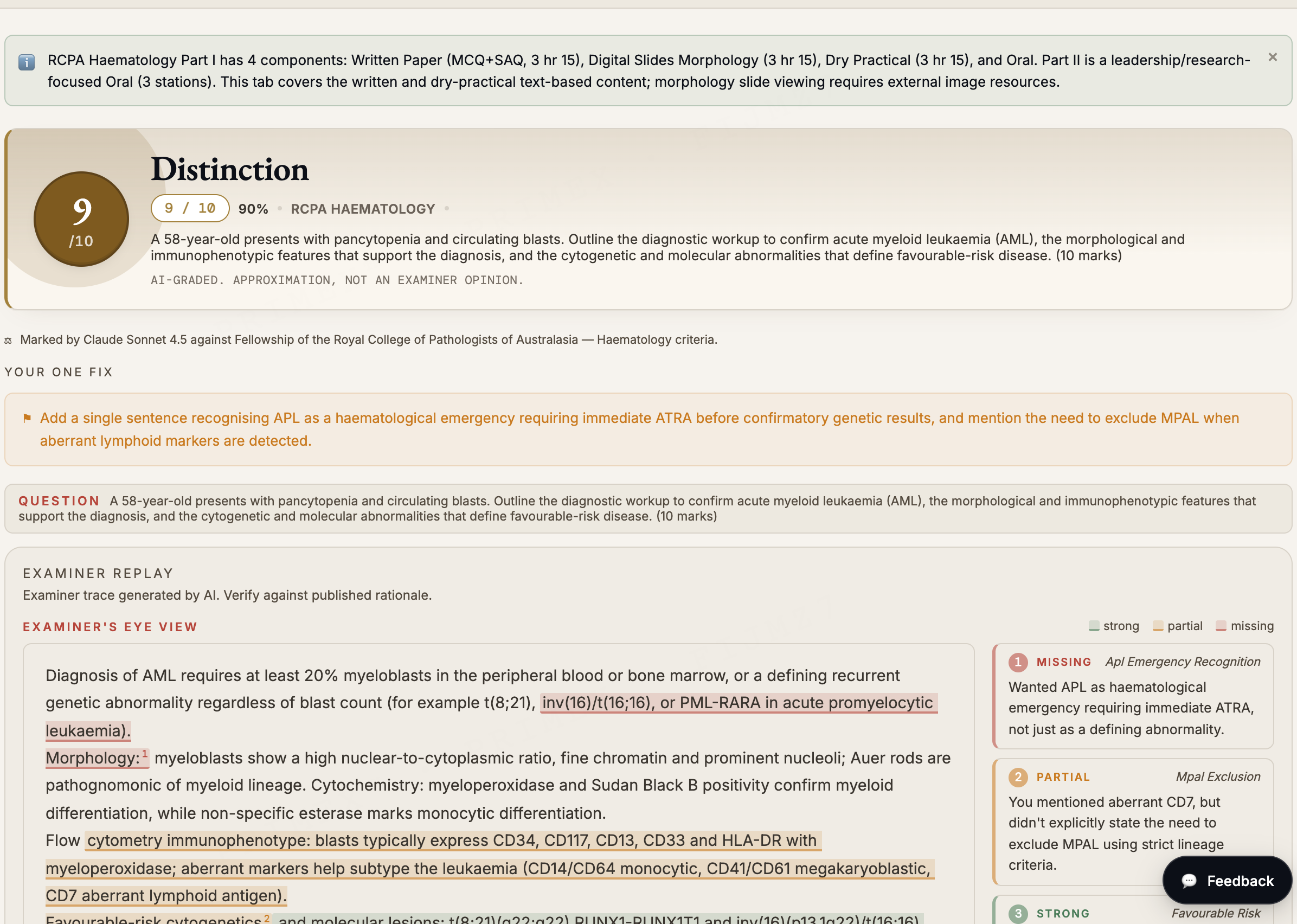
The RCPA Haematology Part I Written exam is a short-answer paper (15 SAQs, 3 hr 15 min) covering basic haematology sciences and laboratory methods; the MCQ practice on PRIMEX maps to the separate Basic Pathological Sciences (BPS) gateway paper. The Dry Practical (3 hr 15 min, a separate component) tests laboratory data interpretation: coagulation panels, FBCs, electrophoresis, flow cytometry numbers, transfusion serology, and cytogenetics. PRIMEX grades your responses against specific numerical thresholds, the kind RCPA examiners note candidates consistently miss (e.g. ADAMTS13 <10% for TTP, blast count ≥20% for AML by WHO).
- Part I Written: SAQ grading across all haematology topic areas (MCQ practice maps to the separate BPS gateway)
- Dry Practical: laboratory data interpretation feedback, coagulation panels and flow cytometry integration
- Specific numerical thresholds checked: ADAMTS13 <10%, blast %, Glucksberg grade cut-offs, ISTH DIC score
- Common candidate errors flagged: FAB 30% blast threshold vs WHO 20%, APL as haematological emergency
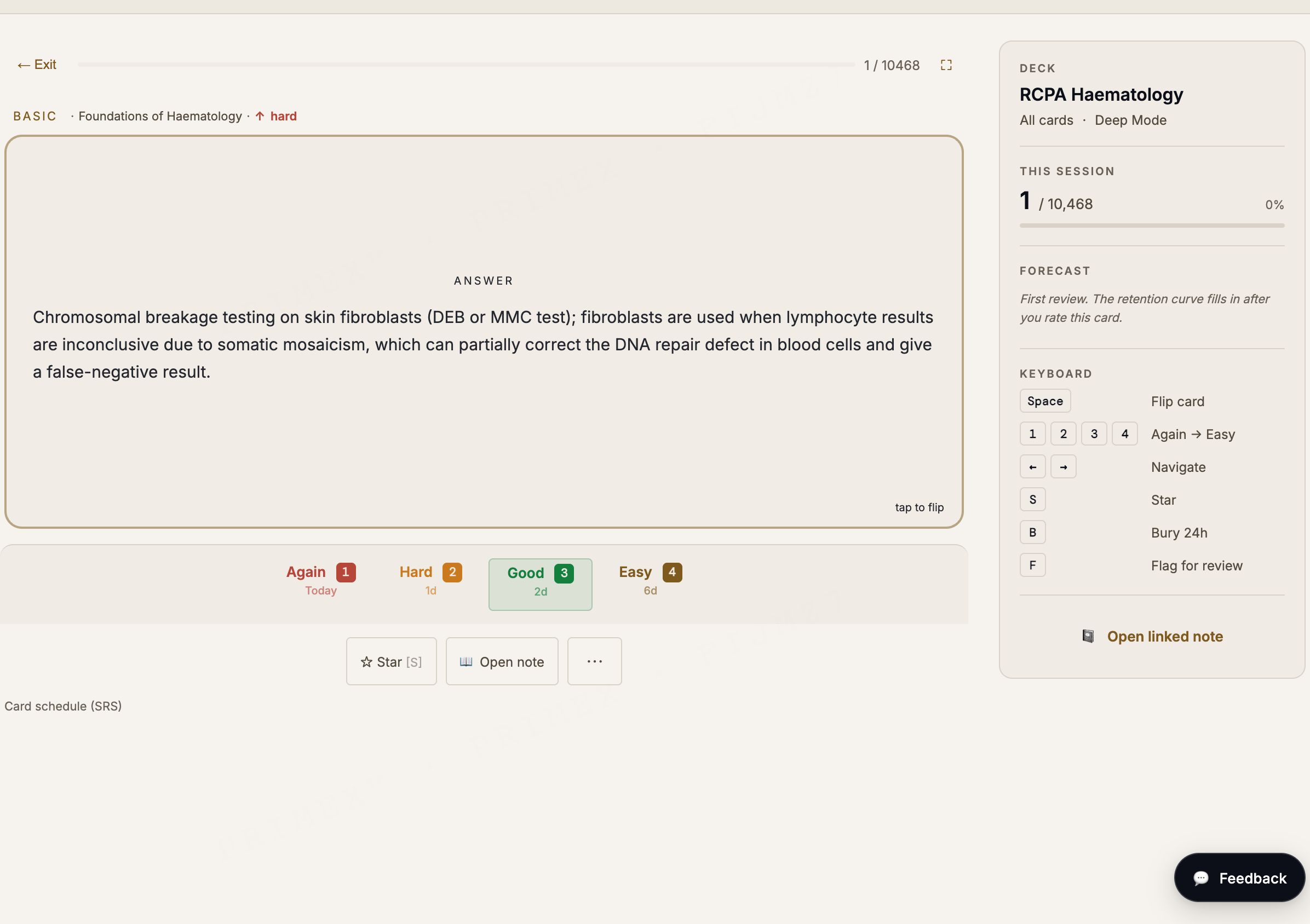
10,468 spaced-repetition flashcards aligned to the curriculum's learning-objective structure across the 223 LOs, with values-first cards because in haematology the number is the diagnosis. Card types include peripheral-blood-film morphology, flow cytometry markers, coagulation values, and transfusion thresholds. Each card ID is linked to an RCPA Haematology LO so cards surface alongside the relevant study note.
- Rebuilding per learning objective across malignant haematology, coagulation, red cell disorders, and transplantation
- Planned card types: WHO 2022 AML subtypes, IMWG myeloma criteria, DLBCL GCB/ABC, FLIPI; cytogenetics (t(15;17), t(8;21), inv(16), BCR-ABL1, del(17p), JAK2/CALR/MPL)
- Numerical threshold cards planned: ADAMTS13, ISTH DIC, Glucksberg, Sokal, 4T HIT
- One click from card to full study note when the deck lands
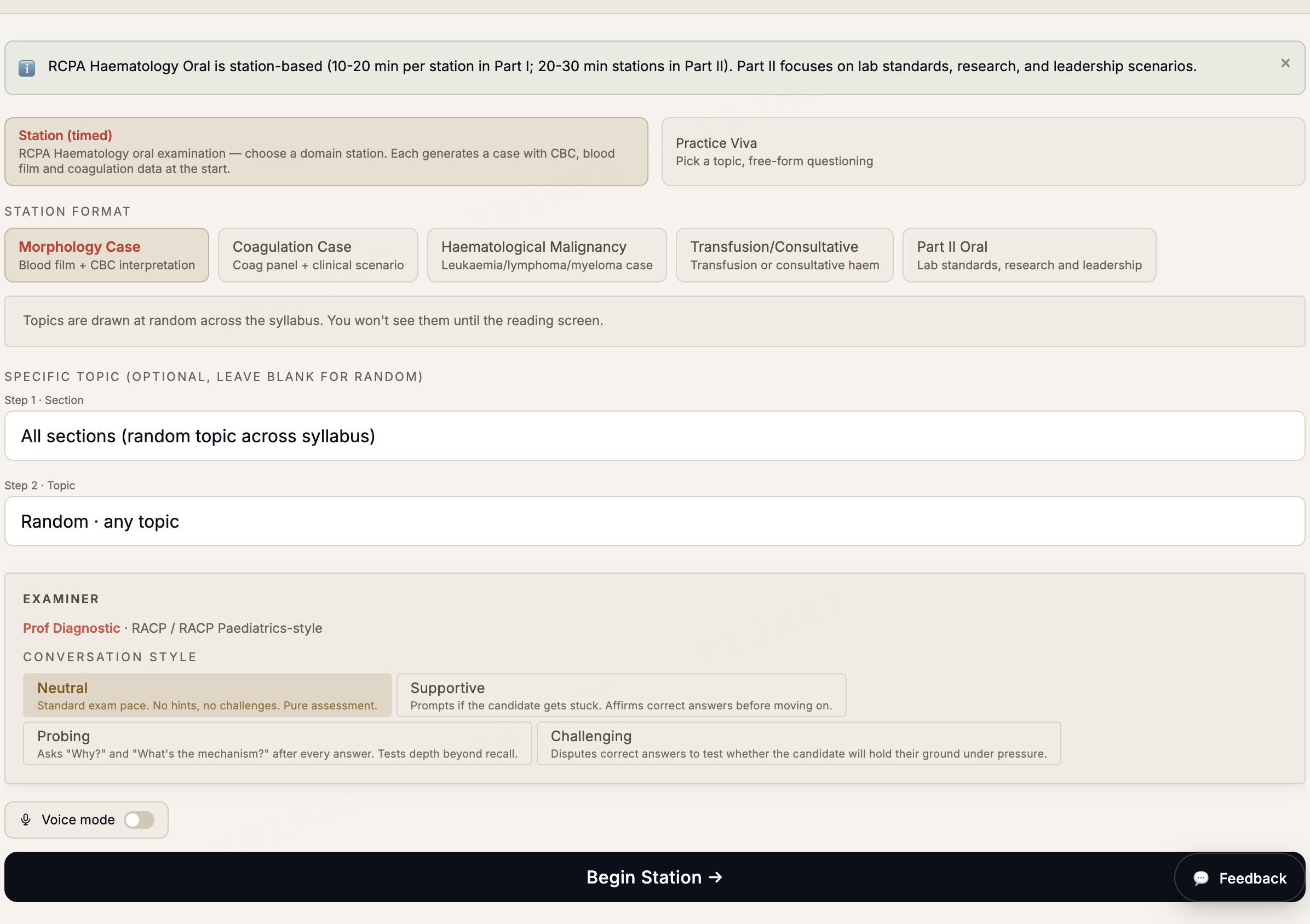
The RCPA Haematology Oral spans both parts of the exam. Part I Oral is station-based (10-20 min per station), with all candidates receiving the same structured questions; clinical vignettes with CBC, blood film description, coagulation studies, flow cytometry, cytogenetics, and molecular results. Part II Oral is a structured all-day Oral examination focused on haematology lab standards, research standards, and lab innovation and leadership. PRIMEX's viva simulator probes systematic interpretation, differential diagnosis, confirmatory investigations, and management at the depth both parts require.
- Integrated data vignettes: CBC + blood film + coagulation + flow cytometry + cytogenetics presented together
- High-yield scenarios: APL emergency (t(15;17) → ATRA immediately), AML with FLT3/NPM1, CLL with del(17p), HIT (day 5 post-cardiac surgery), TTP vs HUS, myeloma CRAB criteria
- Mechanism probes: "Why does del(17p) predict chemoimmunotherapy failure?", "What is the pathophysiology of TRALI?"
- Management with specific drug names, doses, and monitoring parameters
Work through a full mock viva out loud with this college's AI examiner, in real time. Answer by voice, get probed and interrupted like you would in the real viva, then step out to a graded debrief: how you performed on the station, the topics you covered, your strengths and gaps, and how you handled the pressure. Every mock viva feeds your weak-topic plan, so what to practise next is always clear.
- Real-time spoken viva in this college's examiner voice, fully interruptible
- Graded debrief on every station: your performance tier, the topics you covered, and the gaps to close
- Communication and composure feedback: pacing, hesitation, clarity under pressure
- Weak topics flow straight into your study plan and daily practice
- Part of PRIMEX Pro, with monthly mock vivas included
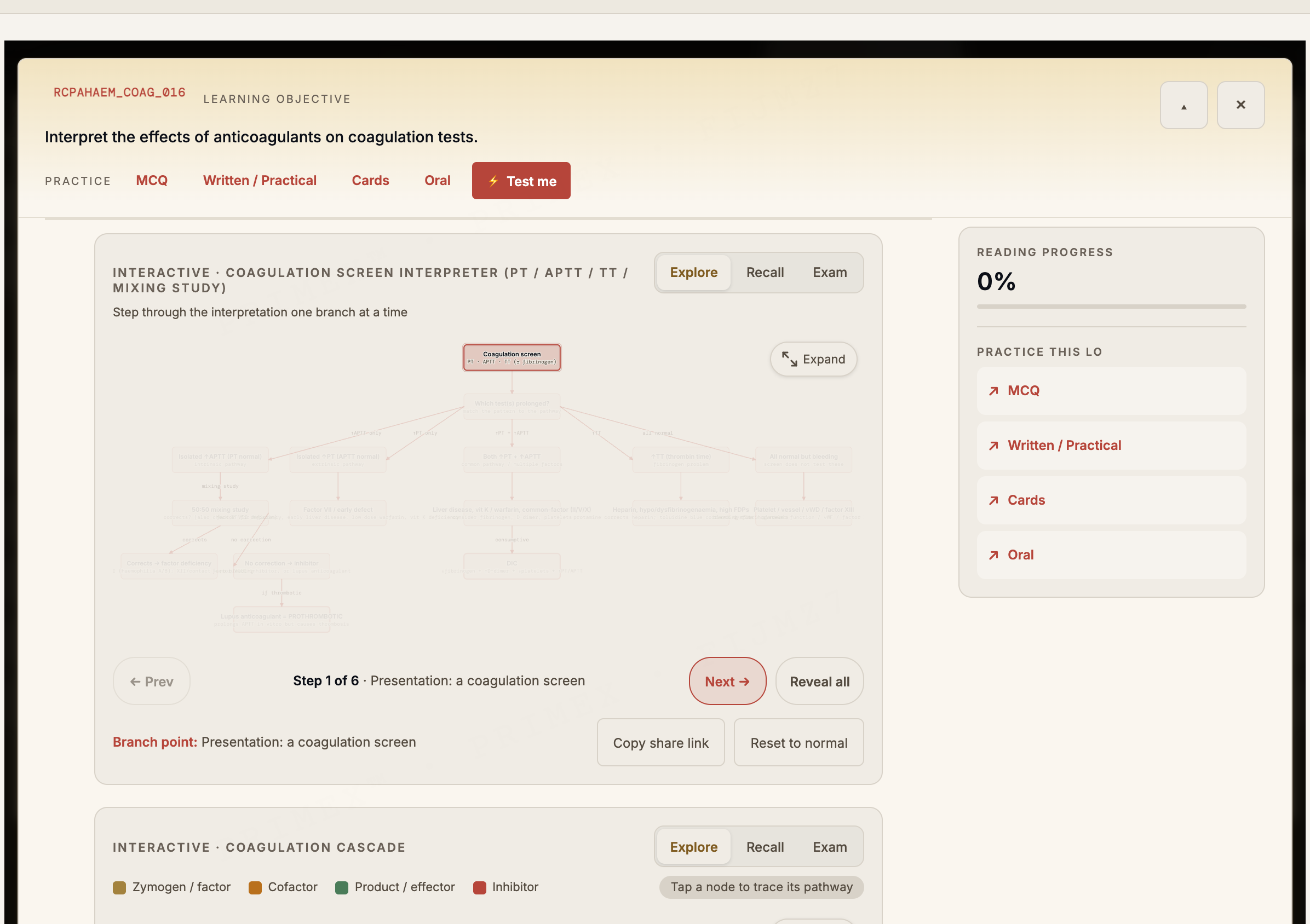
202 sourced study notes across the RCPA Haematology curriculum, one for every covered learning objective. Each follows a structured format: pathophysiology, classification (WHO 2022 where relevant), laboratory diagnosis, treatment with specific agents and thresholds, and exam focus. Cytogenetic and molecular data sit in clinical context, linking the mutation to the treatment decision.
- 202 study notes across the RCPA Haematology curriculum, one per covered LO: malignant, coagulation, red cell, transplantation, laboratory
- WHO 2022 classification criteria with numerical thresholds in every relevant note
- Treatment notes: TKIs for CML, ibrutinib/venetoclax for CLL del(17p)/TP53, proteasome inhibitors for myeloma, ATRA for APL
- References to current ASH guidelines, Australian Haematology and Blood Cancer Group (AHBCG) guidelines, and landmark trials
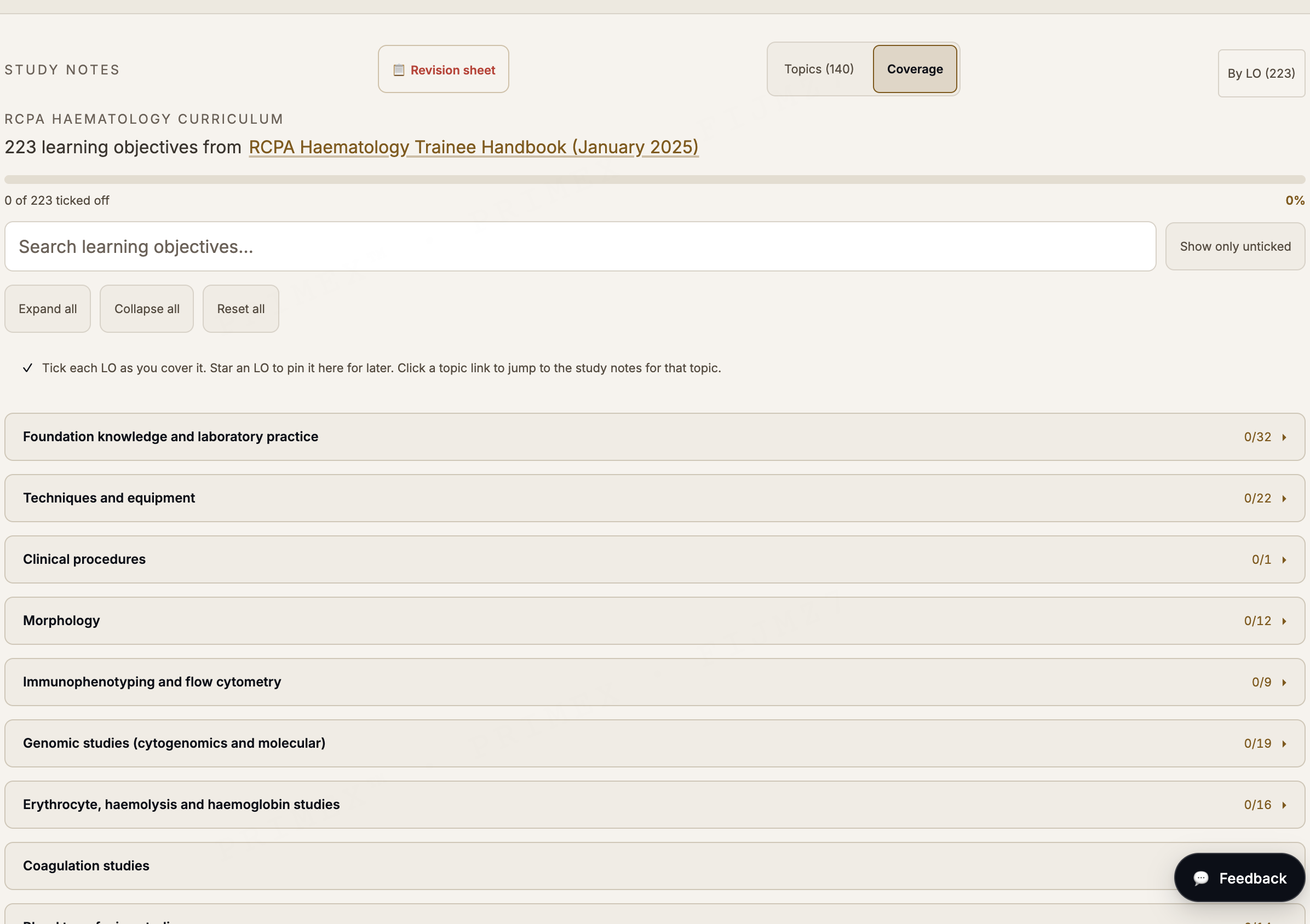
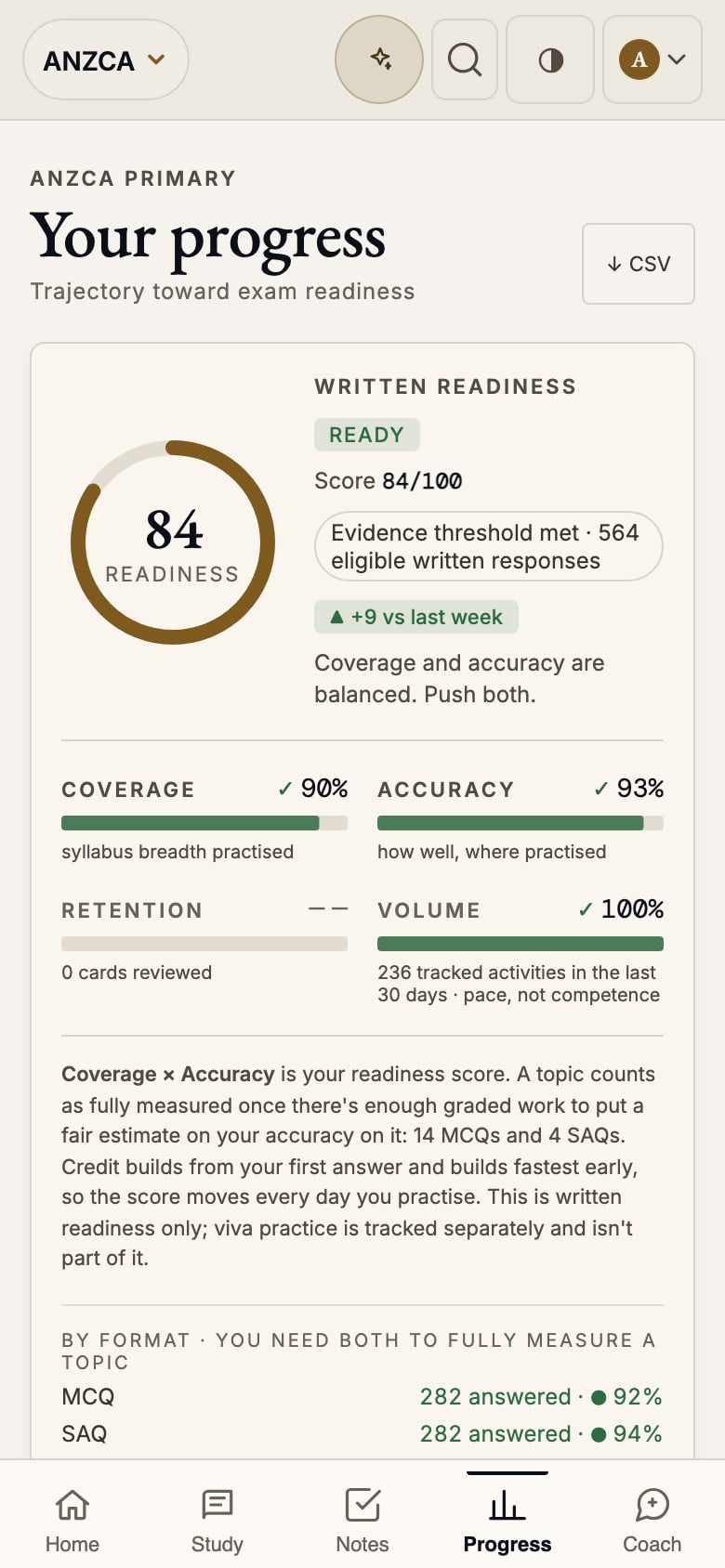
223 LOs is a large curriculum to manage. PRIMEX's curriculum tab organises every LO by haematology domain (malignant, benign, coagulation, transfusion, laboratory, transplantation), with per-domain progress bars so you can see exactly which areas need another pass before the Part I Written, Dry Practical, and Oral components, and the Part II Oral.
- RCPA Haematology LOs mapped across domains
- Checkbox completion persisted to localStorage
- Per-domain progress bars showing coverage across all Part I and Part II components
- High-yield LOs flagged: APL emergency management, ADAMTS13 threshold, AML WHO 2022 defining abnormalities that override blast count
RCPA Haematology format and structure
The RCPA Haematology Fellowship Examination is conducted by the Royal College of Pathologists of Australasia (RCPA). Part I has 4 separately scheduled components: a Written Paper (15 SAQs, 3 hr 15 min), Digital Slides Morphology (3 hr 15 min, blood films and bone marrow cases with structured SAQs), a Dry Practical (3 hr 15 min, laboratory data interpretation without wet bench work), and an Oral (station-based, 10-20 min per station, all candidates receive the same structured questions). All Part I components must be passed; results are not compensable within a sitting.
Part II is a structured Oral examination only, scheduled as an all-day session, with a focus on haematology lab standards, research standards, and lab innovation and leadership. Part II operates at a consultant and leadership scope, distinct from the Part I clinical and laboratory content. RCPA Haematology trainees must demonstrate precise knowledge of WHO 2022 classification criteria, specific numerical thresholds (ADAMTS13, blast counts, 4T scores), and the ability to integrate multi-parameter laboratory data across all components. RCPA publishes no aggregate pass rate; it releases individual candidate results only. PRIMEX is built by Dr Jay Marshall, an anaesthetics registrar in Taree, NSW.
- OrganiserRoyal College of Pathologists of Australasia (RCPA)
- Part I Written15 SAQs, 3 hr 15 min; basic haematology sciences and laboratory methods
- Part I Digital Slides3 hr 15 min; blood films and bone marrow aspirate/trephine cases, structured SAQs per case
- Part I Dry Practical3 hr 15 min; coagulation panels, FBCs, electrophoresis, flow cytometry numbers, transfusion serology, cytogenetics
- Part I OralStation-based, 10-20 min per station; all candidates receive the same structured questions
- Part II OralStructured all-day Oral examination; lab standards, research standards, lab innovation and leadership
- Curriculum223 LOs across haematology domains; one of the most LO-intensive curricula in Australian specialty training
Free notes are just the start.
Get 202 study notes, 10,468 spaced-repetition flashcards, unlimited question practice and the full exam simulator. Free for 7 days, then from A$44.99/month.
Start free trial, 7 days free Cancel anytime · no commitmentCommon questions about the RCPA Haematology exam
Specialist pricing and 7-day free trial
Specialist unlocks every PRIMEX exam track: the specialist pathways, AMC and Medical Student. Every study tool is included, with no per-feature paywalls.
- ✓ Every exam track: specialist pathways, AMC & Medical Student
- ✓ Flashcards with spaced repetition & MCQ drill
- ✓ Study notes for every curriculum topic
- ✓ SAQ library & sessions
- ✓ Study plan with pace tracking
- ✓ Curriculum tracker & readiness insights
- ✓ Every exam track: specialist pathways, AMC & Medical Student
- ✓ Flashcards with spaced repetition & MCQ drill
- ✓ Study notes for every curriculum topic
- ✓ SAQ library & sessions
- ✓ Study plan with pace tracking
- ✓ Curriculum tracker & readiness insights
- ✓ Every exam track: specialist pathways, AMC & Medical Student
- ✓ Flashcards with spaced repetition & MCQ drill
- ✓ Study notes for every curriculum topic
- ✓ SAQ library & sessions
- ✓ Study plan with pace tracking
- ✓ Curriculum tracker & readiness insights
You'll land on a confirmation page. Tap the sign-up button (or sign in if you already have an account) and your subscription links automatically. If you close the page first, just use the same email when you sign up and it'll still link.