
Med Student / start here.
600+ curated OSCE stations across 20 clinical disciplines, plus image-anchored practice spanning nine specialties (dermatology, cardiology, respiratory, abdominal, neurology, paediatrics, orthopaedics, endocrine and eye), 12,522 spaced-repetition flashcards, and study notes across 608 clinical topics in 30 specialties. The platform that covers your clinical finals, then stays with you through fellowship.
Your PRIMEX account, now in your pocket.
Accessible is limited to AMC and Medical Student. Specialist unlocks every PRIMEX exam track. Subscribe on the website or in the iPhone app, then use the same account to keep your access and progress together.

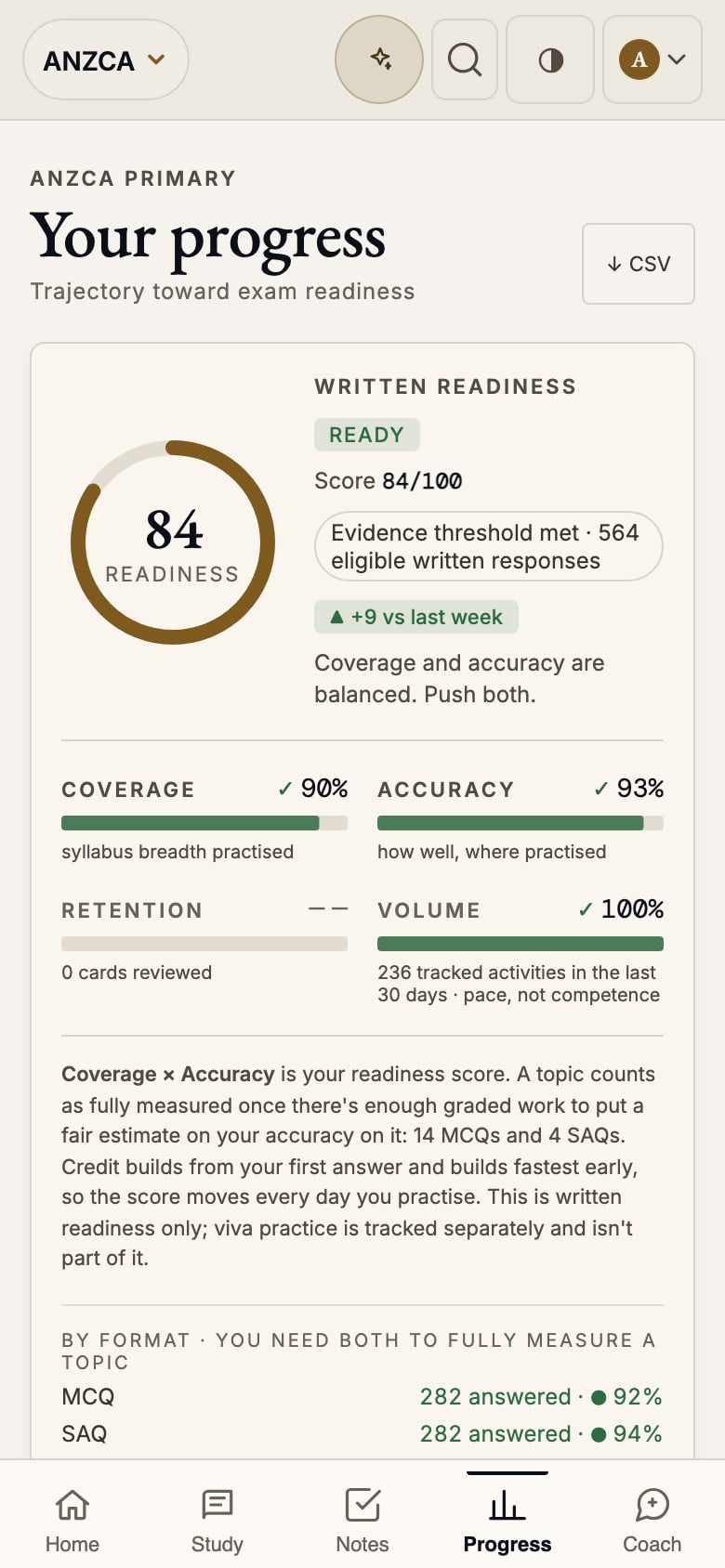
Inside PRIMEX, in under a minute
Recorded in the app, with real Medical Student Finals questions and notes. No sound needed to follow it.
Topics tested in the Australian medical student finals exam
How candidates prepare for the Australian medical student finals
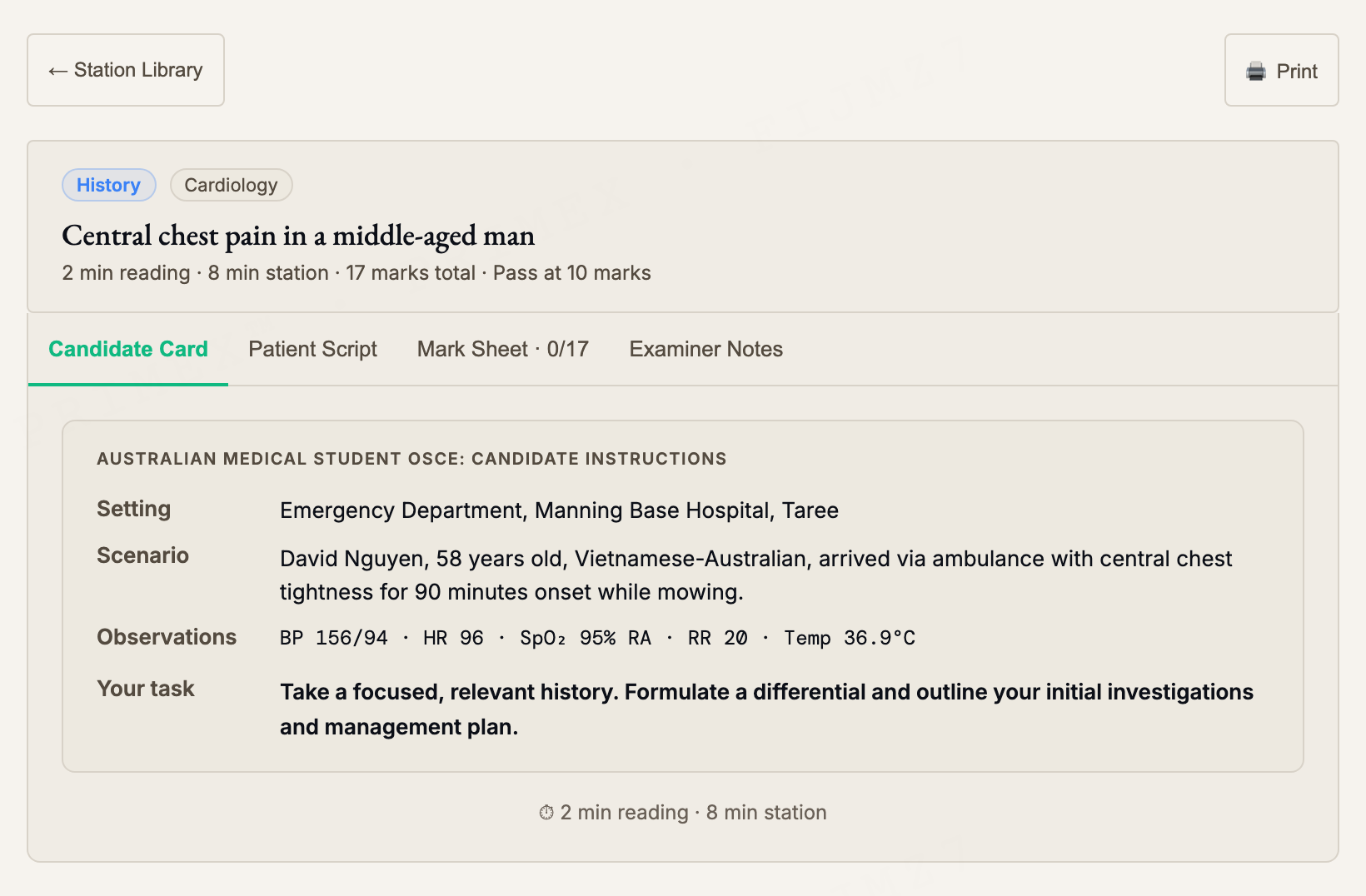
Clinical finals OSCEs vary by university but test the same core skills: history-taking, clinical examination, explanation/counselling, procedural description, ethics/communication, and acute management. The PRIMEX OSCE bank holds 600+ curated stations calibrated to final-year student level, not intern, across all Australian medical schools, with Australian eTG-aligned management and mandatory reporting obligations built in.
- 600+ curated OSCE stations across all 6 types: history, examination, explanation/counselling, procedural description, ethics/communication, and dynamic emergency
- Timed like exam day: enforced reading time, station countdown, scripted examiner questions and a two-minute call
- Dynamic emergency stations where the patient deteriorates mid-station (arrest, anaphylaxis, seizures) and you run the response against the clock
- Examination stations run by voice: you say what you are examining and a separate examiner voice reports the findings, then you present your differential, the way a real OSCE circuit works
- Final-year student competency standard, not intern or fellowship
- Australian context throughout: eTG drug names, Medicare, NDIS, bulk-billing, Australian referral pathways
- Communication stations graded on structure, rapport, ICE (ideas, concerns, expectations), plain language, and checking understanding
- Cultural safety and Indigenous Australian health included in appropriate scenarios
- Examiner feedback on clinical accuracy, communication quality, and patient-centred approach
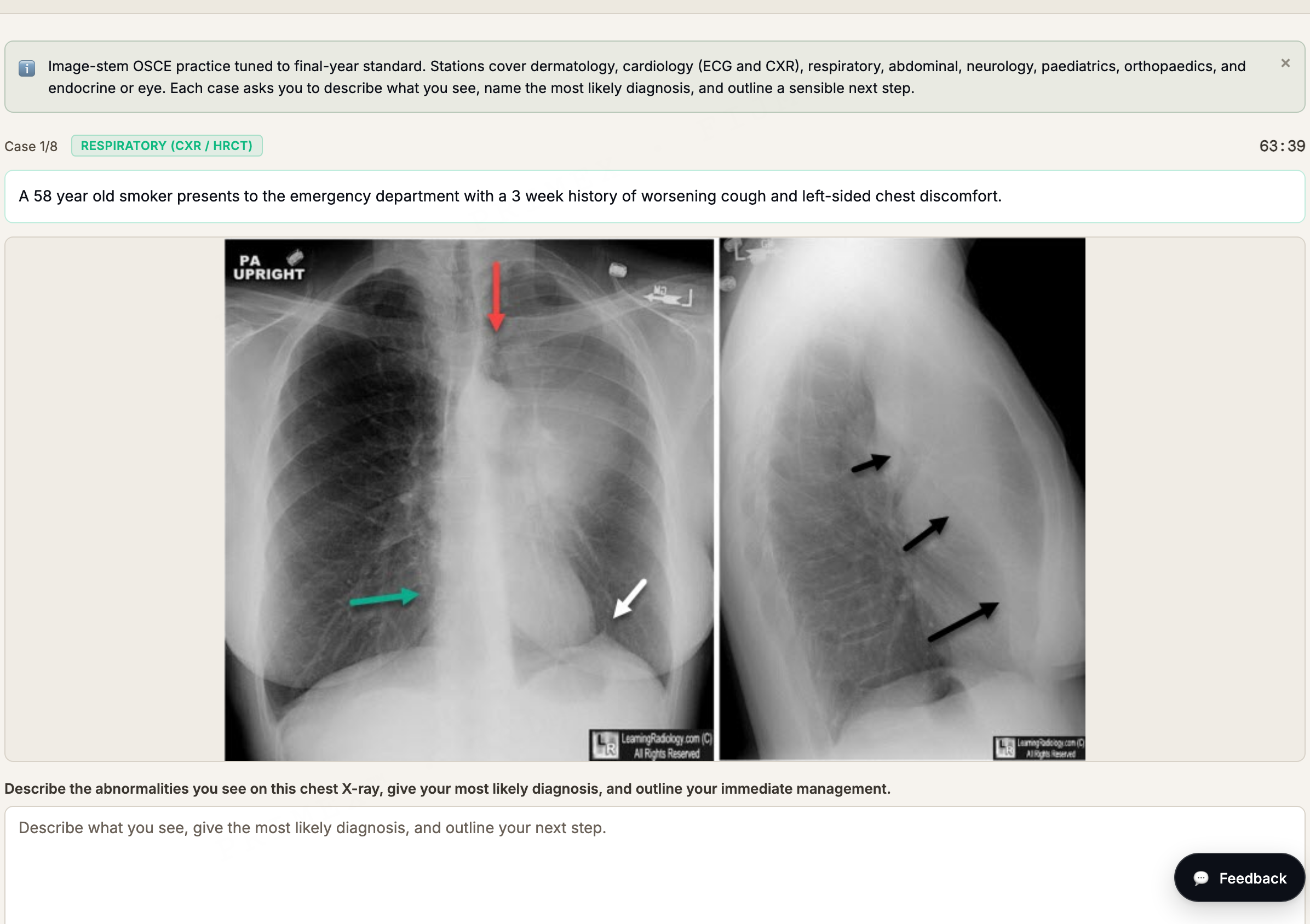
Beyond the structured 600-station OSCE bank, PRIMEX runs an image-anchored mode where each case opens with a real clinical image (dermatology photo, ECG, CXR, abdominal CT, neuroimaging, paediatric finding, X-ray, fundoscopy, or otoscopy) and asks you to describe what you see, name the most likely diagnosis, and outline a sensible next step. Eight specialty buckets, each backed by a real per-exam image library. Graded at final-year medical-student standard, not registrar.
- Eight specialty themes: dermatology, cardiology (ECG and CXR), respiratory (CXR and HRCT), abdominal and GI, neurology (CT head and MRI), paediatrics, orthopaedics (X-ray), endocrine and eye (fundoscopy, otoscopy)
- Real per-specialty image library: dermatology photos, PTB-XL ECG renders, sourced chest radiographs, head CTs, dermoscopy, plain X-rays
- Final-year calibration: marks the broad pattern over sub-specialty pattern recognition. Naming "non-melanoma skin cancer" gets full marks for BCC even if "basal cell carcinoma" was the textbook answer
- 1-4 global rating per case alongside a per-rubric-point breakdown
- One click to the relevant study note from the post-grade panel
- Safe-but-imperfect diagnoses score up; dangerous calls (discharging a STEMI, missing intracranial haemorrhage) still fail
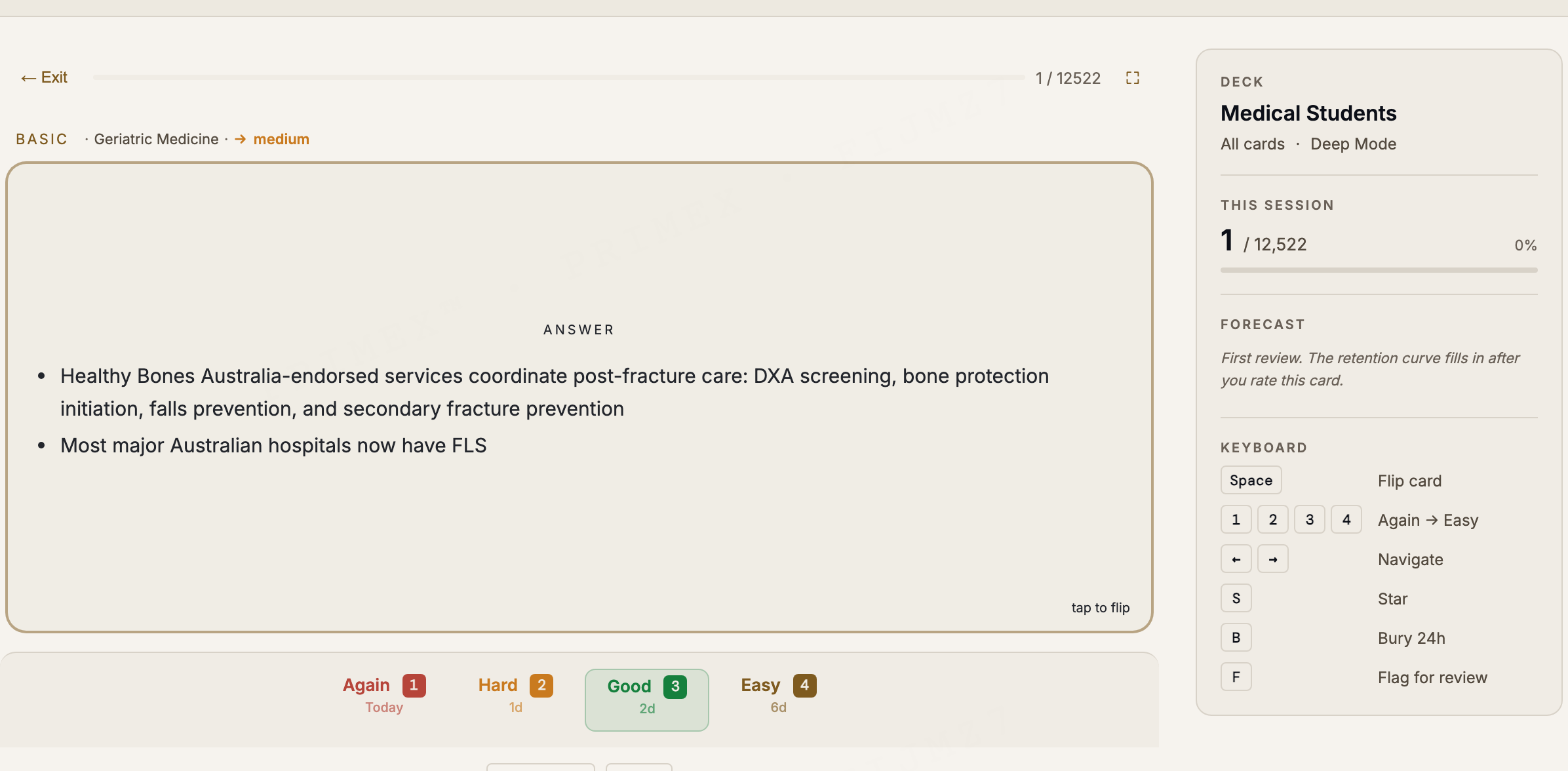
12,522 flashcards covering 608 clinical topics, around 20 cards per topic. The PRIMEX medical student deck spans every major clinical presentation, diagnosis, investigation finding, and management principle across all 30 specialties, with spaced-repetition scheduling that surfaces your weakest areas at the right time before finals.
- 12,522 flashcards across 608 topics, around 20 per topic, covering all 30 specialties
- Presentation-based cards: "A 65-year-old with crushing chest pain. What is your immediate management?"
- Investigation interpretation cards: ECG, ABG, chest X-ray, blood results
- Management protocol cards: eTG-aligned, PBS drug names, Australian dosing
- Communication and ethics cards: consent elements, Austroads criteria, mandatory reporting thresholds
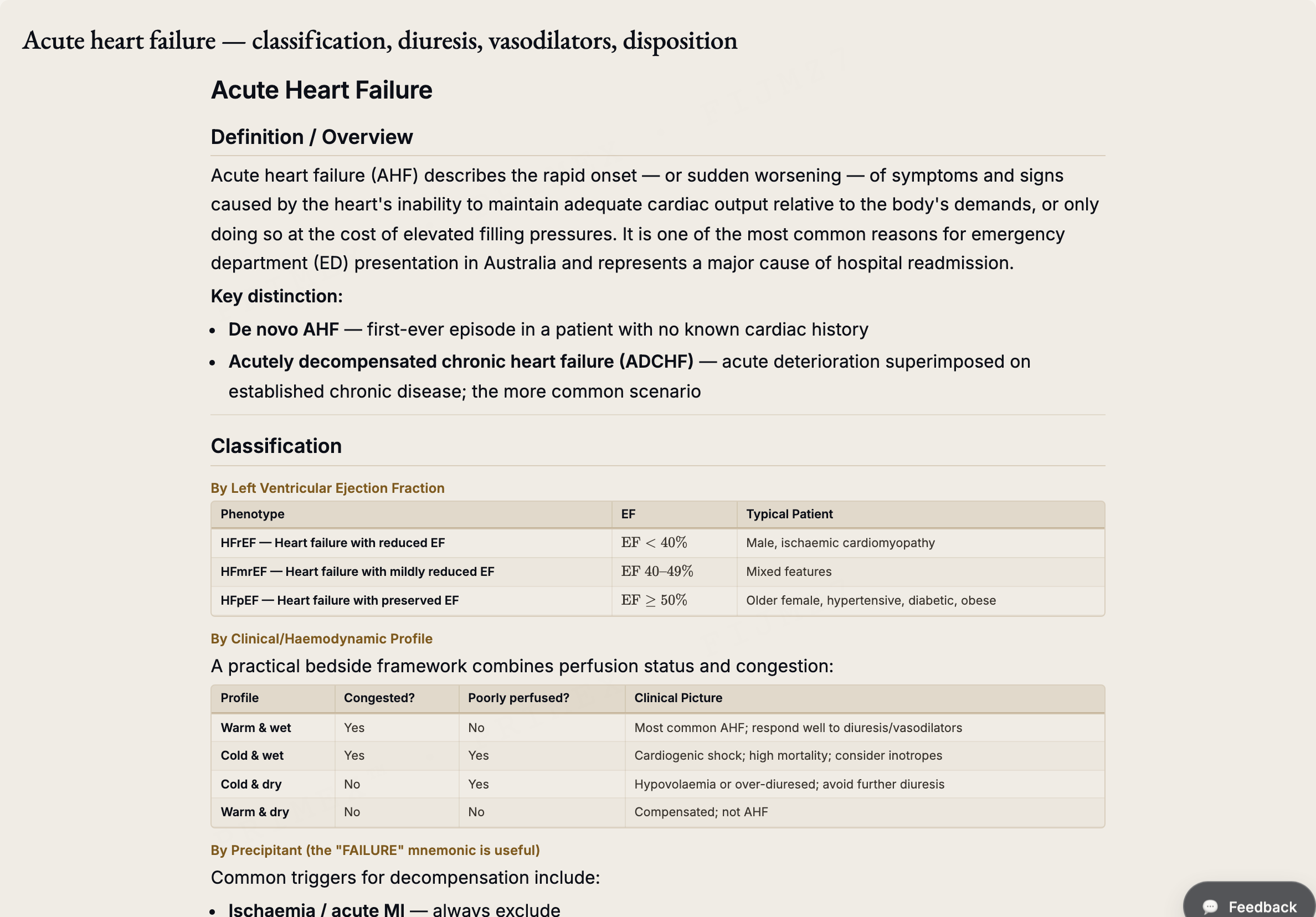
Every PRIMEX medical student study note is designed for a clinical student, not an SAQ candidate. Notes follow a clinical structure: presentation to differential to investigations to management to key points for finals. The depth is calibrated to final-year student assessment: comprehensive enough to answer a clinical tutor's questions, not so deep it becomes a pharmacology reference.
- 608 topics across all 30 clinical specialties
- Clinical structure throughout: presentation to differential to investigations to management
- Australian guidelines, eTG drug names, and PBS prescribing context
- Coverage of high-yield presentations: common, important, and commonly-examined conditions
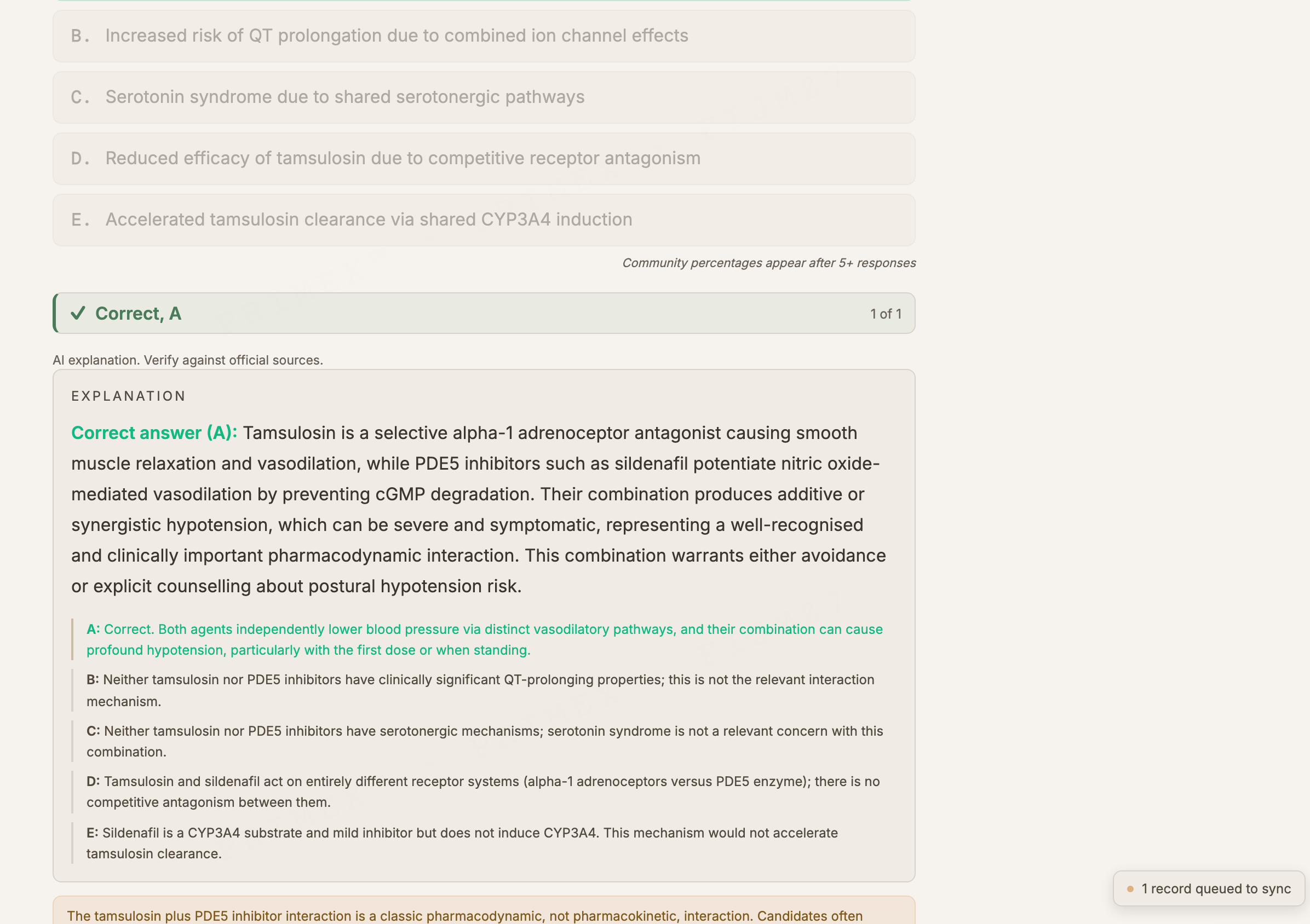
Most Australian medical school clinical finals include MCQ or modified essay question components. PRIMEX generates an unlimited supply of clinical scenario MCQs across all specialties, testing diagnosis, investigation choice, and management decisions at the level of a final-year student with Australian clinical context. AI-generated and curriculum-mapped, so questions never repeat and never run out.
- Clinical scenario MCQs across all 30 specialties
- Australian clinical context: eTG antibiotics, PBS drugs, Medicare/NDIS, Australian referral pathways
- Distractor explanations for every option: why the wrong answers are wrong
- Calibrated to final-year student level, not intern or advanced training level
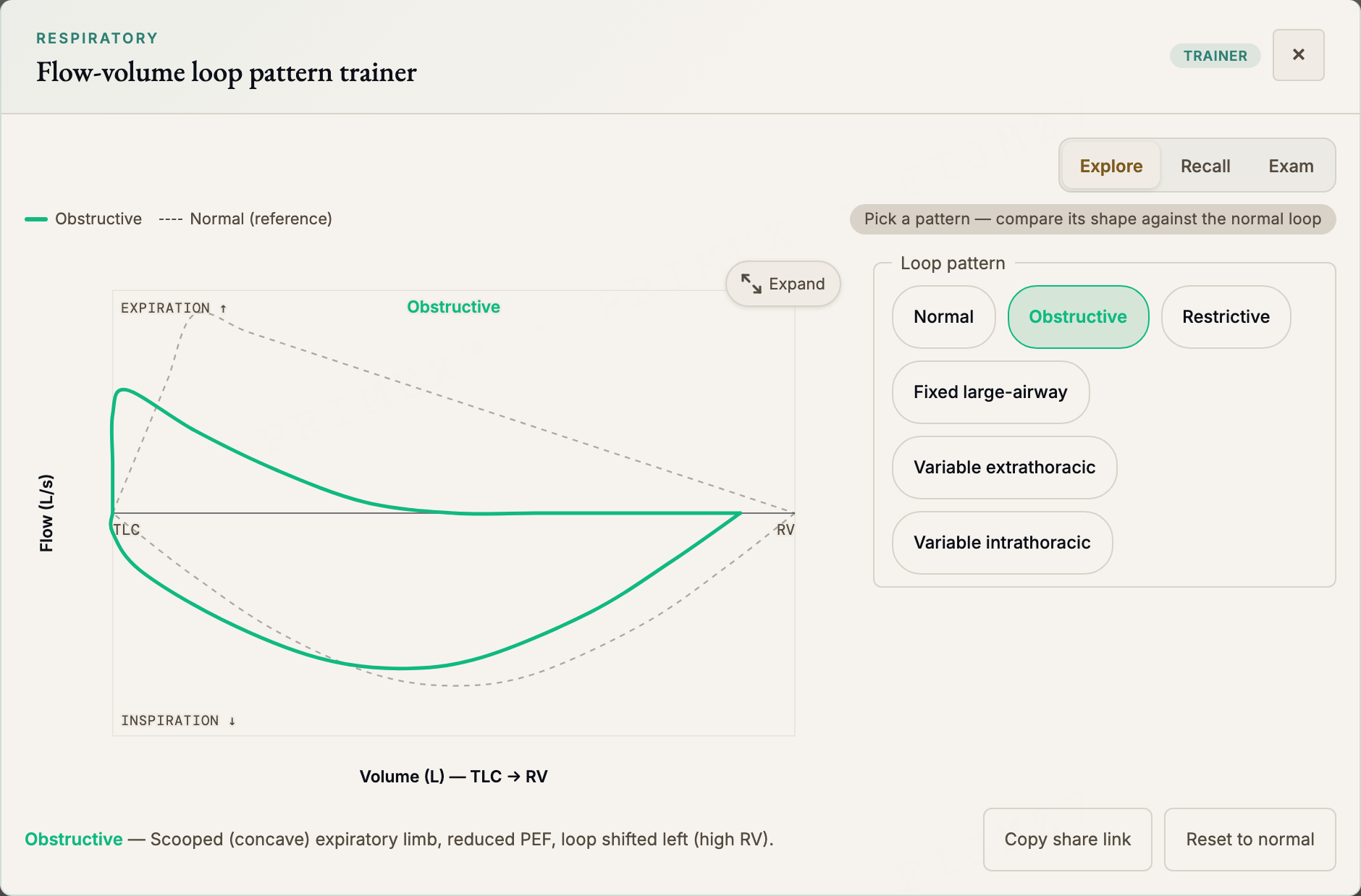
Some concepts only click when you can move them. PRIMEX includes 76 interactive diagrams across 16 systems, 40 of them active-recall trainers with Explore, Recall and Exam modes. Drag a flow-volume loop between obstructive and restrictive patterns, step through an arterial blood gas, build the mean QRS axis from leads I and aVF, or map a 12-lead ECG to its coronary territory, all driven live rather than read off a static figure.
- 76 interactive diagrams across 16 systems: cardiovascular, respiratory, renal and fluid, haematology, pharmacology, neurology and more
- 40 active-recall trainers with Explore, Recall and Exam modes for self-testing
- High-yield finals visuals: flow-volume loops, ABG interpretation, ECG rhythm, axis and coronary territories, pressure-volume loops, shock and sepsis haemodynamic profiles
- Identify-mode quizzes turn each diagram into active recall, not passive reading
- Shared with the fellowship exams, so the same trainers carry through into specialty training
The Accessible plan keeps medical-student finals and AMC preparation together, with the same notes, flashcards, MCQs, OSCE tools and readiness workflow. If you later enter specialist training, the Specialist plan unlocks all 26 PRIMEX exam tracks.
- Medical Student section + AMC prep on one Accessible subscription
- Keep the same account, history and study workflow if you later upgrade
- Specialist is a separate upgrade that unlocks every exam track
Australian medical student finals format and structure
PRIMEX's Medical Student section is designed for final-year Australian medical students preparing for university clinical examinations: written finals, OSCEs, and clinical assessments across all specialties. Content is calibrated to final-year student level across all Australian medical schools.
The platform covers 608 clinical topics across 30 specialties with 12,522 spaced-repetition flashcards, study notes structured for clinical finals, and an OSCE simulator with 600+ curated stations across all six station types run on Australian university OSCE circuits. Australian context is embedded throughout: eTG-aligned management, PBS drug names, Medicare and NDIS, mandatory reporting obligations, and culturally safe clinical practice. PRIMEX is built by Dr Jay Marshall, an anaesthetics registrar in Taree, NSW.
- Coverage608 topics across 30 clinical specialties, any Australian medical school clinical finals
- Flashcards12,522 cards across 608 topics, around 20 per topic, spaced repetition for finals timetable
- OSCE simulator600+ curated stations across 20 clinical disciplines, all 6 station types: history, examination, explanation, procedural, ethics, emergency
- Australian contexteTG-aligned management, PBS drug names, Medicare/NDIS, mandatory reporting
- Also includedAMC preparation on the same Accessible subscription
- CalibrationFinal-year student level, not intern, not fellowship
Start with high-yield clinical topics
Open a free curriculum-mapped study note, then continue into finals-level MCQ or OSCE practice. No signup needed.
Autism Spectrum Disorder - Early Signs, Diagnosis, Early Intervention, and the NDIS
Autism Spectrum Disorder (ASD) is a neurodevelopmental condition characterised by persistent difficulties in social communication and interaction.
Cardiovascular Risk Assessment and Primary Prevention
Cardiovascular disease (CVD) - encompassing coronary artery disease, ischaemic stroke, transient ischaemic attack.
Opioid Use Disorder - Assessment, Pharmacotherapy, and Harm Reduction
Opioid use disorder (OUD) is a chronic, relapsing neurobiological condition characterised by compulsive opioid use despite significant adverse.
Parkinson's Disease - Clinical Features, Levodopa, and Non-Motor Symptoms
Parkinson's disease (PD) is a progressive neurodegenerative disorder characterised by the loss of dopaminergic neurons in the substantia nigra pars.
Liked those five? That's a sliver of what's inside.
Get 608 study notes, 12,522 spaced-repetition flashcards, unlimited question practice and the full exam simulator. Free for 7 days, then from A$24.99/month.
Start free trial, 7 days free Cancel anytime · no commitmentIf you're weighing PRIMEX against another platform
Australian medical students typically compare PRIMEX with the UK-built OSCE and clinical skills platforms many AU schools already recommend. Side-by-side comparisons covering curriculum fit, AI grading, station counts, and pricing.
Common questions about the Australian medical student finals exam
Accessible pricing and 7-day free trial
Library, study notes, OSCE simulator and image-stem practice, all included on every plan. No locked tiers, no per-feature paywalls.
- ✓ AMC exams + medical-student library: MCQ, OSCE & Voice
- ✓ Flashcards with spaced repetition & MCQ drill
- ✓ Study notes for every curriculum topic
- ✓ OSCE stations & clinical exam practice
- ✓ Study plan with pace tracking
- ✓ Curriculum tracker & readiness insights
- ✓ AMC exams + medical-student library: MCQ, OSCE & Voice
- ✓ Flashcards with spaced repetition & MCQ drill
- ✓ Study notes for every curriculum topic
- ✓ OSCE stations & clinical exam practice
- ✓ Study plan with pace tracking
- ✓ Curriculum tracker & readiness insights
- ✓ AMC exams + medical-student library: MCQ, OSCE & Voice
- ✓ Flashcards with spaced repetition & MCQ drill
- ✓ Study notes for every curriculum topic
- ✓ OSCE stations & clinical exam practice
- ✓ Study plan with pace tracking
- ✓ Curriculum tracker & readiness insights
You'll land on a confirmation page. Tap the sign-up button (or sign in if you already have an account) and your subscription links automatically. If you close the page first, just use the same email when you sign up and it'll still link.